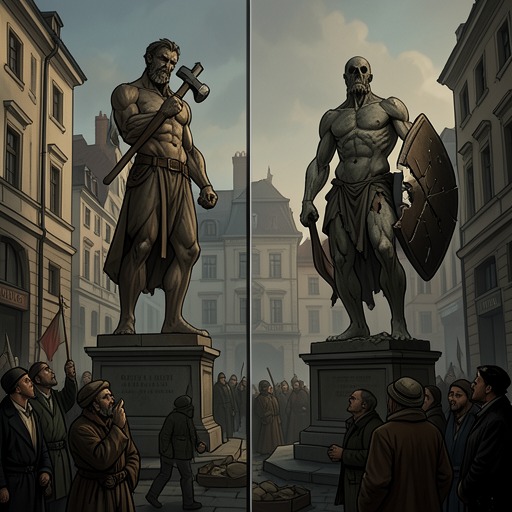
Two Russias stare into each other’s eyes
Limonov“Two Russias stare into each other’s eyes” is Anna Akhmatova’s image for the encounter between former prisoners and the people who had sent them to prison. In the account of the years after Stalin’s death, it gives a compact name to a country divided not simply between innocent and guilty, but between people who must now meet while knowing what the others have done.
The encounter after Stalin
Millions of prisoners were released after Stalin’s death, and some were rehabilitated. The bureaucrats, provocateurs, and informers who had sent them to the Gulag had been certain their victims would never return. Now the two groups crossed paths. The expression makes that meeting reciprocal: each side sees the other, and each knows where the other stood.
The book stresses that this recognition did not produce the bloodbath some might have expected. Instead, people looked away and continued with their business, uncomfortable and vaguely embarrassed, as though both parties shared knowledge of an illicit past that was better left unspoken. The image’s force lies in this pause. The former prisoners’ return does not erase what was done, while the perpetrators’ presence prevents the past from being safely relegated to history.
Responsibility within a system
The surrounding account places this encounter against the machinery that made surveillance and denunciation ordinary. After the Revolution, Trotsky’s use of political commissars to monitor professional military specialists established the Principle of dual administration: one person carried out a task while another ensured that it conformed to Marxism-Leninism. The system spread beyond the army, multiplying supervision rather than concentrating responsibility in a single visible authority.
Venyamin Savenko appears as a modest cog in that structure. He supervised, controlled, and reported; the narrator is careful not to equate that work automatically with terrible repression. During the war, Venyamin served as an NKVD orderly stationed in front of a factory. In peacetime, as a junior lieutenant, he organized soldiers’ cultural and leisure activities, including dance parties on Red Army Day. His place in the system is therefore neither that of a principal architect of terror nor that of someone wholly outside its operations. The phrase’s two sides acquire human scale in such distinctions: a person may belong to the machinery of control without the account reducing every aspect of his life to that role.
That ambiguity also shapes Eduard Limonov’s later joke about his father. In Paris, he liked to announce that Venyamin had been a Chekist because he knew the word would cast a pall over the room, then deflated the implication by describing his father as basically a gendarme. The joke plays on the tension between a frightening institutional label and the more limited duties the narrative recounts. It does not remove Venyamin from the system; it makes the boundary between individual conduct and institutional complicity harder to treat as simple.
A history that cannot be sealed off
The phrase belongs to a period when the official account of Stalin’s rule had begun to shift. In 1956, Nikita Khrushchev denounced Stalin’s cult of personality in a secret report that soon ceased to be secret. In 1962, he authorized publication of Aleksandr Solzhenitsyn’s One Day in the Life of Ivan Denisovich. The novel’s meticulous account of an ordinary day in a camp made public what people had been unable, or forbidden, to say openly. In this context, the two Russias are not only opposing groups; they are evidence that a suppressed history has returned to everyday life.
The image remains deliberately unresolved. It names recognition without claiming forgiveness, and coexistence without calling it reconciliation. Former prisoners and former informers can resume ordinary business, but the knowledge between them persists. The expression’s quiet force comes from holding those facts together: the past is visible in the encounter, even when both sides look away.