Riga St. Peter's Church occupation
LimonovThe Riga St. Peter's Church occupation was a National Bolshevik protest that turned a dispute over Soviet memory into a high-stakes confrontation with the Latvian state. Three militants seized the church’s bell tower to support an imprisoned former Soviet partisan who had also served as a notoriously brutal Chekist. Their surrender did not end the protest’s consequences: they were convicted of terrorism and sentenced to fifteen years, while the Russian government gave its blessing to the outcome. The episode laid bare the movement’s readiness to cast a former agent of repression as a martyr—and the Russian state’s ability to share its reverence for the Soviet past while helping suppress the activists who claimed to defend it.
Background and political stakes
The occupation arose from the National Bolsheviks’ campaign to defend Russians and Soviet legacies beyond Russia’s borders. At a party convention, Eduard Limonov had identified the Baltic states and Central Asia as priorities, arguing that Russians left in former Soviet republics had been abandoned after the Soviet Union dissolved. The party had a foothold in the Baltic states, including around a hundred members in Riga. The church action belonged to this wider effort, though the militants’ immediate demand concerned one imprisoned man.
Latvia’s independent judiciary had imprisoned an elderly Soviet partisan, celebrated in the Soviet account of the Great Patriotic War, who had also been a Chekist notorious for savagery. From outside the National Bolshevik outlook, bringing a former torturer to account could be understood as a society confronting its history. The militants instead treated his imprisonment as an insult to the twenty million who died in the war and to the hundreds of millions who had believed in communism. In their telling, the old Chekist became a hero and a martyr.
That reversal followed a pattern in the party’s politics. Its militants staged conspicuous provocations—tagging trains, hanging banners from hard-to-reach monuments, and throwing tomatoes at officials—and accepted prison sentences as proof of courage. A former teacher in Zakhar Prilepin’s novel could regard such acts as immature but brave precisely because, in Russia, disturbing the peace could bring serious punishment. In Riga, that willingness to turn protest into a test of commitment took a more dangerous form.
The occupation and surrender
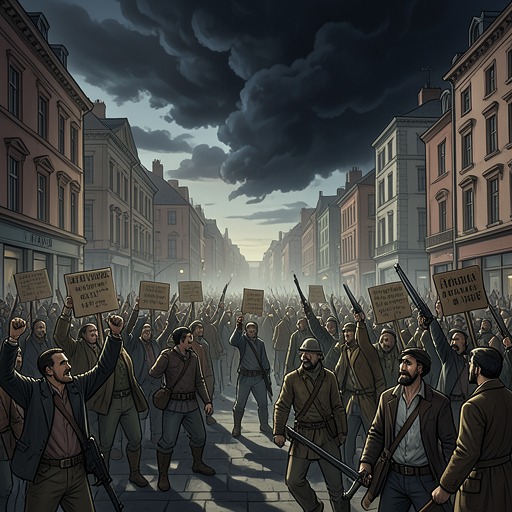
Three National Bolsheviks entered the Cathedral of Saint Peter in Riga, threw a fake grenade to clear the tourists, barricaded themselves in the bell tower, and showered the ground with leaflets. They knew what was likely to follow: police battalions calling through megaphones, negotiations, and demands that the authorities would not accept. The militants demanded the imprisoned Chekist’s release and that Latvia abandon its plans to join NATO. They also made a more limited request: that the Russian ambassador be present when they came down.
The standoff ended in surrender. The ambassador was there, as requested, but did nothing to protect them. The militants were manhandled as if they had opened fire on the crowd, then tried not for hooliganism but for terrorism. Each received a fifteen-year sentence. The severity of the punishment gave the protest a stark result: the militants’ attempt to dramatize Soviet-era loyalty brought them a long term in prison, while the old Chekist whose cause they had taken up remained a symbol rather than a cause they could win.
Contradictions and significance
The episode resists a simple division between a Russian state defending order and an opposition defending freedom. At the time, Vladimir Putin was ready to threaten Estonia over its plans to remove a Red Army monument. In substance, the National Bolsheviks and the Russian authorities could share a defense of Soviet symbols and a hostility to what they saw as insults to the past. Yet, when the activists’ protest was treated as terrorism, Russian security officials cooperated with Latvian police in pursuing them. The state’s attachment to Soviet memory did not mean it would protect the young militants who invoked that memory against its own interests.
The book presents this collision as one of the political knots that make the period difficult to untangle. The Latvian prosecution could represent an effort to remember the victims of Soviet repression; to the National Bolsheviks, it represented humiliation of the wartime dead and communist believers. Their rhetoric made a former persecutor into a persecuted hero, while their actions exposed them to the very coercion they condemned. The fifteen-year sentences completed that reversal: a protest undertaken in the name of historical justice ended with its participants branded as terrorists, and the Russian government endorsed their punishment even as it defended Soviet symbols elsewhere.