Mona Dahl
LolitaMona Dahl is a student at Beardsley School who becomes Dolores Haze's closest friend and confidante during the spring term of their shared academic year. With a 150 I.Q., a husky voice, artificially waved dull dark hair, earrings, amber-brown prominent eyes, and luscious lips, she is described as elegant, cold, lascivious, and experienced. She carries herself with a worldly poise that sets her apart from the other girls, and her hands tremble. Teachers have remonstrated with her for loading herself with so much costume jewelry. She has a tremendous chocolate-brown mole on her womanish back, which Humbert inspects the night she and Lolita wear low-cut pastel-colored dresses to a dance at the Butler Academy. Mona is a year older than Lolita and has long ceased to be a nymphet, if she ever was one, but she possesses a coarse, sensual handsomeness that Humbert finds both alluring and unsettling.
Role as Confidante and Intermediary
Mona is the only schoolmate Lolita brings into the Humbert household with any regularity, and she quickly becomes the repository of Lolita's secrets. Humbert suspects that Lolita has imparted to Mona various incredibly revealing details about their relationship, including the affair Mona herself had with a marine at the seaside. When Humbert attempts to question Mona about what kind of boys Lolita knows, she is elegantly evasive, deflecting with a faint gleam of crystalline irony. She tells Humbert that Lolita is not much concerned with mere boys, and that she and Lolita have a crush on the Reverend Rigger, a joke that Humbert recognizes as such. When Humbert discovers that Lolita has been skipping her piano lessons with Miss Emperor to rehearse the magic forest scene with Mona in a public park, he telephones Mona's house. Mona answers in a low, monotonous, not untender voice, initially mistaking him for Roy, and then, upon realizing it is Humbert, adopts a humble, sexy contralto, saying "yes, sir," "surely, sir," and "I am alone to blame, sir, in this unfortunate business," displaying what Humbert calls "what elocution! what poise!"
The Enchanted Hunters and the Conspiracy
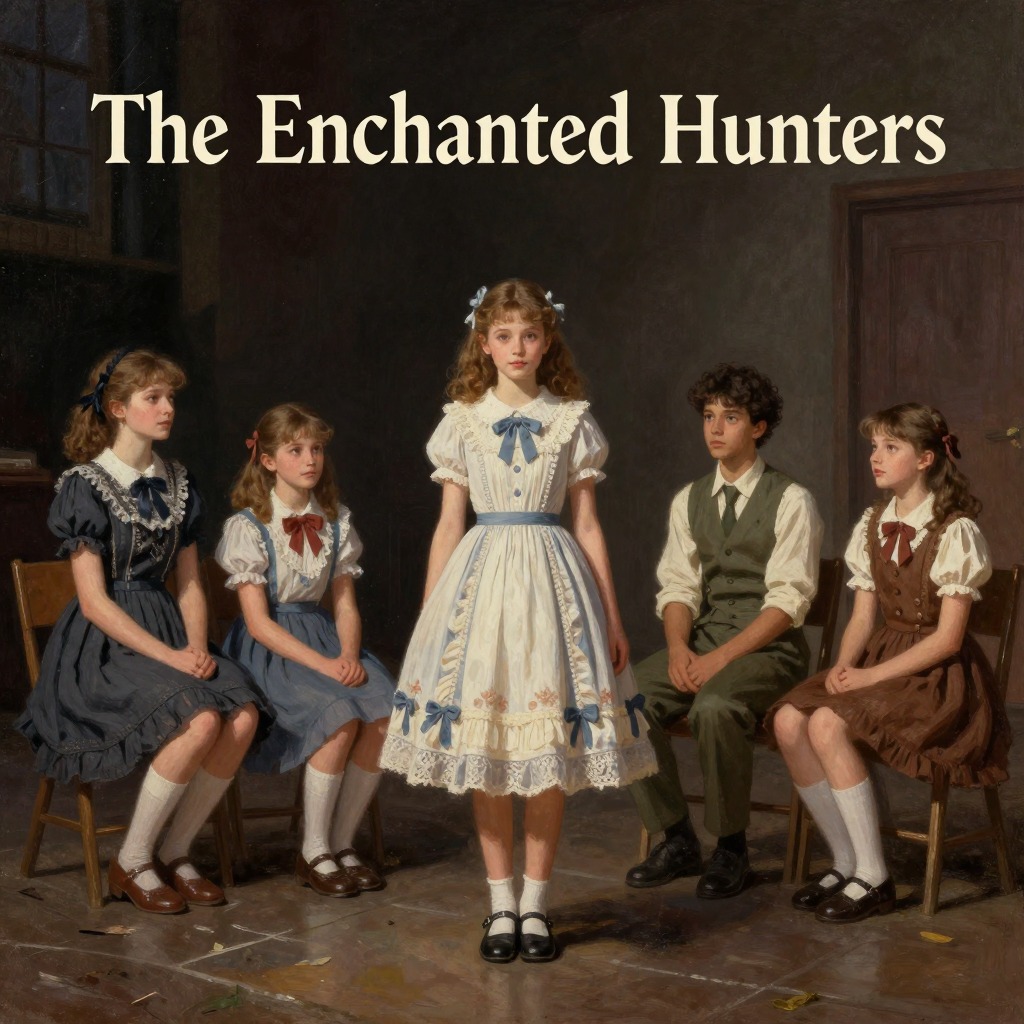
Mona is cast in the school play The Enchanted Hunters, a recent and technically original composition by Clare Quilty. She plays the role of a vagabond poet who, in the final scene, is led by barefoot Dolores (playing a farmer's daughter who imagines herself a woodland witch) to the paternal farm, where a last-minute kiss enforces the play's message that mirage and reality merge in love. The play's rehearsal schedule provides the cover for Lolita's secret meetings with Quilty, and Mona is the primary facilitator of this deception. When Humbert confronts Lolita about the missed piano lessons, Lolita admits she has been rehearsing with Mona, and Humbert's subsequent phone call to Mona confirms the alibi. Mona's role in the play is thus not merely theatrical but conspiratorial, as she helps Lolita maintain the fiction that her absences are devoted to the production.
The Letter from Europe
After the school year ends, Mona writes to Lolita from New York, where she is about to accompany her parents to Europe. The letter, which Humbert intercepts and reads, is a masterpiece of coded communication. Mona reports that the play was a grand success, that Linda Hall knew all of Lolita's lines, and that the author (Quilty) was not present to applaud them as last time. She mentions that her father wants her to go to school in Paris for one year, and that her correspondence is "rigidly controlled." The letter contains an element of mysterious nastiness that Humbert finds too tiring to analyze, but it serves as a final, taunting confirmation that Mona was deeply complicit in the plot that led to Lolita's disappearance. Mona signs off with "Best love from your Poet, and best regards to the Governor," a phrase that Humbert recognizes as a coded reference to Quilty. The letter is preserved in one of the tour books, and Humbert reads it twice, finding in it the confirmation of his suspicions.
Thematic Significance
Mona Dahl embodies the sophisticated, knowing world of adolescence that Humbert both fears and cannot penetrate. Her intelligence, her worldly manner, and her role as Lolita's confidante make her a figure of both fascination and threat for Humbert. She represents the possibility of a normal, healthy social life for Lolita, a life that Humbert's possessive and predatory nature cannot allow. Her complicity in Lolita's escape with Quilty underscores the extent to which Lolita was not merely a passive victim but an active participant in her own liberation, aided by a network of peers who understood and enabled her desire for freedom. Mona's final letter, with its coded references and its promise of a new life in Europe, serves as a haunting reminder of the world that Humbert could never give Lolita, and of the cleverness and resourcefulness of the girl he thought he possessed.