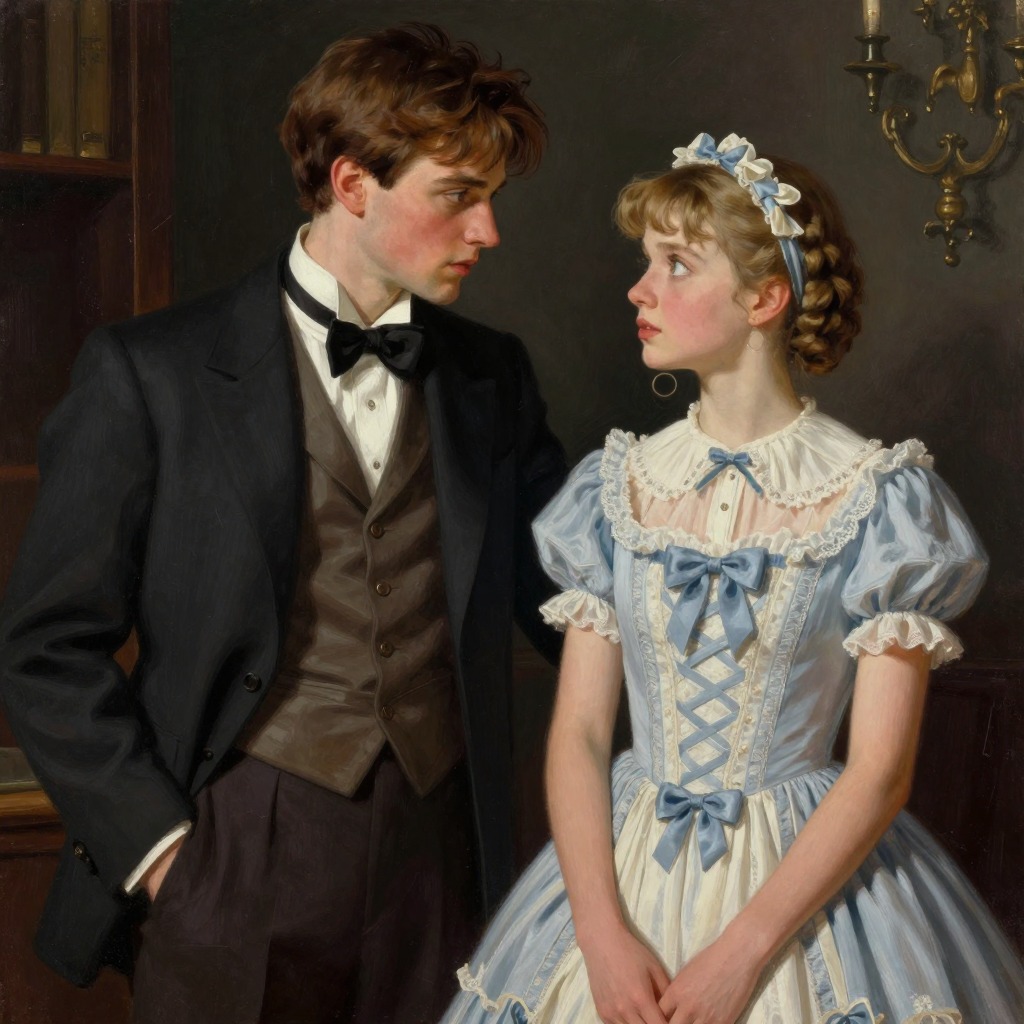
Rita
LolitaRita enters Humbert Humbert's life at a moment of profound crisis, after the loss of Lolita has driven him to the edge of madness. She is not a nymphet or a figure of obsessive desire, but rather a soothing, uncomplicated presence who offers him the only genuine human connection he experiences in the years following Lolita's departure. Her role in the narrative is that of a gentle, albeit flawed, caretaker who stabilizes Humbert long enough for him to pursue his final, destructive purpose.
Identity and Background
Rita is described as a slight, dark-haired, pale-skinned adult woman, weighing a hundred and five pounds, with charmingly asymmetrical eyes and an angular, rapidly sketched profile. She is twice Lolita's age and three-quarters of Humbert's, placing her in her late twenties or early thirties when they meet. Humbert picks her up one depraved May evening somewhere between Montreal and New York, at a bar under the sign of the Tigermoth, where she is amiably drunk. She insists they had gone to school together, a delusion that hints at her own disorientation and need for connection. Her background is marked by instability: she has recently divorced her third husband and been abandoned by her seventh cavalier servant, with numerous other mutable relationships too numerous to tabulate. Her brother, a prominent and pasty-faced politician, pays her several hundred dollars a month under the stringent condition that she never enter his home town of Grainball City, a restriction that becomes a recurring, almost fated, pattern in her life.
Life and Plot Trajectory
Humbert adopts Rita as a constant companion, and they cruise together for two dim years, from summer 1950 to summer 1952. She owns a natty little coup, and they travel in it to California, giving Humbert's venerable vehicle a rest. Her natural speed is ninety miles per hour, a detail that underscores her impulsive, carefree nature. Humbert describes her as the sweetest, simplest, gentlest, dumbest Rita imaginable, and he credits her with saving him from the madhouse. She is the most soothing and comprehending companion he ever had. During their time together, Humbert tells her he is trying to trace a girl and plug that girl's bully, and Rita solemnly approves of the plan. In the course of some investigation she undertakes on her own, around San Humbertino, she gets entangled with a pretty awful crook, and Humbert has the devil of a time retrieving her, used and bruised but still cocky. One day she proposes playing Russian roulette with his sacred automatic, and they struggle for it until it goes off, touching off a very thin and very comical spurt of hot water from the hole it makes in the wall of the cabin room, a moment that ends in her shrieks of laughter.
Relationships and Conflict
Rita's relationship with Humbert is defined by her unconditional, almost maternal acceptance of him. She is not a figure of passion or intellectual challenge, but of pure, uncomplicated companionship. Humbert notes that the oddly prepubescent curve of her back, her ricey skin, and her slow languorous columbine kisses keep him from mischief, suggesting that her presence provides a kind of chaste, stabilizing intimacy that prevents him from acting on his predatory impulses. However, their life together is not without its disruptions. Humbert lodges at Cantrip College for one year, from September 1951 to June 1952, while Rita, whom he prefers not to display, vegetates somewhat indecorously in a roadside inn where he visits her twice a week. She then vanishes more humanely than her predecessor, and a month later Humbert finds her in the local jail, accused of stealing furs from a Mrs. Roland MacCrum. Rita is très digne, has had her appendix removed, and manages to convince Humbert that the furs were a spontaneous, if somewhat alcoholic, gift from Roland himself. Humbert succeeds in getting her out without appealing to her touchy brother.
Change and Ending
Rita's departure from Humbert's life is as abrupt and unceremonious as her entrance. After receiving the letter from Lolita, now Dolly Schiller, Humbert leaves Rita forever. He glances at her as she smiles in her sleep, kisses her on her moist brow, and leaves her with a note of tender adieu taped to her navel, otherwise she might not have found it. This final gesture is both tender and dismissive, reflecting the transient, almost accidental nature of their bond. Rita is last seen in the narrative as a memory, a figure of warmth and simplicity that Humbert abandons without hesitation when the possibility of confronting Lolita and her abductor arises. Her fate after this is unknown, but she remains a poignant counterpoint to the obsessive, destructive relationships that define Humbert's life.
Narrative Role and Evaluation
Rita functions as a narrative and emotional buffer between Humbert's loss of Lolita and his final, violent confrontation with Clare Quilty. She is a character of pure, uncomplicated goodness, a foil to the manipulative and predatory figures that populate Humbert's world. Her presence allows Humbert to survive the years of his search without completely disintegrating, and her departure marks the point at which he is finally free to pursue his revenge. In the context of the novel, Rita represents the possibility of a normal, if flawed, human connection, a possibility that Humbert ultimately rejects in favor of his all-consuming obsession. She is a reminder of the life he could have had, and a measure of the depth of his damnation.