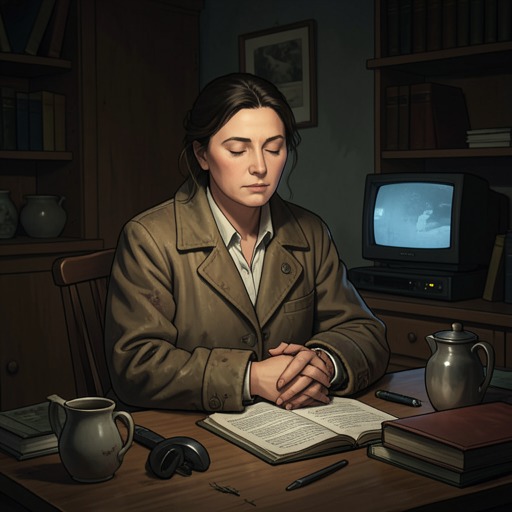
Dorothy Day
LongingDorothy Day’s spirituality took shape in the encounter between religious devotion and the material needs of poor people. She understood service to them not as an alternative to faith but as a way of meeting Jesus Christ: the divine presence, in her account, was hidden in the people who came asking for food, shelter, and attention. That conviction shaped both her personal practice and the Catholic Worker movement she helped establish with Peter Maurin.
Identity and spiritual outlook
Day’s mysticism differed from accounts centered on visions or a felt union with God. She saw no lights and reported no visions; instead, she believed that God was present in other people, especially those living in poverty. Her daily Mass, prayer, and reading of theologians sustained an inward religious life, but its test and expression lay in how she treated people who needed help. Church officials could be suspicious of her pacifism, social criticism, and opposition to capitalism. Some regarded her as a possible saint, a description she resisted because she thought sainthood could be used to dismiss a challenging person.
This understanding made hospitality spiritually demanding rather than sentimental. People seeking help at Catholic Worker houses could be struggling with addiction or mental illness, and some were hostile or difficult to assist. Day believed that their distress did not make Christ less present in them. She understood feeding or sheltering a guest as an act directed toward Christ, not merely a charitable gesture toward someone else. The practice offered no guarantee of an uplifting encounter: love enacted amid need could be far harder than love imagined in the abstract.
Conversion and personal relationships
Day’s turn toward Catholicism followed years of religious stirrings rather than a sudden break with her earlier life. In 1924 she returned to New York and met Forster Batterham, with whom she entered a common-law marriage. Her religious longings grew despite Batterham’s lack of interest in religion. After their daughter, Tamar Teresa, was born, Day decided to have her baptized. Tamar’s baptism in July 1927 deepened Day’s own attraction to the Church; Day was baptized in December. She understood the decision as worth the painful cost of her separation from Batterham, with whom she remained in touch.
Her reasons for joining the Catholic Church included a conviction that it was a church of poor people, as well as the convergence of several experiences: her concern for social reform, time spent among religious friends, suffering in prison, motherhood, and encounters with religious practice. She was not unaware of the Church’s failings. Rather, she sought a religious community in which her radical commitments and desire to worship with ordinary people could meet. Her later influence in American Catholic life would be substantial and controversial.
Peter Maurin and The Catholic Worker
After returning from Washington, where she had covered an unemployment hunger march and prayed for a way to help poor people, Day met Peter Maurin. A French peasant and former member of the Christian Brothers, Maurin had developed a program of social action grounded in Christian teaching. He helped deepen Day’s knowledge of Catholic intellectual and spiritual traditions, giving her classics to read and teaching her about Church history and the lives of the saints. Their partnership turned her wish to respond to poverty into a public project.
They began The Catholic Worker as a monthly newspaper advocating social action based on Catholic teaching. Its first issue appeared on May 1, 1933, with 2,500 copies sold for a penny each at Union Square. It covered unemployment, trade unions, cooperatives, the exploitation of Black Americans, child labor, and a local strike. Maurin believed that reporting should include moral judgment, not simply record events; the paper therefore paired accounts of social conditions with commentary on responsibility toward the poor. Day and Maurin rejected political partisanship and did not endorse a political party.
The paper’s circulation reached 190,000 in 1938, later falling during the Second World War because of Day’s pacifism, before stabilizing at about 104,000 by 1984. Its subject matter ranged across racism, labor, unemployment, poor housing, hunger, injustice, and war and peace. The newspaper was one part of a wider effort: Day and Maurin also established a House of Hospitality where people could receive food and shelter. The Catholic Worker movement sought social change through pacifist means, opposing violence and force while aiming to make it easier for people to live well.
Hospitality as a religious practice
Day’s approach held immediate care and structural criticism together. Some people in the peace movement regarded the work of feeding and sheltering the poor as too limited in the face of larger social problems. Day nevertheless insisted that people in immediate need had to be cared for even as the larger wrongs were challenged. For her, hospitality was not a substitute for social action; it was an obligation in its own right, rooted in the teaching of Jesus Christ.
She grounded this obligation in the parable of the last judgment in Matthew’s Gospel. In her reading, Jesus Christ identifies himself with people who are hungry, thirsty, strangers, sick, imprisoned, or without clothing. To act for one of these people, Day believed, was to act for Christ. This interpretation made the poor not merely the recipients of her work but the place where she expected to encounter God. The movement’s hospitality houses made that belief concrete, while the newspaper carried its criticism of the conditions that produced poverty.
Legacy and narrative significance
Day’s account of spiritual life places ordinary, repeated acts beside prayer and sacramental practice. Her religious commitment included daily Mass and the Psalms, but the defining sign of divine presence was often a person at the door asking for help. In this way, her mysticism differs from traditions that depend on extraordinary revelation: it is recognized through service, shared bread, and the difficult work of receiving people as they are.
The movement’s reach extended beyond the newspaper and its houses. Catholic Worker houses opened in other American cities, and students worked in them during the summer. The early editor Michael Harrington later wrote The Other America, a landmark book on poverty that influenced politicians. Day’s significance in the book’s account lies in the union she insisted on between inward faith and public responsibility: contemplation did not draw her away from the poor but taught her to find Christ among them.