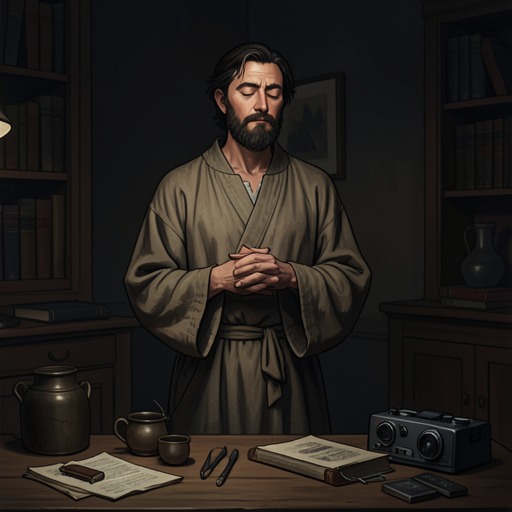
Howard Thurman
LongingHoward Thurman was an African American religious leader, educator, and writer whose defining work joined contemplative spirituality to the struggle for human dignity. His life moved between the realities of racial segregation, the disciplined cultivation of prayer, experimental forms of worship, and encounters with people of other faiths. For Thurman, mystical experience was not an escape from the world: awareness of God could change how people met one another and answered the demands of their neighbors.
Identity and Formative Circumstances
Born in 1899, Thurman grew up in a segregated society that restricted educational opportunity for African Americans. His hometown in Florida had no high school for Black students; its school ended after the seventh grade. When he was fourteen, a cousin offered him room and board in another town if he could get there to continue his education. Thurman arrived at the Daytona train station intending to travel to Jacksonville with a battered trunk tied with rope. Because the trunk had no handle to which a baggage tag could be attached, the clerk would not check it. Shipping it by express required a fee Thurman could not pay, and he sat on the station steps in tears, believing that his chance to go to high school had disappeared.
A stranger in overalls and a denim cap asked why he was crying. After hearing the problem, the man paid the express fee from a rawhide money bag and left without giving his name. The episode later became one of the stories Thurman told about the radical change a stranger’s help can make in a life. It was a concrete opening in a world structured to close doors: the money enabled him to continue toward an education that his hometown could not provide.
His religious imagination was also formed within the history of racial oppression. Thurman’s grandmother, who inspired his faith, had been enslaved and could not read, so he read the Bible aloud to her. She loved the stories in the King James language but would not listen to passages by Saint Paul, whom she associated with the command that enslaved people obey their masters. Her response made the interpretation of Christianity inseparable from the lives of those subjected to its authority. That tension would recur in Thurman’s own effort to distinguish the spirit of Jesus Christ from a Christianity compromised by racial injustice.
Education, Prayer, and Mystical Formation
At Haverford College, beginning in January 1929, Thurman pursued the inner life with deliberate intensity. He attended Rufus Jones’s lectures, joined a seminar on Meister Eckhart, and participated in discussions of mystical religion. Jones assigned him readings, met with him regularly, and helped direct his study of mystics. Thurman also visited Quaker meetings, where he was sometimes asked to speak, and wrote papers on well-known spiritual writers. At the end of the semester, he regarded the Haverford experience as a watershed that shaped much of the thought and work to which he would devote the rest of his life.
That formation informed his teaching after he returned to Atlanta. Thurman held appointments at Spelman College, where he taught Scripture, and Morehouse College, where he taught religion and philosophy. At Spelman, his New Testament work allowed him to examine the mind of Jesus Christ, while his students’ experience of racial oppression gave particular force to comparisons between their circumstances and the position of a Jewish minority under the Roman Empire. Religious study thus became a way to think about both spiritual life and the worth of people living under a degrading social order.
Personal loss interrupted this work. During his second year in Atlanta, Thurman’s wife died. His mother moved in to care for his daughter, while Thurman, exhausted emotionally and physically, sought time to reconsider his personal and professional direction. Travel in Europe, including time in London, Scotland, Paris, and Geneva, helped him return refreshed. He later renewed a friendship with Sue Bailey, a traveling secretary for the national board of the YWCA; their marriage was long and happy.
Interreligious Encounters in Asia
In 1935, the World Christian Student Federation asked Thurman to lead a delegation of African Americans on a pilgrimage of friendship to India, Burma, and Ceylon, now Sri Lanka. The delegation included Thurman and his wife, as well as minister Edward Carroll and his wife, Phenola. British officials initially raised objections to issuing visas, invoking the difficulties they expected from the travel and public speaking of four educated African Americans. The visas were eventually granted. The obstacles themselves exposed the racial assumptions that accompanied a journey intended to foster international friendship.
In Sri Lanka, after Thurman lectured at a law college, its principal challenged him over the history of Christian involvement in slavery and the continuing realities of segregation, lynching, and racial violence in the United States. Their conversation lasted more than five hours. Thurman did not set out to defend a Christianity that had sanctioned oppression. Instead, he distinguished Christianity as practiced from the religion of Jesus Christ and argued that his condemnation of slavery and racial prejudice was itself profound. He also pointed to people in the United States who found in Jesus Christ a vision of freedom, liberty, and justice for all. The exchange brought his faith into direct confrontation with the historical conduct of Christian institutions, without requiring him to abandon the religious tradition he sought to reform.
In India, an extended conversation with the head of an Oriental Studies division began with each man speaking from within his own tradition: Hinduism and Christianity. They recognized that their morning discussion had become a contest over positions. When they met again that afternoon, Thurman experienced what he later described as an unusually direct sharing of religious life. He understood the encounter as a meeting on a ground not marked by social, political, or cultural separation, in which the two men became spiritually close without ceasing to be distinct individuals. Its significance lay not in erasing their differences but in discovering a depth of relation that those differences had not prevented.
A meeting with Mahatma Gandhi became another high point of the journey. Thurman and his wife spent three hours with him in a tent in an open field. Gandhi asked about voting rights, lynching, discrimination, public education, and the operation of American churches. Thurman asked what Gandhi considered the greatest obstacle to Jesus Christ in India. Gandhi identified Christianity’s association with Western culture, Western civilization, and colonialism. The answer sharpened a problem already present in Thurman’s conversations: a religion’s claims could not be separated from the political power and social practices associated with its institutions. For Thurman, faith had to be tested by whether it could answer injustice rather than merely profess spiritual ideals.
Ministry and the Practice of Worship
Thurman brought his contemplative formation into institutional ministry. He joined the faculty of the School of Religion at Howard University in Washington, D.C., and was later appointed dean of the chapel. Attracting students to chapel without making worship feel like an imposed obligation was a substantial challenge. Drawing on his studies at Haverford, he introduced periods of silence for meditation and prayer, as well as liturgical dance. The first dancer was a Roman Catholic woman who taught at a Catholic school in Baltimore.
He also used visual art to reshape the service. In one presentation, six European Madonna masterpieces were recreated with live participants. Each life-sized scene appeared behind a nine-by-five-foot frame, with careful attention to costume, color, background, and lighting. The paintings were presented one at a time, separated by silence, while Ave Maria accompanied each display. The service brought congregation and participants into what Thurman understood as a shared moment of spiritual transcendence. Its form made unity something enacted in a gathering: worshippers attended together, across their different roles, to a sequence of images and silences. Thurman saw such an experience of common life as capable of making human unity more compelling than the forces that divide people.
The ministry grew beyond the student body. Students from other schools and people with no university connection began attending. When some of these participants sought a church board of their own, university trustees refused, concerned about losing control. Thurman eventually resigned as dean of the chapel and became university minister at large. The episode shows both the reach of his work and a limit imposed by institutional authority: a community widened through worship could seek forms of participation that the institution was unwilling to grant.
Religious Experience and Continuing Work
Thurman described religious experience as a dynamic encounter between humanity and God, and, in Creative Encounter, as the individual’s conscious and direct exposure to God. Its central feature was awareness of meeting God. He did not claim that people could simply manufacture such an experience. Prayer, especially engagement with Scripture, including the Psalms and Gospels, prepared a person, but the initiative remained with God. The encounter involved movement in both directions: people seeking God and God finding them. For Thurman, knowledge of God was not merely an inference but a disclosure apprehended directly.
This account helps explain why his contemplation repeatedly issued in attention to other people. His ministry, interreligious conversations, and reflection on racial injustice treat spiritual awareness not as private possession but as a source of changed relationship. In India, the experience of spiritual kinship left distinct identities intact; in worship at Howard, a gathered community could experience unity through a shared form; in his discussion of Christianity and slavery, religious claims had to face their social consequences. These were different settings, but each tested whether an inward awareness could widen the capacity to recognize another person.
After retirement, Thurman received a $10,000 check to establish the Howard Thurman Foundation, which was intended to assist African American students. His family settled again in San Francisco, where he did much of his writing and continued to publish. His life’s significance lies in the coherence of these pursuits: prayer and mystical study supplied neither a retreat from racial history nor a substitute for public responsibility. They gave him a language for encountering God and for imagining forms of human fellowship that crossed, without pretending to erase, the divisions of race, culture, and religion.