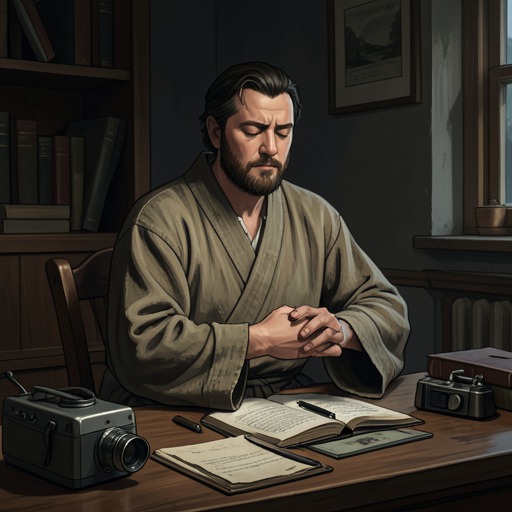
Douglas Steere
LongingDouglas Steere was a leading Quaker of the mid-twentieth century, a scholar of philosophy and theology, and a spiritual writer who joined contemplative practice to work for peace and human welfare. His life traced a sustained movement from religious uncertainty toward Quaker faith, and from inward prayer toward active, international service.
Identity and Formation
Steere’s religious search began during his studies at Michigan Agricultural College, later Michigan State University. At Harvard, new ideas unsettled his already limited faith; he later recalled that his first year there had left him feeling he had reached bottom. His renewal came through encounters with prayer: a Chinese student spoke to him about conversion from communism to Christianity, and students from the Episcopal Divinity School near Harvard gathered for silent prayer at noon. Though he did not regularly join their group, the practice opened him to prayer, and by the end of the year his faith had returned.
His philosophical studies then flourished. After two years he qualified for Harvard’s PhD program, but a Rhodes Scholarship took him to the University of Oxford, where he earned bachelor’s and master’s degrees and discovered the Quakers. Among them, he experienced what he understood as Christ’s indwelling spirit. In 1928, Rufus Jones invited him to the faculty of Haverford College; Steere later succeeded Jones as chair of its philosophy department. He completed a Harvard PhD in 1931 with a dissertation on Baron Friedrich von Hügel, a liberal Roman Catholic philosopher and theologian whose work addressed the mystical element of religion.
Choosing a Religious Home
Steere’s commitment to Quakerism took shape amid a serious attraction to Roman Catholic spiritual life. During an academic sabbatical in a monastic setting, he read the Rule of Saint Benedict and works by Bernard of Clairvaux, Hildegard of Bingen, and Teresa of Avila. The library, liturgy, devotional practices, discipline, and daily rhythms of monastic prayer impressed him as resources for spiritual growth. At the same time, he was a professor at a Quaker college and valued Quaker silent worship, pacifism, social justice, and mystical heritage. Choosing between the two traditions, he wrestled with uncertainty before becoming a convinced Quaker in 1933; the faith of Rufus Jones was decisive in that choice.
Steere’s attraction to Quaker worship was not merely theoretical. He loved meetings in which no one spoke unless moved by the Holy Spirit, while recognizing that participants did not always follow the counsel, “When in doubt, wait.” He described silent worship as a shared inward experience that could soften divisions: he had seen a meeting bring people separated by an ugly barrier toward asking forgiveness. The stillness mattered because it could alter relations among those gathered, not simply because it offered private quiet.
Spiritual Understanding and Prayer
Steere’s account of spirituality began with God’s initiative: God seeks human beings and affirms the worth of each person. He also described a deep human yearning for the living God, a spiritual mark within the soul that distortion cannot wholly erase. This understanding aligned with the Quaker belief in the Inner Light, the divine presence in every person, and supported his conviction that Christian identity concerns who people are, not only what they do.
He regarded mystical experience as a gift rather than an achievement, while insisting that receiving it requires a willingness to be changed. Drawing on Bernard of Clairvaux, he described an encounter with God as brief and passing, yet capable of leaving a profound effect. For Steere, longing for such an experience without accepting its consequences would miss its point: spiritual encounter calls for transformation.
His book Dimensions of Prayer, first published in 1962 and revised by his wife in 1997, gave this conviction practical form. Steere compared prayer’s role in religious life to original research in science. Prayer responds to God’s initiative, makes approach to God possible, and can lead into the unknown. Its test, in his account, is charity: it turns the person toward action and an ethical challenge to complacency. Prayer also places each soul within the leveling reach of God’s concern. Steere’s writing thus connected inward attention with outward responsibility rather than treating contemplation as withdrawal.
Public Work and Shared Religious Life
Steere became a widely influential Quaker whose contacts and interests crossed religious boundaries. He served as a Quaker Observer delegate to the Second Vatican Council, took part in the ecumenical movement through the National Council of Churches and the World Council of Churches, and traveled internationally for the American Friends Service Committee. He organized Christian-Buddhist dialogues in Japan and Christian-Hindu dialogues in India, quoted Jewish writers, and remained interested in people whose commitments crossed conventional religious lines. His life, he said, was “lent to be spent.”
His work for peace also involved practical relief. In July 1945, at the end of the war in Europe, he led the organization of a Quaker relief effort in Finland, a country that had suffered greatly during the war. At an early planning meeting, at about 8:50, he offered a brief prayer; after Fred Tritten prayed, Steere experienced what he described as an immediate release into the life of God. He was moved to tears, felt close to everyone present, and noticed two others who seemed to share the experience. The episode joined mystical experience to a particular communal undertaking: prayer and a shared purpose became, for him, a moment of closeness among those preparing to serve. In recognition of his work, the Finnish government awarded him the Declaration of Knight First Class of the White Rose in Finland in 1987.
Practice, Legacy, and Ending
Steere’s public commitments rested on a life of prayer rather than replacing it. He combined travel and peace work with silence, worship, and attention to spiritual experience; he and his wife Dorothy were remembered for their energy and generosity, and for accepting arduous journeys and demanding duties. His example joined the contemplative and active lives in a single vocation, with prayer understood as a source of responsibility toward other people.
In the final five years of his life, Steere suffered from Alzheimer’s disease, and the intellectual powers that had shaped his scholarship were stilled. He died in 1996. His legacy, as presented in the account of his life, lies in the connection he maintained between inward receptivity and outward action: a faith grounded in God’s initiative, attentive to the divine worth of every person, and measured by the charity it set in motion.