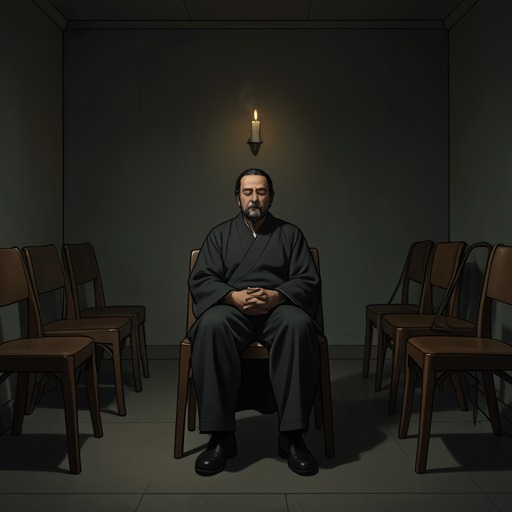
God
LongingGod is the decisive presence at the center of the book’s account of Christian mysticism, but not a character described through a continuous sequence of actions. The mystics’ testimony instead gathers around a paradox: God may be known with certainty while remaining beyond language, the senses, and reason. Encounters differ in form, yet they repeatedly turn attention toward a presence that cannot be adequately pictured or possessed.
Presence Beyond Description
The book’s simplest account of a mystic is someone who has experienced God directly, with a certainty that leaves no doubt about the encounter. That certainty does not make the experience easy to explain. Human language fails to convey what happened, and no vocabulary or image is adequate to define God. Mystics therefore approach the divine not by producing a complete description but by acknowledging the limits of description and being transformed by the mystery those limits cannot contain.
The examples resist equating divine presence with visions or other unusual sensations. Hildegard of Bingen experienced visions, but Bernard of Clairvaux reported no sensory perception in his encounter with God. Thomas Merton, describing his experience in Cuba, was convinced that God was immediately before him, yet reported no sensory experience. Rufus Jones, for his part, was wary of expecting supernatural messages. Across these contrasting accounts, the desired reality is not spectacle but God; visions may accompany an encounter, but they are not its necessary proof.
Bernard McGinn’s account, as presented in the book, places mysticism within religion, as a process or way of life, and as an attempt to express direct consciousness of God’s presence. William James’s four marks clarify the character of such encounters. They are ineffable because language cannot report their contents adequately; noetic because they yield knowledge that is experienced rather than reached through ordinary reasoning; transient because they pass, often briefly, even if the mystic loses a sense of time while they last; and passive because they are not produced by the person’s will. The mystic may feel taken over, and the experience is understood as an unearned gift.
Encounter, Knowledge, and Readiness
This account makes divine presence both intimate and beyond human control. Mysticism presumes that the mind can reach beyond the physical world, the five senses, and rational thought. The resulting knowledge is not simply a conclusion argued into existence: it is known through encounter. Yet a person cannot command such an encounter to occur. Its unexpected arrival and temporary character help explain why the absence that follows can be painful, even as the memory of a moment of certainty remains a source of gratitude.
Howard Thurman gives this relationship a practical shape. Prayer and preparation matter, especially engagement with Scripture such as the Psalms and Gospels, but preparation does not make the person the author of the encounter. The initiative remains with God. Thurman describes religious experience as a disclosure of God’s reality, and judges its truth partly by its consequences: a genuine encounter changes the person’s focal point, calls for surrender, and begins a slow moral transformation. The experience is thus not validated merely by its intensity; its bearing on how a person lives matters.
The book also frames mystical life through recurring alternation: moments of religious height can give way to a felt absence of God, a spiritual desert in which faith is threatened. Thurman’s account of “Falling and rising is the way” makes this movement a pattern rather than a simple progression from doubt to permanent certainty. The inward light offers a point of return, while the changing experience itself remains part of the spiritual life.
The Divine Within
Across the mystics considered in the book, contact with God is linked to a depth within human beings described variously as ground, spark, seed, or watermark. These terms name an element of divinity that remains untouched by sin and makes encounter possible. The Quaker affirmation that there is something of God in every person gives this inwardness a social as well as contemplative consequence: the divine is not restricted to a remote image or to a select visionary.
Meister Eckhart’s teaching gives the inward depth a particularly developed expression. The ground of the soul is the part of a person touched by nothing other than God; when God’s ground and the human ground come together, mystical life flourishes. Eckhart associates this realization with detachment from inadequate images of God and with knowing through unknowing. His preaching urged listeners toward inner union with God, and the book connects this teaching to his insistence that people recognize their inward relation to the divine.
Other accounts extend divine presence into relationships and public life. Dag Hammarskjöld’s words locate God within human beings, while Dorothy Day saw divine presence among people who were poor, demented, or addicted. In these examples, inwardness does not mean withdrawal from the world: the recognition of God within becomes a way of perceiving the dignity and claims of others.
Revelation, Authority, and Changed Lives
Hildegard of Bingen’s experience shows how an encounter interpreted as divine could become a public vocation. In 1141 she reported a brilliant fiery light penetrating brain and heart and giving her immediate knowledge of the Bible. She understood the experience as a call to prophesy and teach, and used that authority to criticize neglected Scripture, sluggish clergy, and the poor biblical knowledge of laypeople. Her visions therefore joined mystical experience to interpretation and reform rather than remaining private revelation.
Such claims could bring recognition as well as institutional tension. Bernard of Clairvaux encouraged Hildegard, and Pope Eugenius III endorsed Scivias after its examination at the Synod of Trier in 1148–49. Meister Eckhart, by contrast, faced heresy proceedings over teachings that included the birth of the Word in the soul. The contrast shows that an appeal to divine presence could acquire public authority while remaining open to scrutiny over how that presence was described and taught.
For the book’s mystics, the encounter’s meaning finally lies neither in a complete account of God nor in a single extraordinary sensation. God remains beyond adequate image and expression, while being experienced as directly present and inwardly near. The encounter may be brief, unbidden, or difficult to communicate; its enduring test is whether it reorients the person toward God and reshapes the life that follows.