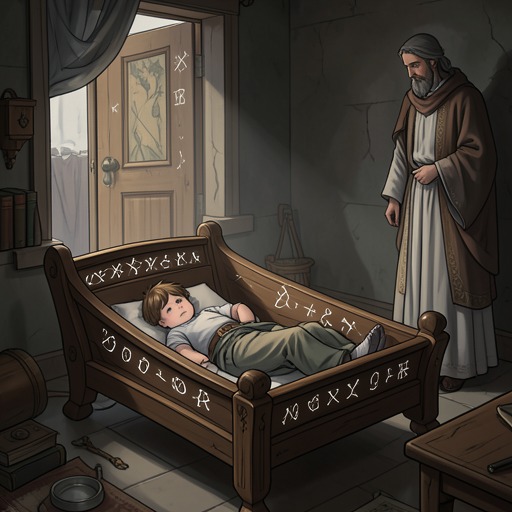
Math's Requirement to Rest His Feet on a Maiden's Lap
MabinogionMath son of Mathonwy’s Requirement to Rest His Feet on a Maiden’s Lap makes the ruler’s physical dependence a condition of his ordinary life and a constraint on his movement. The rule binds courtly routine to the presence of a maiden; when Goewin can no longer serve in that role, the arrangement exposes the violence concealed within the court’s order and forces Math to respond to the wrong done to her.
The Rule and Its Setting
Math could not exist, the narrative says, unless his feet rested in a maiden’s lap, except when the tumult of war prevented it. The exception is explicit, but the condition governs peacetime: Math dwelt continually at Caer Dathyl in Arvon and could not make a circuit of the land. His nephews Gwydion and Gilvaethwy, with Math’s household, went around the territory in his stead. The rule therefore shapes not only a private bodily routine but also the exercise of kingship, limiting the ruler’s travel and assigning his representatives work beyond the court.
Goewin, daughter of Pebin, is the maiden who attends Math. The account describes her as the fairest maiden known in her time. Her position is indispensable to Math’s continued existence, yet the narrative also shows that this indispensability leaves her exposed within the court: Gilvaethwy becomes enamored of her, and his desire precedes the violence that breaks the arrangement.
Goewin’s Disclosure and the Rule’s Disruption
After Math returns to his chamber and prepares to place his feet in Goewin’s lap, she tells him to find someone else: she is now a wife. She then discloses that Gwydion and Gilvaethwy, Math’s nephews, attacked her by surprise and did her wrong. Her account transforms what might have appeared to be an established courtly service into evidence of a serious breach committed within Math’s own household. The rule has depended on Goewin’s presence, but it has not protected her from the men around her.
Math responds by promising to secure compensation for Goewin and amends for the dishonor done to him. He also says that he will take her as his wife and place his dominions in her hands. The episode thus records a change in her stated position: she can no longer fill the former role, and Math proposes marriage and a grant of authority in response to her disclosure. The passage presents that response alongside the wrong itself, without suggesting that the proposed compensation erases what happened.
Political and Narrative Significance
The rule links the sovereign’s bodily condition to the organization of his court. Math’s inability to travel means that his nephews carry out the circuit of the land; the maiden’s presence, meanwhile, is made necessary to his existence. When Goewin reveals the assault, this intimate arrangement becomes a political crisis as well as a personal one: Math names both the wrong to her and the dishonor done to himself, and promises action on both counts.
The exception for war emphasizes how completely the condition governs ordinary life: only the tumult of war suspends it. Yet the narrative’s decisive interruption comes not from battle but from Goewin speaking when Math returns to resume the customary arrangement. Her disclosure makes the rule’s human cost visible and shifts attention from the king’s dependence on her service to her claim for recognition and redress.