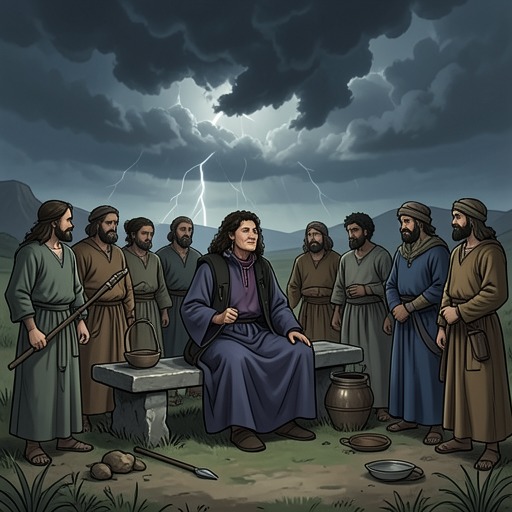
The Annual May Duel for Creiddylad
MabinogionThe Annual May Duel for Creiddylad is a settlement imposed by Arthur on two rivals whose contest for Creiddylad had already produced imprisonment, killing, and madness. It does not end their competition with a single judgment: it leaves Creiddylad in her father’s house and makes the struggle recur every first of May until the day of doom, when the victor is to have her.
Origins of the Agreement
Creiddylad had been betrothed to Gwythyr son of Greidawl, but before she became his bride, Gwyn ap Nudd carried her away by force. Gwythyr gathered a host and fought Gwyn; Gwyn defeated him and captured several nobles, including Nwython and his son Kyledyr Wyllt. Nwython was killed, and Kyledyr was forced to eat his father’s heart, an act from which he became mad.
Arthur intervened in the aftermath. He went north, summoned Gwyn ap Nudd, freed the imprisoned nobles, and made peace between Gwyn and Gwythyr. The annual duel emerged from that reconciliation: it was a way to contain a conflict that had moved beyond the two claimants and brought harm to their followers and kin.
Terms and Recurrence
The agreement placed Creiddylad in her father’s house, with neither claimant given an advantage over the other in the meantime. Gwyn ap Nudd and Gwythyr son of Greidawl were to fight for her on every first of May from then onward until the day of doom. Whichever man won that day would have her.
The settlement therefore postpones rather than permanently resolves the contest. It sets a fixed recurring date and a clear means of deciding who prevails, but leaves Creiddylad’s eventual fate dependent on a future victory. The account does not name a final winner or describe the arrangement reaching a lasting conclusion.
Significance in the Story
The rule transforms an immediate feud into a recurring contest bounded by a calendar and an agreed condition. Arthur’s intervention first releases the captives and establishes peace between the chiefs; the duel then preserves their rivalry in a regulated form, rather than allowing the surrounding violence to continue unchecked. Its indefinite term makes the settlement unusual: peace between the rivals is secured not by abandoning their claim, but by deferring its resolution to repeated May contests.