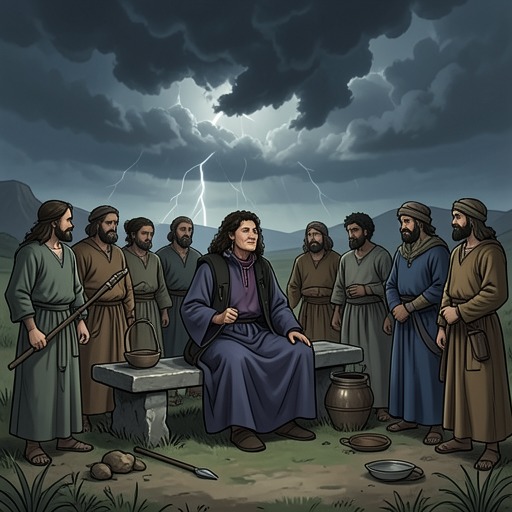
The Conditions Under Which Llew Could Be Killed
MabinogionThe Conditions Under Which Llew Could Be Killed are a set of safeguards and exceptions that Llew Llaw Gyffes explains to Blodeuwedd, then sees deliberately assembled against him. He cannot be killed by an ordinary weapon or in an ordinary setting: his death requires a spear made over the course of a year and a precise arrangement beside a river. The conditions matter because Llew gives them in response to an apparent expression of concern, and Blodeuwedd converts his explanation into instructions for Gronw Pebyr. The rule that seems to secure Llew instead supplies the plan for his defeat.
Llew’s Account of the Conditions
Llew discloses the conditions during a night-time conversation after returning home. He has spent the day with Blodeuwedd in discourse, minstrelsy, and feasting, but at night she remains silent when he speaks to her. Asked what troubles her, she says she is thinking about his death and fears that he might die before her. Her concern prompts Llew to assure her that he will not easily be slain, then to explain the exceptions that make his death possible.
The weapon is subject to a lengthy restriction: the spear with which he is struck must take a year to make, and work on it is permitted only during the sacrifice on Sundays. Llew then rules out the ordinary places and circumstances in which an attack might occur. He cannot be killed inside a house or outside one, on horseback or on foot. The repeated exclusions make the conditions sound comprehensive, but they lead toward an exceptional posture rather than closing every possibility.
That posture requires a bath beside a river, with a cauldron roofed and tightly thatched. A buck must be brought beside the cauldron. Llew says that he could be killed if he placed one foot on the buck’s back and the other on the edge of the cauldron, and someone struck him while he stood that way. The account specifies not merely a vulnerable location but a conjunction of objects, position, and weapon: the bath, roofed cauldron, buck, and year-made spear together define the opening in his protections.
From Disclosure to Design
Blodeuwedd’s questions elicit each part of the condition. She asks how Llew could stand at once on the cauldron’s edge and on a buck, then presents her request as a practical wish to understand what he has told her. Her manner gives the exchange the appearance of attentive care; the later actions reveal that the information is being gathered for another purpose. As soon as the conversation is over, she sends word to Gronw.
Gronw works at making the spear, and it is ready a year later. That duration answers directly to Llew’s first safeguard: the weapon is not improvised, but produced within the unusual time limit he has described. When it is complete, Gronw informs Blodeuwedd. She then returns to Llew with a request that he demonstrate the posture he had explained, saying that she has prepared the bath and asking him to show how he could stand on the cauldron and buck together.
The preparations reproduce the terms Llew supplied. Blodeuwedd arranges for Gronw to lie in wait on Bryn Kyvergyr, on the bank of the Cynvael River, and has the goats in the cantref gathered across the river. When she tells Llew that the bath and its roof are ready, he agrees to go and inspect them. On the following visit, he enters the bath and anoints himself. At Blodeuwedd’s prompting, he identifies the animals as bucks and asks for one to be brought over. He then leaves the bath, puts on his trousers, and places one foot on the bath’s edge and the other on the buck’s back. Each small request has brought the arrangement closer to the precise posture he had described.
The Exception Enacted
Once Llew assumes that position, Gronw rises from his hiding place on the hill. Resting on one knee, he throws the poisoned dart and strikes Llew in the side. The narrated attack fulfills the conditions Llew had set out: the year-made weapon, the riverbank, and the posture involving the cauldron and buck converge in a single ambush. Llew rises in the form of an eagle, gives a fearful scream, and is thereafter no longer seen. The rule thus culminates not in an ordinary death scene but in a sudden transformation and disappearance.
The attack also transfers political power. That night Gronw and Blodeuwedd go together to the palace; the next day Gronw takes possession of Ardudwy. After overcoming the land, he rules it, bringing both Ardudwy and Penllyn under his sway. Llew’s exceptional vulnerability therefore has consequences beyond the threatened man: its exploitation enables Gronw to establish control over two territories.
Consequences and Narrative Function
The conditions are presented first as knowledge Llew voluntarily shares, then as a procedure his opponents reproduce. Their force lies in the contrast between the broad exclusions—neither inside nor outside a house, neither mounted nor on foot—and the exact combination that escapes them. The account does not describe Llew as simply unprotected; it shows that his security depends on a rule with a tightly specified exception, and that the exception becomes usable once its details have been disclosed.
When news reaches Math son of Mathonwy, grief falls upon him and more heavily upon Gwydion. Gwydion says that he will not rest until he has news of his nephew, and Math wishes him strength. Their response marks the unresolved consequence of Llew’s disappearance: Gronw has taken power, while Llew’s fate is not yet settled in the account of the attack. The rule is therefore both a mechanism of betrayal and the hinge between Llew’s disappearance and the search that follows.