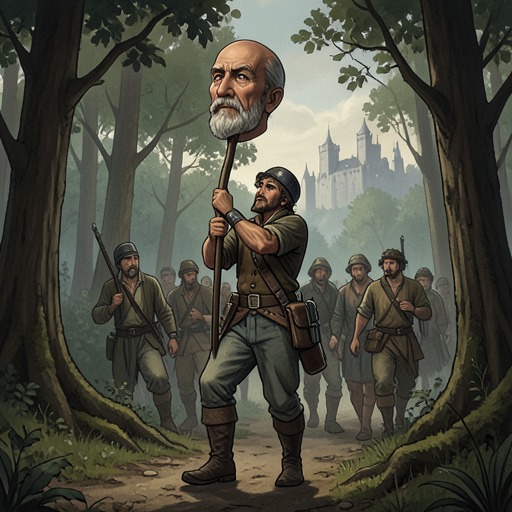
The Prohibition Against Opening the Door Facing Cornwall
MabinogionThe Prohibition Against Opening the Door Facing Cornwall is Bendigeid Fran’s final instruction to his companions: preserve his head as they travel toward its burial place, but do not open the door at Gwales that faces Cornwall. The prohibition protects an enchanted refuge from the return of painful memories; when it is broken, the company must leave and complete the burial in London.
The instruction and its terms
After his death, Bendigeid Fran directs his companions to carry his head to the White Mount in London and bury it there facing France. He warns that the journey will be long, then gives two measures of the time they may spend along the way: seven years feasting in Harlech, with the birds of Rhiannon singing, and a further fourscore years at Gwales in Penvro.
At Gwales, the head is to remain with them, uncorrupted and as welcome a companion as it had been in life. Their stay, however, is conditional. They must not open the third door, the one that looks toward Cornwall and Aber Henvelen. Once that door is opened, they may no longer remain there: they must set out for London and proceed directly to bury the head.
The refuge at Gwales
At the end of seven years, the company leaves Harlech for Gwales. They find a regal place overlooking the ocean, with a spacious hall whose two doors stand open and whose third, facing Cornwall, remains closed. Manawyddan identifies it as the door they are forbidden to open, making the instruction an active boundary within their new refuge.
The hall’s enchantment suspends ordinary awareness. The companions enjoy the food and company without remembering what they have seen, any sorrow they have suffered, or the losses behind them. They remain for fourscore years without feeling the passage of time or becoming more weary than when they arrived. The preserved head is part of this interval of ease, not a burden that interrupts it.
The breach and its consequence
One day, Heilyn son of Gwynn opens the forbidden door because he wants to know whether the warning is true. Looking toward Cornwall and Aber Henvelen breaks the company’s oblivion: they become conscious of the evils they have endured, the friends and companions they have lost, and the misery that has befallen them. Their lord’s fate weighs especially heavily upon them.
Unable to rest after this return of memory, the companions leave Gwales with the head and travel to London. They bury it at the White Mount, fulfilling Bendigeid Fran’s instruction. The door’s opening therefore ends the enchanted stay and converts a protected, timeless interval into a forced departure and a final act of burial.
Concealment and narrative significance
The burial at the White Mount is identified as the third goodly concealment, while the opening of the door is the third ill-fated disclosure. The account links the head’s concealment to the island’s security: no invasion from across the sea came to the island while the head remained buried there. The prohibition thus connects a seemingly private rule of hospitality and remembrance to a wider political consequence.
Its structure turns on a precise limit. The companions are permitted extraordinary longevity and joy at Gwales, but only while they preserve the boundary Bendigeid Fran set; curiosity makes the concealed past present again, and the refuge can no longer hold them. The instruction is at once a travel rule, a condition of the enchanted reprieve, and the means by which the head reaches the place where its continued concealment protects the island.