Yspaddaden's marriage tasks
MabinogionYspaddaden's marriage tasks transform Culhwch's pursuit of Olwen into a chain of conditions tied to the wedding itself. Yspaddaden first requires a pledge that he will be treated justly, then names work, provisions, tools, and hunting resources that Culhwch must obtain. The demands repeatedly stress that ordinary force or willingness will not suffice: some tasks depend on a specialist, a reluctant owner, or a rare object. Yspaddaden finally makes the arrangement explicit: once Culhwch has accomplished the marvels, he may have Olwen as his wife.
The agreement and its conditions
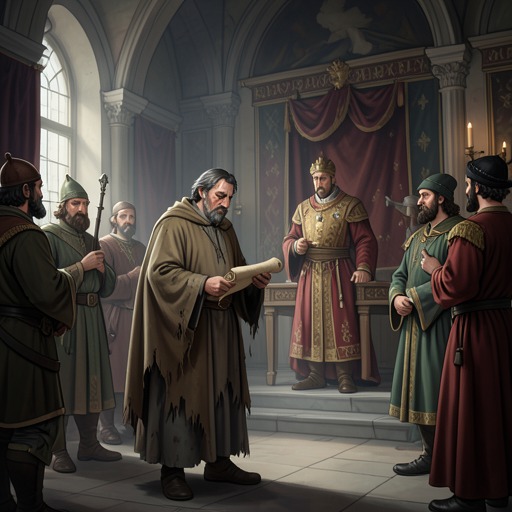
Yspaddaden Penkawr asks Culhwch directly whether he seeks his daughter. Culhwch answers that he does, but first requires a pledge that Yspaddaden will act justly toward him; the agreement is therefore framed as reciprocal terms rather than an unqualified demand. Once Culhwch promises to undertake whatever is named, Yspaddaden begins setting the conditions. The tasks are not a single feat but an expanding list, with each apparent concession followed by another obstacle.
The demands make the wedding feast a practical measure of completion. Yspaddaden requires a vast hill to be uprooted, its brush burned for manure, and the ground ploughed and sown; the grain must ripen on that same day so it can provide food and drink for the wedding. He adds a difficult qualification: no husbandman can prepare the wild land except Amaethon, who will not come willingly and cannot be compelled. The task thus requires both extraordinary speed and access to a particular worker.
Crops, provisions, and wedding equipment
The agricultural conditions extend beyond the hill. Yspaddaden points to ground where nine bushels of flax had been sown when he first met Olwen's mother, but none had grown, white or black. He still has the measure of the original seed, and requires flax to be sown in the new land so it will grow into a white wimple for Olwen to wear on her wedding day. The old failed sowing is made part of the new obligation: the wedding garment depends on reversing a long-standing lack of growth as well as cultivating new ground.
He also requires honey nine times sweeter than honey from a virgin swarm, without scum or bees, for making bragget for the feast. The tasks thereby specify not only that a feast must be held, but the quality and preparation of what it will contain. For boiling the wedding meat, Culhwch must obtain the cauldron of Diwrnach Wyddel, steward to Odgar son of Aedd, king of Ireland. Yspaddaden presents the cauldron as another necessary item rather than a substitute for the other provisions.
Other requirements concern the preparation of Yspaddaden himself and the serving of guests. He asks for the tusk of Yskithyrwyn Benbaedd to shave himself with, insisting that it must be pulled from the animal while it is alive; only Odgar can accomplish that feat. Fresh milk for everyone depends on obtaining the bottles of Rhinnon Rhin Barnawd, which keep liquid from turning sour. Their owner will not give them willingly, and cannot be compelled. The comb and scissors needed to arrange Yspaddaden's hair are likewise unavailable elsewhere: they lie between the ears of Twrch Trwyth, who will not hand them over voluntarily.
The hunt and its dependencies
The comb and scissors make the hunting of Twrch Trwyth indispensable, but Yspaddaden describes that hunt as a task with its own prerequisites. It cannot be undertaken without Drudwyn, the whelp of Greid son of Eri, and the swift hounds Aned and Aethlem, which have never been released upon an animal without killing it. These requirements turn the pursuit into an organized expedition rather than a simple contest between hunter and quarry.
Yspaddaden also requires Arthur and his companions to join the hunt, although he says Arthur will not come for Culhwch and cannot be compelled. He further names Bwlch, Kyfwlch, and Sefwlch, grandsons of Cleddyf Difwlch, and supplies a densely specified roster around them: their shields, spears, swords, dogs, horses, wives, grandchildren, daughters, and handmaids. The three men are to sound the horn while the others shout, in a clamor that will make it seem as if the sky is falling to earth. The elaborate company and its prescribed noise make the hunt a collective undertaking on a scale that reaches well beyond Culhwch's own strength.
A further condition is the sword of Gwrnach the Giant, which Yspaddaden says is the only weapon with which Gwrnach can be slain. Gwrnach will not give it for payment or as a gift, and cannot be compelled. This demand is distinct from the hunt: it is another obstacle in the marriage list, attached to an object that is indispensable to overcoming a particular opponent. Yspaddaden warns that the work will involve difficulties and sleepless nights, and makes successful completion the threshold for obtaining Olwen.
Fulfillment and narrative function
Culhwch answers the escalating demands with confidence, repeatedly maintaining that they will be easy for him to accomplish. He identifies Arthur, his lord and kinsman, as the source of horses, chivalry, and assistance. His confidence does not erase the obstacles Yspaddaden has specified: several objects belong to people who refuse to give them, some feats require the cooperation of a named specialist, and the hunt itself depends on an extensive network of allies and animals.
Yspaddaden's closing terms preserve the conditional character of the agreement. Culhwch is not to be charged for Olwen's food or clothing while he seeks the required marvels, but he will have her as his wife only when he has accomplished them. The tasks therefore connect courtship, resource-gathering, collective action, and the wedding feast in one extended test. Their accumulation also shapes the story as a quest: a promised marriage is the goal, while each new condition opens another practical challenge and brings additional participants into its pursuit.