Victoria Belle
MasqueradeVictoria Belle is a serial killer whose defining contrast with Robert Michael Rothman is that she does not try to disguise her violence as an ordinary life. Known to Claire Rothman as Vicky Belle, she first encountered Robert at her mother’s funeral and recognized in him a kindred predator. She later returns to Turtle Creek to help him after his crimes are exposed, but her flight into the woods ends with her fate unresolved and her body unrecovered.
Identity and Background
Belle’s earlier identity, Vicky Belle, is tied to her mother, Marge Belle, who had worked as a housekeeper for Claire and Robert Rothman. Marge suffered a major stroke at forty-two, became disabled, and later died. Claire recalls that she and Robert attended Marge’s funeral, where they met her daughter Victoria. Claire remembers the young woman staring at Robert and Robert staring back. Claire later guesses that Robert crossed from watching women to taking them around the time he met Vicky, but she has no date and presents this as her inference, not certain knowledge.
Belle was eighteen at the time of that meeting and thirty-six when she reappears in the present-day action. By then, the name Vicky Belle belongs to a past identity: she has lived under numerous names and identities. The contrast between the name Claire remembers and the woman waiting outside Turtle Creek Jail makes her history of reinvention part of her introduction. Her aliases conceal her from others, but, unlike Robert, she does not seek the broader performance of respectable normality.
Relationship with Robert Michael Rothman
The funeral encounter becomes the origin of Belle’s powerful attachment to Robert. She recognizes him immediately as someone like herself, and the narrative describes their affinity as a shared predatory nature. Robert, in turn, becomes her mentor and, as she understands it, her only friend. When she learns that his true nature has been uncovered, she rushes back to Turtle Creek, watches the jail, and waits for an opportunity to help him. Her return is not a casual visit: she has come to stand by the person she considers her closest bond.
Their recognition of each other is not entirely mutual in its intensity. Belle has an exceptional ability to identify others like herself, while Robert does not normally share that sensitivity. He can recognize it in a different man, however, and feels that this man makes him seem like prey. When Belle approaches Robert and insists that they both know what he is, he rejects her identification, saying that he will never be like her. Her gesture of patting his cheek follows the disagreement rather than resolving it. The exchange exposes a tension in their alliance: Belle treats their likeness as undeniable, while Robert resists being defined by her category.
Violence and Self-Definition
The narrative presents Belle as a predator who knowingly embraces that identity. Her victims, both men and women, number well over a hundred. She has never held a job, owned a car, or bought a house; instead, the account says she relies on the weak and unwary for what she needs. This detail distinguishes her way of living from Robert’s concealed double life. She does not merely commit violence while maintaining an ordinary public role; the narrative says that her existence is organized around her desire to kill.
An early account of her violence shows the force of that self-recognition. After setting fire to the bedroom where two sisters are present, Belle escapes through the basement window she used to enter. Their parents rush toward the room without seeing her. On the drive home, she laughs repeatedly and feels whole for the first time in her life. The account links this response to a decisive acceptance of herself: she knows what she is and lives accordingly, rather than experiencing her violence as a temporary lapse from another identity.
Her ability to identify kindred predators also shapes how she understands the world around her. She senses Robert’s nature with particular intensity, then later recognizes Jessica White’s husband as a predator. The text presents this perception as unusually acute, a light appearing in a dark corner of her mind when she encounters someone like herself. That capacity does not make her an observer detached from violence; it draws her toward other predators and, in Robert’s case, into a sustained alliance.
Return to Turtle Creek and Flight
After learning that Robert’s crimes have been exposed, Belle returns to Turtle Creek in a recently stolen blue Honda. The car’s owner has been killed by the woman driving it. Outside the jail, amid the news vans gathered for developments in Robert’s case, Belle watches for a chance to help him and peers through a telephoto lens as the noise grows. The waiting scene brings her concealed, mobile life into contact with the public spectacle surrounding Robert’s arrest.
Belle’s intervention also reaches Kaye Swan. In the woods bordering the property, she pulls Swan from the back seat of a stolen car and makes her sit on a dirt road. Swan is bound and wearing a raincoat over no other clothing; Belle, in camouflage and sneakers, escorts her barefoot through the woods toward the FBI Safe House while whispering threats. These details establish Belle as an active participant in the effort around Robert, not simply a watcher outside the jail. Her role places a captive in her custody and carries the conflict into the woods near the safe house.
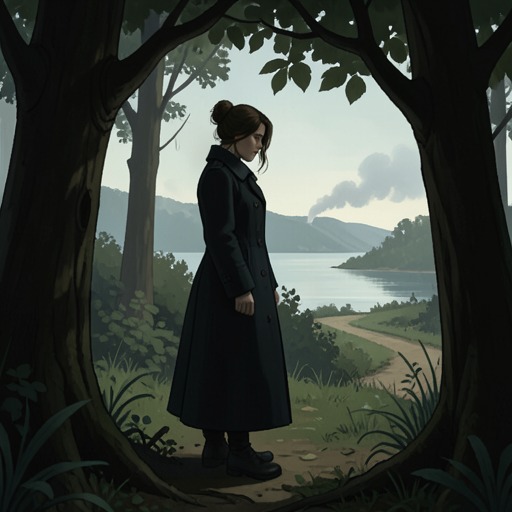
Later, after a fire has been put out, Belle does not see the smoke until she reaches a large clearing, because the surrounding trees have hidden it. She looks back and sees Jessica White’s husband approaching with the rifle she had given Robert. Belle understands that Robert must be dead or captured. With the two of them about eighty yards apart and the pursuer closing in, she runs into the trees, limping from a leg wound. She takes out her knife and hopes to encounter a hiker or camper who could serve as a hostage and shield. Her escape is therefore an immediate response to the apparent collapse of the cause that brought her back: Robert is no longer in a position she can reach or protect.
Unresolved Ending and Narrative Role
Belle’s flight leaves the outcome uncertain. The following morning, Jessica White and her husband leave for home, but Belle’s body has still not been recovered. The narrative gives no confirmation of her death. The missing body preserves the distinction between evidence of danger and proof of an ending: she has been wounded and pursued, but her fate remains unknown.
Belle’s character also sharpens the book’s contrast between concealed and openly embraced violence. Robert has struggled against his nature and, once exposed, describes himself as freer; Belle’s history is presented as one of recognition and acceptance rather than concealment. Yet her bond with him is not simple confirmation that they are alike: his refusal to accept her description, and his sense that another predator can make him feel like prey, unsettle the certainty she brings to their connection. She is at once Robert’s loyal ally, a killer with a life built around predation, and a surviving threat whose disappearance leaves the story open.