Dan Stevens
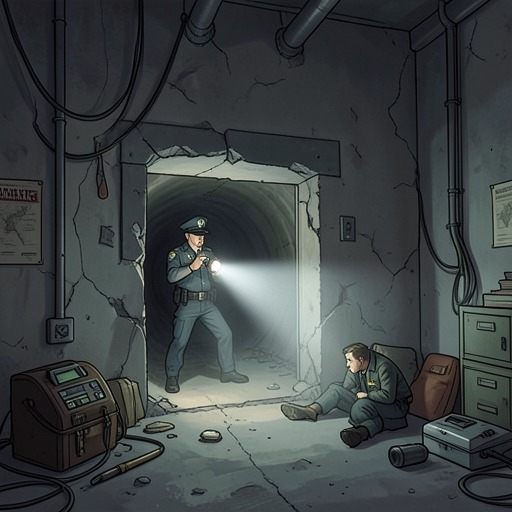
MasqueradeDan Stevens, the chief of police, is the local authority confronting the consequences of the violence on Robert Michael Rothman’s property. The discovery finds him trying to steady his breathing inside the renovated barn, where the number of dead recalls the last time he saw so many bodies: in a war zone. His response establishes both the scale of the case and the limits of what a local department can manage alone. Rather than claim expertise he does not have, Stevens brings in federal investigators and continues to contribute local personnel and support as the danger shifts from investigation to immediate pursuit.
Identity and First Response
Stevens arrives at the Rothman property after a call comes in just before one in the morning. He is late to the scene because he has been out of town visiting his widowed mother in Florida. He receives the news while retrieving his baggage at the airport, having just taken a redeye flight home. The circumstances place an abrupt return to official duty beside an ordinary family visit; on arrival, the renovated barn confronts him with a scene comparable in scale to what he remembers from a war zone.
His first response is not detached procedure. He tries to steady his breathing as he stands among the dead, registering the discovery as an exceptional crisis. The comparison to a war zone indicates prior exposure to mass death, but the narrative does not specify his military role or the circumstances of that experience. It gives the memory a precise function: the Rothman property has produced a scene severe enough to recall the worst scale of death Stevens has previously encountered.
Calling in Federal Investigators
The investigation soon reveals a hidden criminal operation beneath the apparent boundaries of a local case. When Phil Colson says that the discoveries below ground may have continued for years, possibly decades, and that the available facilities cannot process what they have found, Stevens identifies the necessary next step: he calls in the Federal Bureau of Investigation. His decision acknowledges that the department lacks the resources and specialist capacity the case requires. It also changes the investigation’s scale, bringing federal agents and civilian consultants into the response.
Stevens welcomes Special Agents John Brice and Robyn Dyer, along with Dr. Jessica White and her husband, in his office. He openly tells the assembled group that serial killers are beyond the local department’s usual expertise. The candor matters: he does not present the FBI’s arrival as a formality or pretend that his own department can direct every part of the inquiry. Instead, he receives the specialists and makes room for their work in a station housed in a building more than a century old, where the floors creak with every step. Around a round table with a coffee maker, he offers the group Styrofoam cups and begins the working relationship in his office.
Local Support for the Operation
As the investigation develops, Stevens remains involved in coordinating the local response. At the Pines Way Motel, he meets Brice and the agents at the entrance and introduces them to two of his deputies, including Joe Perkins. The motel’s No Vacancy sign is lit despite the sparse vehicles in its lot, a discrepancy that forms part of the setting for the operation taking shape there.
Brice outlines a planned trap to the assembled investigators. The cover is to make the motel appear occupied: ten vehicles are being sent from his brother-in-law’s used-car dealership, two female agents are to pose as maids, and Perkins is to act as a handyman so he can move around without attracting notice. Brice assigns Dyer to lead at the motel while he watches Claire Rothman at the FBI Safe House by the lake, accompanied there by Jessica White and her husband. The evidence places Stevens in the local command structure that supports this arrangement, but identifies Brice, rather than Stevens, as the person explaining its design.
Stevens is also present as the plan accounts for the arrival of Claire and a decoy made up to resemble her. When Brice says that both are on their way, Claire enters with the disguised agent following directly behind her. Stevens reacts with a double take, registering the striking resemblance. The moment gives the abstract plan a visible form: the operation depends on a substitute convincing enough to function as bait, while the real Claire is brought into the investigators’ protection.
The Safe House and the Pursuit
Stevens continues to take part in meetings about the response. He joins Brice and Dyer for an early dinner at a renovated hunting lodge situated between the decoy motel and the safe house; Jessica White and her husband attend as well. The available account establishes Stevens’s presence at this meeting, but does not specify what he says or decide there. Its position between the two operational sites places him within the continuing coordination of the investigation rather than only at its initial discovery.
The threat eventually reaches the FBI Safe House. When Kaye Swan runs toward it seeking help, Agent Martin Cantwell sees her from the kitchen and warns the other agents that there may be a situation at the rear of the house. Cantwell tells one agent to stay with Claire and another to guard the front and call Brice, then goes to meet Swan. Victoria Belle follows, and the breach of the house turns the protective arrangement into a direct confrontation. These actions are carried out by the agents; Stevens is not identified as being inside the safe house. His connection to the episode is through the wider law-enforcement response and, later, the deputies who pursue Belle.
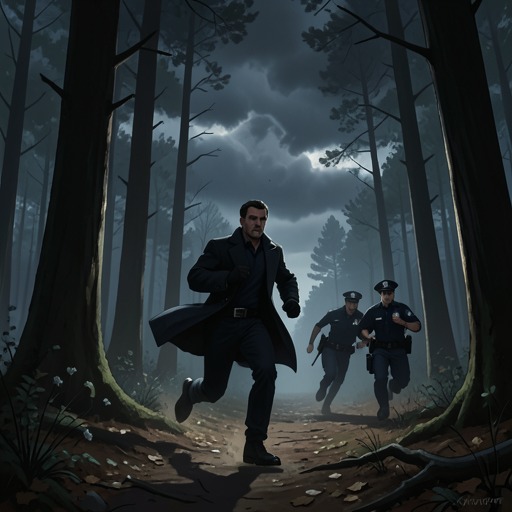
After Belle flees into the gorge area, a gunshot draws the troopers’ attention. Belle runs along the edge of the gorge, with two of Stevens’s deputies—a man and a woman—closing in behind her. The male deputy orders her to stop or he will shoot, and Belle halts. The scene confirms that Stevens’s department is still actively involved after federal agents have taken a central role. It ends with Belle stopped, but does not establish her ultimate capture or the outcome of the confrontation.
Role in the Investigation
Stevens’s contribution is defined less by solitary detection than by the decisions and cooperation that keep the response functioning. He recognizes the limits of local capacity, asks for federal assistance, receives the agents and consultants, introduces deputies, and remains present as the investigation’s operational plans develop. The story contrasts the intimate scale of his return from visiting his mother with the institutional scale of the crisis waiting at the barn; later, the FBI’s elaborate motel and safe-house arrangements still rely on local officers. His authority is therefore neither discarded nor sufficient by itself: it becomes part of a larger response, and his deputies remain consequential when the case turns into pursuit.