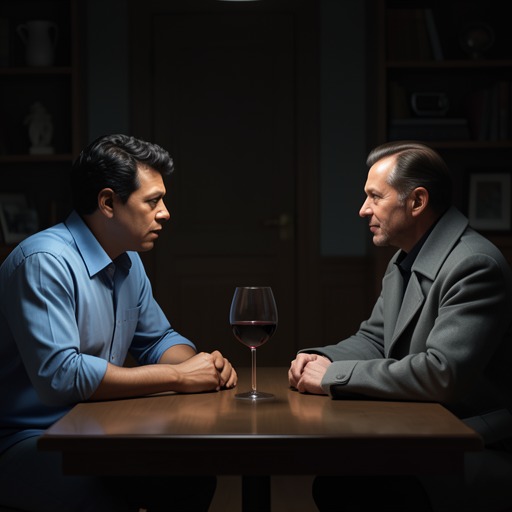
Frank and the Gecko Gordon Vie for the Gin
MayaFrank and the Gecko Gordon Vie for the Gin is a comic nighttime confrontation built around a simple territorial impasse: Frank wants the gin, while Gordon sits on the bottle and hunts mosquitoes. The episode transforms Frank’s dependence on a drink into a contest of attention, nerve, and improvised tactics, while giving the gecko the watchfulness and claims of a wary co-inhabitant rather than treating him as mere scenery.
The Bottle and the Standoff
Returning to his bure, Frank switches on the light and finds a gecko perched on the gin bottle beside his bed. The animal is nearly thirty centimeters long, apparently well-fed on mosquitoes, and positioned so that even approaching the bedside table might send the bottle crashing to the floor. Frank has already spilled enough gin that evening; the danger is not simply that Gordon will remain in his way, but that a move against him could cost Frank more of the drink he is trying to reach.
The bottle holds the scene in a precarious balance. Frank knows geckos are common in the region and cannot realistically be excluded from a bedroom, but this particular animal is too large and too intent a presence to ignore when he is about to sleep. He watches the gecko’s belly and cloaca magnified through the glass, while the animal’s head and tail show around the bottle. Frank reads its stillness as a calculated choice: it might stay motionless and blend in, or dart up a wall toward the ceiling and the cover of a beam. Neither movement promises a safe approach to the gin.
A Rival with a Name
Frank’s resistance to sharing the room is personal as well as practical. He recalls that animals, especially vertebrates such as geckos and iguanas, can seem like individual personalities. Insects do not make him feel watched in the same way: a fly has no face or individual expression, whereas a saurian does. The gecko on the bottle therefore confronts him not as an anonymous pest but as a stubborn, observant presence in what Frank considers his paid-for private space.
He names the male gecko Gordon after the bottle’s label. Frank guesses that the animal is old by human comparison, perhaps some decades his junior, and imagines that it could have descendants several generations deep. Gordon belongs to a species introduced to the Fiji Islands only about thirty years earlier, so Frank even speculates that its grandfather may have immigrated to Taveuni. These guesses turn a brief encounter into a miniature history of settlement and survival; they also establish the uneasy symmetry between a human visitor and an animal already established in the room.
Frank considers why Gordon does not simply flee. Perhaps long experience has taught him that clothed, head-haired primates are not a serious threat; perhaps the gecko is curious, or even seeking company. But Frank cannot comfortably accept that possibility while he is tired, his feet hurt from the long walk to the International Date Line, and his sleeping medicine remains beyond reach on the bottle. The encounter becomes a test of who will yield first, even though the two opponents do not share the same stakes.
Negotiation, Threat, and Mosquitoes
Frank first tries to define the dispute narrowly: he does not want to strangle Gordon or even drive him away; he only wants the bottle. The gecko, in the dialogue Frank supplies to their silent watchfulness, answers that he was sitting there before Frank entered and has no reason to surrender his territory. The imagined exchange makes the contest funny without erasing its genuine tension: Frank is anxious about losing the gin, while Gordon’s stillness leaves his intentions unreadable.
Gordon states a more immediate claim of his own: he is hungry, and night is when he eats. Mosquitoes often land on the bottle, he explains, giving him a convenient feeding perch. Frank recognizes that the gecko has a point. In the past, Fijian chiefs employed a naked “mosquito man” to sit beside them through the night and attract the insects, sparing the chief their bites. Frank imagines that the profession became unemployed when the efficient house gecko spread through the islands; by the present day, the gecko is effectively part of a house’s ordinary inventory. In principle, Gordon could eat the mosquitoes and let Frank sleep without waking up bitten. In practice, the gin prevents an easy alliance.
Frank proposes giving Gordon another bottle and asks him to get off the gin. The gecko counters that Frank must fetch the beer first. The bargain fails because Gordon will not give up his present perch on the strength of a promise, and Frank cannot simply take the bottle without risking a spill. Their exchange repeatedly turns on sequencing: each wants the other to move first, and each treats that first move as a possible surrender of leverage.
The Straw and Its Cost
Frank conceals his next maneuver behind a challenge about what Gordon can know. While declaring that the gecko cannot know anything Frank does not already know, Frank is actually opening his bag and preparing the juice container. He then puts a straw between his lips and feeds it into the gin bottle without lifting the bottle to his mouth. Gordon remains still as Frank drinks. Frank manages about a deciliter before he has to surface for air, accomplishing the trick without dislodging his rival from the bottle.
The small victory changes Frank’s confidence but does not end the contest. He feels more animated and courageous after drinking, and he recognizes that Gordon had been right not to accommodate him: another deciliter might make Frank bold enough to betray the gecko. At the same time, Gordon makes a sudden turn around the bottle, and some of the precious gin spills onto the bedside table. Frank releases the bottle because he expects Gordon to climb onto him if given the opportunity. The maneuver has won Frank a drink, but the spill and the gecko’s continued proximity preserve the risk that has governed the scene from the beginning.
Gordon then warns Frank plainly that he will regret repeating the trick. Frank accepts the warning and says he never intended to crush him. His relation to geckos remains ambivalent after the encounter: admiration for Gordon’s alertness and ingenuity sits beside the desire to protect his drink and keep the animal away from the bed. The scene ends not with a settled friendship or a decisive defeat, but with a truce defined by mutual suspicion.
Comedy and Uneasy Coexistence
The episode’s humor comes from giving an ordinary obstacle the structure of a standoff. A bottle becomes contested territory; a man who can reach for it cannot safely do so; a gecko’s silent watch is translated into arguments about ownership, hunger, and retaliation. Frank’s increasingly elaborate calculations contrast with Gordon’s advantage in simply remaining on the bottle. The disparity in scale is comic, but Frank’s fatigue, sore feet, need for sleep, and fear of spilling the gin give the conflict concrete consequences.
Gordon’s place in the scene also complicates the distinction between nuisance and neighbor. Frank’s reflections on animals as individuals, his invented dialogue for the gecko, and the mosquito-man analogy all make the contest a negotiation between competing forms of life sharing domestic space. The proposed alliance is practical—Gordon eats mosquitoes, Frank sleeps without bites—but remains blocked by the bottle both characters want to use. Frank obtains a drink through ingenuity, yet the spilled gin and Gordon’s warning prevent the episode from becoming a simple victory story: coexistence is possible, but only while neither side mistakes the other’s restraint for helplessness.