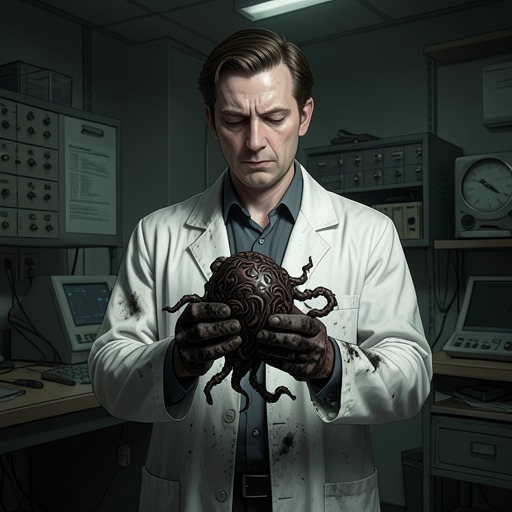
Expendable Backup and Continuous Service Protocol
Mickey7The Expendable Backup and Continuous Service Protocol keeps a dangerous mission role continuously staffed by preserving an Expendable’s knowledge in uploads and authorizing a replacement when the current instance is no longer functional. At Niflheim, this arrangement helps sustain a colony that depends on human bodies for work machines cannot perform; it also makes continuity of the assignment more reliable than continuity of the individual’s lived experience.
Purpose and Operational Basis
The protocol’s clearest stated requirement is that the colony must have a functioning Expendable at all times. When Mickey Barnes’s seventh instance was reported lost, Berto Gomez explained that the rule required a replacement, and that he had requested production of Mickey8 after the seventh instance ceased to be functional. The procedure turns a death or disappearance into an operational trigger: the assignment does not end with the person performing it.
That requirement reflects the material conditions of a beachhead colony. Dangerous duties include external repairs, exposure to local organisms, medical experiments, combat, and exploration of unstable terrain. Some hazards, particularly radiation, can be endured by a human body longer than by a mech; other work, especially certain medical experiments, cannot be performed by a mech at all. On a new colony, an Expendable can also be easier to replace than a machine, because making another human instance depends on agricultural resources while lost metal cannot readily be recovered before heavy industry exists. The protocol therefore treats the Expendable as both a person and a renewable operational resource.
The same logic shapes preparation for the Drakkar’s emergencies. Its propulsion specialists can specify repairs, but an Expendable who already understands basic procedures can help more quickly when time is short. The danger is explicit: an hour after shutdown, neutron flux in the combustion chamber can deliver a lethal dose through combat armor in less than sixty seconds. Backup and replacement make it possible to assign such work to a human body without making the mission depend on that body surviving.
Uploads and the Transfer of Experience
The protocol’s continuity depends on information being uploaded before an instance dies. Standard practice is to make the upload as close to termination as possible, so the next instance can learn what happened and perhaps avoid the same fate. The principle resembles a pilot’s duty to report what caused a crash: the death is not merely a loss but a source of operational knowledge that should be passed on.
The transfer is not automatic or complete. Mickey Barnes has died six times in eight years at the point he recounts his history. One death was a surprise, another occurred in an emergency, and one instance refused to upload before dying. Because he remembers only what was uploaded, his knowledge of those iterations comes from what Nasha or Berto Gomez told him and from surveillance footage. The gaps show the distinction between a replacement being produced and a replacement inheriting the predecessor’s experience. The protocol can restore a functioning worker without guaranteeing a complete personal record.
The value assigned to that record is especially clear after a critical emergency aboard the Drakkar. Mickey Barnes understands why he was made to upload before he was allowed to die: experience acquired in a crisis is too useful to be lost with one instance. The next instance can then act on information learned through a predecessor’s suffering. What the system preserves as knowledge, however, remains inseparable from a death the individual had to undergo to acquire it.
Continuous Service and Constrained Choice
The promise of a new instance can make lethal work sound less final than it is. During recruitment on Midgard, Gwen Johansen explains that an Expendable may face acute radiation poisoning, with a prolonged and agonizing decline. Mickey Barnes initially assumes he could end such a death himself and wake as a new instance. Johansen corrects that expectation: most Expendables do not kill themselves, despite the apparent logic of doing so, and some must remain alive until an experiment or exposure has run its course.
The reason is not simply that the replacement needs an upload. In medical experiments and tests of local microbiota, command needs to observe the biological effects and will not permit the subject to end the trial early. For Niflheim, assessing hazards in the local environment is a first priority, and the Expendable is exposed to isolated organisms while the expedition waits to see what happens. The protocol’s demand for useful knowledge can thus extend the suffering of the instance producing it. Replacement offers continuity to the mission, not a guarantee of a painless or freely chosen death to the worker.
That tension complicates the idea that a backup makes an Expendable disposable. Uploading preserves lessons, but it does not erase the bodily experience of radiation, disease, or injury; nor does a successor remember events that the previous instance did not upload. The colony’s need for reliable information and an uninterrupted role presses against the individual’s self-preservation, while the system’s apparent safety net makes repeated exposure institutionally possible.
Colony Infrastructure and Significance
The rule belongs to a broader system of survival infrastructure. The biological recycler converts waste and corpses into protein paste, vitamin slurry, and fertilizer; its operation depends on abundant power from the antimatter-driven ship engine. The Expendable protocol similarly turns biological vulnerability into a managed resource: the body performs hazardous tasks, the upload carries forward useful experience, and replacement keeps the work going. Neither system makes the colony independent of scarcity. Niflheim’s agricultural base is not yet established, while producing devices later puts a dangerous dent in the remaining antimatter supply, with no foreseeable way to replenish it.
The protocol is therefore more than a technical method for restoring a worker. It connects survival to a continuous chain of bodies, stored knowledge, and limited resources, making the colony’s dependence on an Expendable visible in both routine operations and emergencies. Its central distinction is stark: service can remain continuous even when memory is incomplete, a predecessor has suffered a drawn-out death, or the person who returns is not assured of possessing every experience of the one who came before.