Colony Rationing Policy
Mickey7The Colony Rationing Policy turns food into both a survival system and a source of power on Niflheim. Its allowances respond to failing agriculture and are adjusted through work-based bonuses, shared accounts, and disciplinary cuts. As the colony’s harvest struggles to materialize, a ration card can determine not only what a colonist eats, but what they owe one another and what Command can take away.
Basis and changing allowances
The colony’s starting ration was 1,400 kilocalories per day, before bonuses tied to lean body mass and work schedule. Those allowances were cut twice after the hydroponics tanks struggled to grow crops, leaving many colonists gaunt. The underlying rule reflects the precarious economics of a beachhead colony: settlers arrive with limited supplies, cannot be sure their crops will grow, and must make their new land produce food before their reserves run out. The policy’s famous shorthand is that beachhead colonies have no room for surplus bodies—or surplus appetites.
The shortage is connected to a wider production bottleneck. Niflheim’s Agricultural Section has difficulty growing nearly anything in the local environment, and local microbiota also interfere with crops inside the dome. The colony can theoretically turn waste into food through the Biological recycler, which breaks material down into atoms and rebuilds it as specified products. Its output includes protein paste and vitamin slurry, and, in an emergency, a colony can subsist on recycler paste for a long time. The process consumes enormous energy, but the colony’s antimatter-powered engine supplies energy more readily than it supplies reliable food. Recycling therefore helps make scarcity survivable; it does not remove the dependence on successful agriculture.
Allocation, accounts, and daily choices
Allowances can differ substantially between colonists. Mickey Barnes and Mickey8 have a heavy ration card that provides 2,000 kilocalories a day, unless their status has changed since the previous upload. When the two share that allowance, however, the nominal amount does not make the food plentiful: they have to divide it, and the amount each receives becomes a matter of negotiation. Mickey Barnes offers Mickey8 the remainder of their account for the day and proposes 900 kilocalories for him the next day, leaving Mickey Barnes with only 540 kilocalories for the following thirty-six hours. Mickey8 is still recovering from the regeneration tank and has not yet eaten solid food, so the split carries unequal physical costs even when it comes from a shared balance.
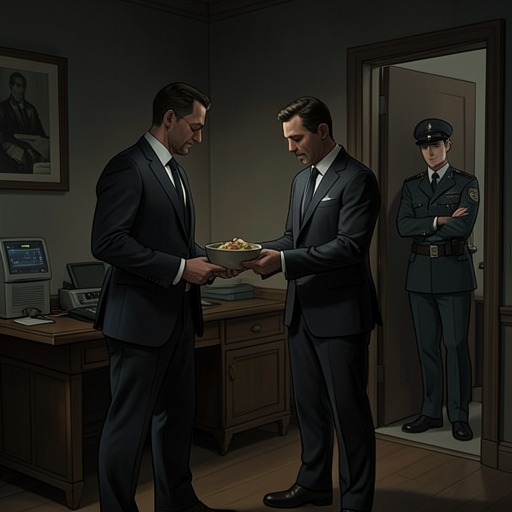
The ration card makes those limits visible at the point of purchase. Mickey Barnes checks his balance through his ocular at the cafeteria counter and finds that Mickey8 has already used 600 kilocalories. With only 450 kilocalories left on another day, he recognizes that 300 are owed to Mickey8 under their arrangement; using the remainder for himself would break that deal. The possibility of reporting their duplicate existence to Command does not offer an easy remedy: by then, both fear discovery would lead to their disassembly and conversion into slurry. Their food agreement is thus shaped by hunger, secrecy, and the absence of a safe appeal.
The contrast between the account balance and the meal in front of them sharpens the rule’s effects. At one late-shift dinner, Mickey Barnes drinks a half-full mug of cycler paste while Cat Chen eats roasted tomatoes and a rabbit haunch. Later, with only 300 kilocalories available, he orders paste rather than the yam-and-tomato scramble Cat selects. His remaining balance permits another half mug before bed, but not the more appealing food on display. These moments show the policy operating not as an abstract daily total but as a repeated calculation over meals, portions, and what must be left uneaten.
Cuts as discipline
Command also uses ration allowances to penalize conduct. After the recent activities of Mickey Barnes and Berto Gomez have removed nearly 300,000 kilocalories from the colony’s energy budget, Hieronymus Marshall states that the resulting loss will require further ration reductions until agriculture reaches full production. He rules that the two men should bear the brunt and permanently docks each of their ration cards by 20 percent. The decision makes a colony-wide resource shortfall into a targeted sanction: the loss is attributed to the pair, and their private allowances are cut on grounds of equity.
Berto Gomez later receives a further 10 percent reduction after a dispute involving his wager, the ration transfers he used to cheat members of Security Section, and a fight in the cafeteria. Marshall also orders Berto to cover Nasha’s shifts aloft as well as his own for five days and blocks his ability to accept transfers from other personnel. The punishment therefore reaches beyond the number on the card: it combines reduced food, extra work, and a restriction on the informal movement of rations between colonists. When Mickey8 objects to the additional cut, Mickey Barnes treats it as a shared burden, insisting that it affects them both rather than only one of them.
The policy’s social force
Because rations are scarce, allocation carries a practical expectation of fairness as well as a formal administrative rule. People depend on fixed daily limits, work-related adjustments, and, in some cases, agreements to divide a shared balance. Transfers can help someone eat, but they can also be used to manipulate others; Command’s response to Berto includes preventing further transfers. A cut imposed on individuals can therefore reach into relationships and informal support, while the colony’s food shortage gives each deduction consequences beyond the disciplinary message.
The policy also helps explain why survival on Niflheim is measured in small, concrete units: a 20 percent dock, 300 kilocalories owed, a mug of paste, or the difference between a 1,400-kilocalorie base and a 2,000-kilocalorie heavy card. The colony’s recycling system can reclaim material and the engine can provide energy, but neither can guarantee that crops will grow. Until the agricultural base becomes productive, the ration card remains both a ledger of limited food and an instrument through which the colony assigns obligation, hardship, and blame.