Beachhead Colony Rationing System
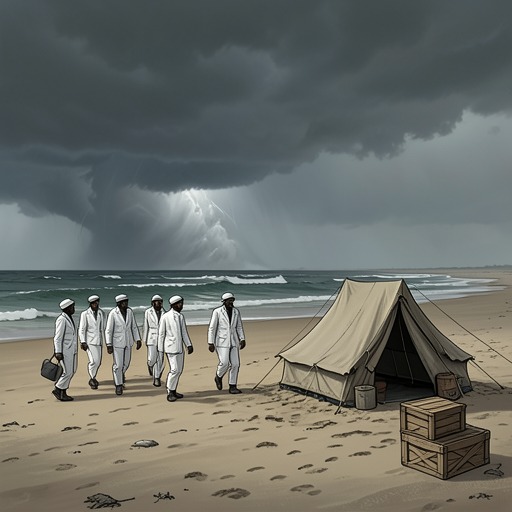
Mickey7The Beachhead Colony Rationing System governs access to food when a new settlement cannot yet reliably feed itself. Its basic logic is stark: colonists arrive with finite provisions and must make them last until local production works. On Niflheim, where crops struggle even inside hydroponic tanks, rationing is not a temporary administrative detail but a daily measure of the colony’s vulnerability. Its rules determine who eats, how much, and who bears the cost when the food supply contracts.
Settlement Logic and the Base Allowance
The system’s rationale is explained through the history of human settlement across the Pacific. Micronesian voyagers crossed wide stretches of ocean in small canoes, carrying what provisions remained after the journey while waiting for a new island to provide food. A beachhead colony faces a similar interval, scaled up to interstellar distances: its stores must bridge the gap between landing and a harvest that may never come. Colonists cannot be certain that the crops they brought will grow at their destination, so the settlement begins with scarcity built into its expectations.
At Niflheim, the initial ration was 1,400 kilocalories per day as a base allowance. Bonuses depended on current lean body mass and work schedule, tying allocation both to a colonist’s body and to their assigned labor. The guiding beachhead maxim that there are no fat people in such settlements condenses the physical consequence of this arrangement: weight and food availability are connected, and the colony has little room for surplus consumption.
That baseline did not remain stable. Rations were reduced twice after landing because the hydroponics tanks were struggling to grow anything, for reasons the colonists could not explain. The prospect of growing food outside the dome was also a serious long-term challenge. On Niflheim, local microbiota seemed to interfere with crops grown inside as well, so the system had to distribute less food while the agricultural problem remained unresolved.
Food, Recycling, and Material Limits
Rationing is part of a larger survival infrastructure. A beachhead colony’s Biological recycler processes waste, plant matter, animal remains, and eventually corpses, returning protein paste, vitamin slurry, and fertilizer. Its corpse hole feeds material into a disassembler that breaks it down into component atoms before reassembling them as specified. The process consumes enormous energy, but the colony’s antimatter-powered engine initially provides energy in abundance. Recycling can sustain a desperate colony for a long time, although it does not make the shortage disappear: paste is a fallback food, not evidence that agriculture has succeeded.
The colony’s dependence on recycling also exposes a tension in how it values people and machinery. Mickey Barnes accepted the Expendable role knowing that dangerous work could kill an individual incarnation, but the colony uses people for tasks that can be more dangerous to machines, including work involving lethal radiation and medical experiments. On a beachhead, a human Expendable can be easier to replace than a mech, while the materials needed to make another incarnation depend on an agricultural base that the colony has not yet established. Food production, replacement labor, and the settlement’s material limits are therefore bound together.
Ration Cards During the Multiple Crisis
The shortage becomes immediate when Mickey Barnes and Mickey8 must reckon with two versions of the same person living on one colony’s provisions. The two have a heavy ration card that provides 2,000 kilocalories a day between them. Dividing that allowance evenly would give each 1,000 kilocalories: enough, they calculate, to stay alive for a while, but not to live comfortably. They consider asking Berto Gomez for help, though they doubt how willing he would be to share food or how strongly he would object to multiple instances. They also consider asking Marshall for a larger allowance, an option Mickey Barnes treats as implausible.
A discounted supply of protein paste offers a possible way to obtain more actual nutrition from their allotment. If they eat nothing else, the calculation is 1,250 kilocalories each. Even that compromise leaves their central problem untouched. Mickey Barnes expects Marshall to regard the existence of two Mickeys as unacceptable, and fears that discovery could lead to the Biological recycler. The ration card, in this case, is both a limit on what the pair can consume and a measure of whether they can remain undiscovered.
The figures continue to shift as the situation worsens. After further reductions, Mickey8 complains that the allowance has fallen to 720 kilocalories each and says that he has not eaten a single bite of solid food since emerging from the tank. Later, while reading about the ethical and religious objections to creating expendables, Mickey Barnes checks the card and finds 450 kilocalories left for the day. Under an agreement with Mickey8, 300 of those belong to him. The arithmetic makes their arrangement concrete: even a shared ration is not simply a common resource, but a negotiated claim between two people in a colony with too little food.
Discipline, Fairness, and Consequences
Rationing also becomes a means of imposing penalties. Marshall tells Mickey Barnes and Berto Gomez that their recent activities have removed nearly 300,000 kilocalories from the colony’s energy budget. Because agriculture is not yet operating at full production, he argues, the resulting loss requires another reduction in rations and that the two men should bear its brunt. He rejects Berto’s attempt to respond and permanently docks both ration cards by 20 percent. The decision makes the language of equitable burden-sharing inseparable from command authority: the ration system distributes scarcity, but it can also assign blame for it.
A later dispute shows how reductions reach beyond the two Mickeys. When Mickey8 protests another 10 percent cut, Mickey Barnes distinguishes the person administering it from the person he considers responsible, blaming Berto for depriving half the Security Section of rations and striking one of its members in the cafeteria. Mickey8, meanwhile, says he cannot manage on the reduced amount. These scenes do not present food allocation as a neutral calculation. They show a policy whose effects pass through disputes over responsibility, retaliation, and whose needs count.
The ration system’s pressure is sharpened by the colony’s prohibition and taboo against multiple instances. Even apart from that objection, a second Expendable means another mouth at a time when the hydroponics are failing and the colony has already cut its allowances. The resulting conflict cannot be settled by producing an extra ration card alone: the two Mickeys must weigh sharing, concealment, and the risk that Marshall will send them to the recycler. The Beachhead Colony Rationing System thus gives material form to the settlement’s most basic constraint. Food is a daily allowance, a consequence of agricultural failure, and a lever of authority; every reduction turns the colony’s uncertain future into an immediate question of who gets to eat.