Prohibition on Multiples
Mickey7The Prohibition on Multiples bars more than one living instance of the same person, turning a capability of the Bio-printer into a capital crime and a deep social taboo. Its history is inseparable from Alan Manikova’s conquest of Gault: what might have looked like a practical way to multiply expendable labor became, in public memory, a means of mass violence. On Niflheim, the accidental existence of two Mickey Barnes instances makes the rule immediate and intimate, revealing how swiftly a prohibition justified by collective survival can become a demand for execution.
Definition and Historical Background
The rule addresses simultaneous copies, not the mere fact that a person can be recreated after death. The account of the Expendable system assumes that one body may die and another version may be printed from a stored pattern; the crisis arises when two instances coexist. That distinction is central to the rule’s practical meaning: replacement is treated as a function of the system, while concurrent existence is an intolerable violation.
The prohibition’s historical weight comes from Alan Manikova’s actions on Gault. A Bio-printer had been invented long before the launch of the Ching Shih, but Manikova brought the technology into a setting where it could be used at scale, along with advanced military technology he did not share with the people around him. About nine months after using up the feedstock he had brought, he had nearly a hundred copies of himself and had built two more replication units. His first victims were indigent people and loners; when those ran out, he began taking people whose absences would be noticed by family and friends.
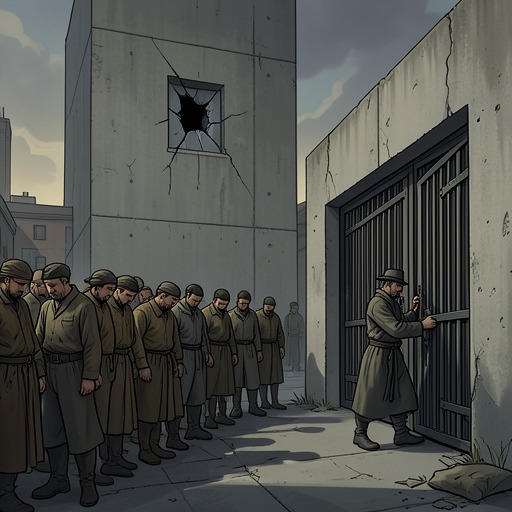
When the clan hosting Manikova sent Security forces to question him, they discovered that his gifts of seeds and trinkets had concealed a more consequential refusal: he had not shared his military technology. Manikova put every member of the host clan into the Bio-printer’s feedstock, reproduced them as copies of himself, armed the resulting force, and attacked a neighboring clan. The other clans did not unite against him until nearly a year later. By then, Manikova had become an absolute majority of Gault’s human population. Their eventual resistance came too late to reverse his advantage; the last clans managed to send a desperate message to Eden.
From Atrocity to Social Taboo
The remembered catastrophe extends beyond the immediate violence on Gault. Farhome is not blamed for what happened; blame falls on Manikova. The planet’s destruction as a ball of molten slag is described as the Union’s greatest historical crime, while turning one of the few habitable worlds into that ruin helps explain why the episode became a lasting warning. The association is not simply between copies and technical danger, but between multiplication, stolen bodies, military domination, and planetary loss.
That history gives the prohibition an unusually visceral social force. The account contrasts the reaction to being a multiple with the stigma attached to crimes such as child-stealing or collecting human heads: in most parts of the Union, being a multiple is considered worse. This is more than a legal classification. Public horror has become part of the rule’s enforcement, so that the mere discovery of multiple instances can make a person seem monstrous before the circumstances of their creation are considered.
The Expendable System and the Cost of Copies
The rule operates within a society that already treats the Expendable’s body as a resource for dangerous work. Before accepting the position, Mickey Barnes is told that an assignment could expose him to a lethal dose of radiation. He assumes he could end his life and wake as a new version, but Gwen Johansen warns that most Expendables do not kill themselves, despite the availability of that option. During medical experiments or exposure to local microbiota, command may require an Expendable to survive until it has collected the necessary data. The ordinary promise of replacement therefore does not guarantee control over the timing or manner of death.
The colonial setting also makes the material cost of an additional body explicit. On Niflheim, the colony is close to starvation, and Marshall says that the two Mickey Barnes instances have consumed seventy kilos of vital calcium and proteins. He treats that depletion as a reason to set aside the question of whether the duplication was deliberate. The rule is thus invoked not only as protection against a repeat of Manikova’s military accumulation, but also as a response to immediate competition for scarce biological resources. A second body is both a prohibited person and a substantial claim on a colony’s stores.
Enforcement on Niflheim
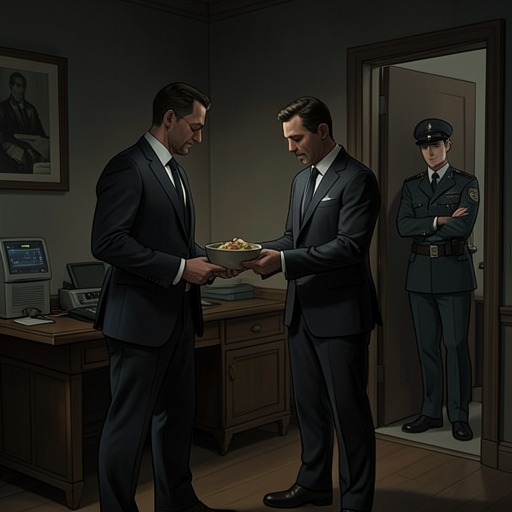
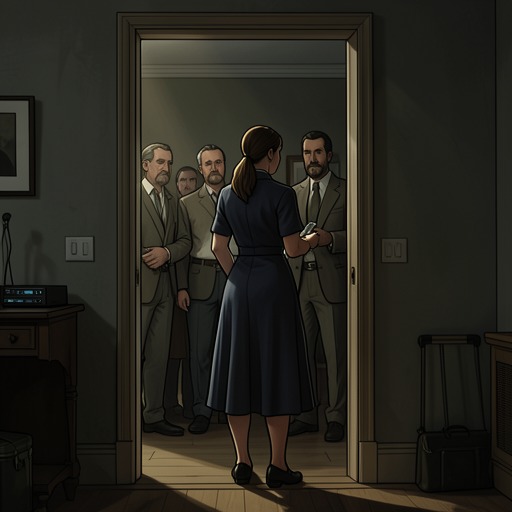
Nasha Adjaya identifies the duplication as a capital offense for everyone involved and asks how the Biology Section could have made a multiple. Mickey Barnes denies requesting it, says he knows the law, and explains that it was a mistake. His account does not make the existence of two instances permissible, but it distinguishes an accidental duplication from Manikova’s deliberate program of coercion and conquest. The distinction matters to the people involved, yet it does not soften the authorities’ initial response.
When Mickey Barnes and Mickey8 argue that the colony needs both of them and that they could be twice as useful, Marshall rejects utility as a defense. He cites both the stolen nutrients and the failure to return one instance to the Biological recycler as soon as the duplication became known. He also condemns the two instances for having relations with one another, treating that fact as an additional source of revulsion rather than as a separate question about the rule’s stated purpose. He then declares both of them destined for the recycler and frames the remaining decision as whether there will be a ninth iteration and whether Nasha should be sent down the corpse hole with them.
The Niflheim confrontation exposes a stark imbalance: the prohibition is presented as a defense of human survival, yet it permits the colony’s command authority to decide which instance may continue and whether those who know about the duplication should die with them. The crisis therefore turns on more than the abstract status of copies. It pits the rule’s inherited fear of mass replication against an accidental case, the colony’s material desperation, and the immediate claim of two living people to be treated as more than a disaster already named in history.