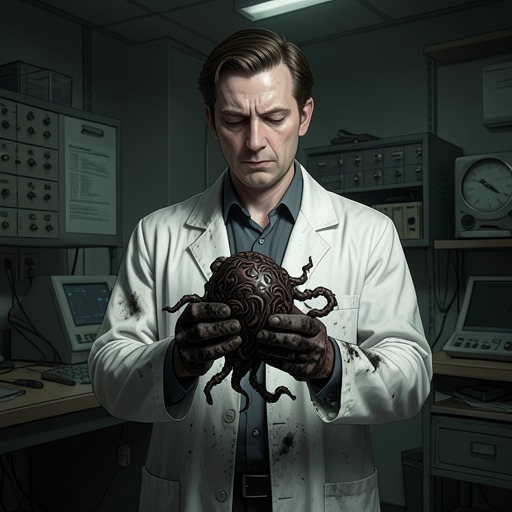
Restriction on Expendable Self-Termination During Experiments
Mickey7The Restriction on Expendable Self-Termination During Experiments governs a stark limit on an Expendable’s ability to use backup as an escape from a lethal assignment: when a test requires observing the full course of an exposure, command may require the Expendable to remain alive until data collection is finished. The practice turns a technology that appears to make death temporary into a means of extending the experiment, subordinating the individual’s immediate welfare to what the colony needs to learn.
Definition and Scope
The restriction is presented as an operational practice rather than as a separately described written law. Its clearest application is to medical experiments and exposure to local microbiota. In those cases, premature euthanasia would end the observation before command knew the biological effects, so an Expendable might have to endure the process through its final stages whether or not he wished to continue.
The recruiter, Gwen Johansen, also warns Mickey Barnes that the work could include deliberate exposure to a lethal dose of ionizing radiation. She describes a possible progression of fever, skin rashes, blistering, and failing internal organs over several days. That example establishes the bodily stakes of the job, while her later explanation makes the experimental boundary explicit: a backup does not guarantee that an Expendable can choose when the current body’s suffering ends.
The Backup Assumption and Its Limits
Mickey initially assumes that, after being irradiated, he could kill himself, take a pill, and wake as a new version. He understands backup as a way to cut short a drawn-out death. Gwen corrects that expectation: most Expendables do not kill themselves, despite the apparent logic of doing so. In her account, training lectures cannot readily overcome the deeply ingrained instinct for self-preservation.
Even if an Expendable were willing to die by choice, that choice could conflict with the purpose of a test. Gwen explains that an experiment cannot be short-circuited by premature euthanasia when command needs to see what the exposure does. The restriction therefore rests not only on the Expendable’s reluctance to end his own life, but also on the expedition’s demand to retain the subject until the observation is complete.
Colonial Need and the Expendable’s Body
The rule belongs to a colony system in which dangerous work is assigned according to what bodies and equipment can withstand. Mickey has signed up for external repairs, exposure to local life, medical experiments, and combat, but he has not fully grasped how frequently beachhead work will call for such risks. On Midgard, remote machines handled some hazardous exploration; on a beachhead, human bodies can tolerate certain dangers longer than mechs, and some medical procedures cannot be performed on a mech at all.
Replacement economics reinforce that dependence. Before heavy industry and mineral extraction are established, lost metal cannot readily be recovered, while the raw materials needed to make another Expendable are, in principle, available once agriculture is operating. On Niflheim, however, agriculture is itself uncertain: the climate makes outdoor growing difficult, and local microbiota interfere with crops inside the dome. The Expendable’s supposed replaceability is thus both a practical rationale for risking him and a precarious promise dependent on a colony that has not yet secured its food supply.
Ethical and Narrative Significance
The restriction makes the difference between replacement and consent consequential. Mickey signs after hearing a long list of potentially fatal duties because passage off Midgard is his only viable route out; he acknowledges the risks but expects backup to spare him the worst of them. Gwen’s explanation reveals that the colony may need not merely his labor or his eventual replacement, but the prolonged course of what happens to the body already undergoing the test.
That arrangement gives experimental knowledge a direct human cost. The colony’s need to identify hazards in Niflheim’s microbiota is presented as a first-order requirement for human health, yet the method is to expose its Expendable to whatever can be isolated and wait to see what happens. The restriction names the point at which that wait becomes compulsory: the data must be complete before the subject can leave the experiment, even when the subject’s backup makes death appear, from the outside, to be easily reversible.