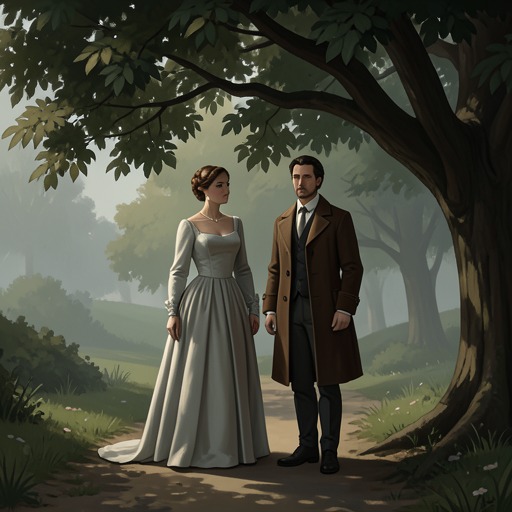
Dorothea Brooke and Will Ladislaw’s marriage
MiddlemarchDorothea Brooke’s marriage to Will Ladislaw turns a choice condemned by much of her family into the basis of a life shaped by love, public purpose, and mutual commitment. She gives up the position and fortune that would have been hers under Edward Casaubon’s will, but the conclusion presents the marriage not as a sacrifice she regrets, but as a bond that enables her to live by her convictions and support Will’s work.
Background: Marriage and Unequal Expectations
The marriage answers, in part, the expectations that had governed Dorothea’s first marriage. Edward Casaubon had believed that a young, religious, intelligent wife could serve as the appreciative helper his scholarship required, even allowing him to dispense with a hired secretary. His assumptions reflected a social model in which a wife’s abilities were valued for their service to her husband, while her own prospects received little consideration. The narrator emphasizes this imbalance: Casaubon carefully considered what he wanted in a wife without asking whether he could make her happy.
That earlier model of marriage also throws the later choice into relief. At the start of her relationship with Will, Dorothea’s acceptance of Casaubon had seemed to him the beginning of the domestic happiness he had long anticipated. By the end, Dorothea’s decision to marry Will is not an attempt to fulfill another man’s plan for her. She acts with knowledge of the loss attached to the choice and insists on it despite warnings that she is making another mistake.
Decision and Family Opposition
When Mr. Brooke tells the family that Dorothea is going to marry Will, Sir James Chettam reacts with anger, and Mrs. Cadwallader immediately asks whether the intended husband is Ladislaw. Mr. Brooke explains that Dorothea summoned him to Lowick the previous day and that the decision had come about suddenly: neither Dorothea nor Will had expected it two days earlier. He says he had stated his objections and done what he considered his duty, but Dorothea was determined and could act as she wished.
Celia’s opposition is more intimate and anxious. She argues that Dorothea should not marry again, invoking her sister’s earlier declaration that she would remain unmarried, and says the family does not consider Will a suitable husband. Dorothea does not deny that she might have acted more wisely or achieved something better under different circumstances. She nevertheless makes her decision plain: she has promised to marry Will and will do so. When Celia asks whether Will loves her, Dorothea answers that she hopes he does and that she loves him deeply. Her resolve does not depend on winning the family’s approval first.
The Cost and Meaning of the Choice
The marriage carries a material cost as well as a social one. Dorothea gives up position and fortune by marrying Will, in the shadow of Casaubon’s will and its restriction on her marriage to him. The family’s discussion recognizes that the will has made matters worse, but the consequences do not change Dorothea’s decision. She does not later regret giving up the inheritance, and Will would have regarded such regret as a source of profound sorrow and shame.
The novel’s ending describes the couple as bound by a love stronger than impulses that might have damaged their relationship. Dorothea’s life, the narrator says, needed to be filled with emotion; it is now also filled with beneficent activity. She no longer faces alone the difficult task of identifying and defining a useful course for herself. In this marriage, emotional attachment and practical purpose are joined, though Dorothea’s contribution is not treated as a separate public career of her own.
Shared Life and Narrative Significance
Will becomes an ardent public figure, works for reform, and is eventually returned to Parliament by a constituency that pays his expenses. Dorothea welcomes his involvement in political struggle and wants to help him as his wife. Their partnership therefore gives her a meaningful part in public life, while also exposing a limitation in how others understand her: some believe it a pity that a rare and substantial person should be absorbed into another’s life and known mainly as a wife and mother. Yet even Sir James, despite his opposition to the marriage, cannot specify what Dorothea should instead have done.
The marriage completes neither a simple fairy-tale resolution nor a return to the fortune and rank Dorothea relinquishes. Its significance lies in the life the couple builds with the resources they retain: their affection endures, Will serves reform, and Dorothea supports the work she believes matters. The family’s eventual reconciliation follows through correspondence and Mr. Brooke’s invitation to the couple at the Grange, showing that the initial anger does not become permanent estrangement.