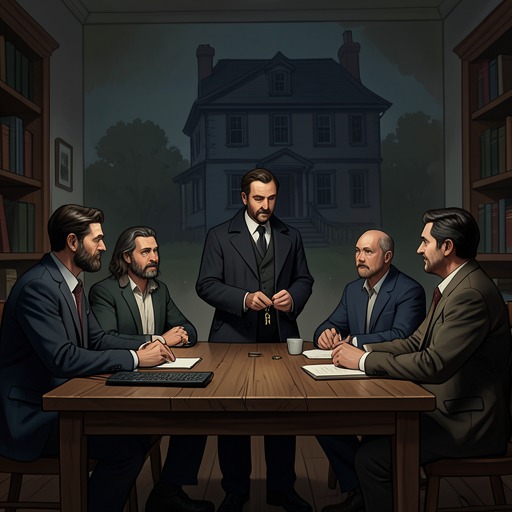
Mary Garth refuses to alter Featherstone’s will
MiddlemarchMary Garth refuses to alter Peter Featherstone’s will at the moment when his secrecy, family anxiety, and imminent death converge. He asks her to open his iron chest and remove a will he intends to burn; she refuses, rejecting both the keys and his offer of money. Her decision keeps her from becoming entangled in a potentially compromising act and makes her the sole witness to the private struggle that precedes the public reading of Featherstone’s testamentary papers.
The request in the night
Featherstone’s behavior that night contrasts with the habitual hostility Mary has endured while serving him. He has often snapped at her, and she has remained faithful without pretending to feel a pious concern for a man whose life appeared to her to be little more than a remnant of vice. On this night, however, he lies unusually still before she hears him rattle the keys kept with a tin box beside his bed. Around three in the morning, he calls her over. He has drawn the box from beneath the bedclothes himself and chosen its key, displaying a sharpness and initiative that make clear he is directing the encounter rather than asking for ordinary assistance.
Featherstone asks how many of his relations are in the house. Mary understands his indirect way of speaking and tells him that Solomon Featherstone and Mrs. Waule are there every day, while the others visit often. He dismisses their presence as foolishness and insists that he still possesses all his faculties, knows his property and where his money is invested, and has made everything ready to change his mind at the end. His insistence that he is fully competent makes the coming action a deliberate assertion of control over his affairs, not simply a confused request from a dying man.
Refusal and temptation
Featherstone says he has made two wills and is going to burn one. He gives Mary the key to the iron chest in a closet and explains how to release its catch by pressing the side of the brass plate before turning the key in the front lock. He instructs her to take out the topmost paper, marked as the last will and testament. The precision of the directions places Mary in a consequential position: carrying them out would make her an active participant in the private handling of a document whose destruction could affect the claims of everyone waiting for the inheritance.
Mary answers firmly that she cannot do it. When Featherstone insists that she must, she states the reason plainly: she cannot touch the chest or the will because the act might expose her to suspicion. His insistence that he is in his right mind and entitled to do as he wishes does not remove that danger for her. The scene turns on a conflict between his claim of personal authority over his property and Mary’s refusal to take an action that would implicate her in secret interference with a will.
Her decisive explanation is that she will not let the close of his life soil the beginning of hers. She moves away from the bedside rather than yield to his command. Featherstone stares blankly, still holding up the key, then begins hurriedly emptying the tin box with his bony left hand. His change from command to pleading is a visible reversal: he stretches the key towards Mary and offers her the notes and gold, telling her to take everything if she will do as he asks. She retreats again and refuses both the key and the money. She warns that if he asks her once more, she will call his brother.
A secret witness to the wills
Featherstone drops his hand and begins to cry, a response Mary has never seen from him. She asks him to put his money away and returns to her place by the fire, hoping that her withdrawal will end the pressure. He rallies and asks her to call Fred Vincy instead. Mary’s heart beats faster as she considers what the burning of a second will might mean. She proposes that she call Jonah and the others too; Featherstone refuses, insisting on Fred alone and repeating that he will do as he likes.
Mary’s decision is difficult because she does not know what the destruction of one will would signify, while the old man is pressing her to act without witnesses. Her refusal is not a revelation of the inheritance’s final distribution; it is a refusal to assume responsibility for an opaque and potentially consequential intervention. At the eventual reading, no one else knows what passed on that last night. Mary recognizes that she has virtually determined whether a second will would be produced, and understands that the choice could have momentous consequences for those present.
The public reading and the act’s significance
At the reading, Mr. Standish identifies three documents: an earlier will executed on 9 August 1825, a later instrument dated 20 July 1826 that had been unknown to him, and a codicil to the later will dated 1 March 1828. He begins with the earlier will because Featherstone had not destroyed it. The dates and documents make public the history of changing intentions that Mary had confronted in private, but the evidence does not establish that her refusal alone determined the contents or legal outcome of the papers. What it does establish is that she remained outside the secret manipulation Featherstone attempted, while carrying knowledge of the night that the gathered relations lacked.
The episode places moral caution beside the uncertain formal authority of a dying man’s wishes. Featherstone invokes his faculties and his right to change his mind; Mary measures the requested deed by the suspicion it could cast on her and by the consequences she would have to live with after his death. Her refusal is therefore both practical self-protection and a clear boundary: money cannot turn her into an accomplice, and a testamentary decision made in secrecy is not hers to execute. The quiet scene also sharpens the contrast between private knowledge and public procedure: Mary knows the circumstances of Featherstone’s request, while the family and Mr. Standish encounter the competing documents only when they are read aloud.