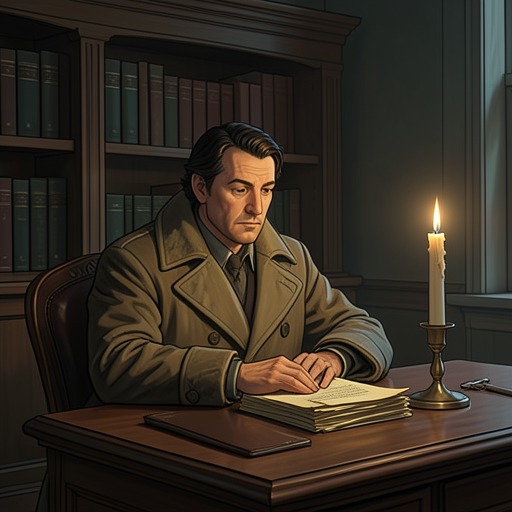
Dorothea rejects the task of completing Casaubon’s Key to All Mythologies
MiddlemarchDorothea rejects the task of completing Edward Casaubon’s Key to All Mythologies, refusing the intellectual bequest through which he had sought to bind her after his death. Her decision is not a simple repudiation of him: pity had once made her ready to honor her promise, and she continues to order his papers with care. But the discovery of secrecy and suspicion in their marriage changes the meaning of that promise. At Lowick Manor, she gives the notebooks their imagined order and then seals away the Synoptical Tabulation, acknowledging that she cannot devote herself to work she does not believe in.
The Bequest and Its Uncertainty
Before examining Casaubon’s papers, Dorothea considers the appointment of a successor to the living at Lowick. She tells Mr. Brooke that, since she never heard Casaubon name a clergyman after Mr. Tucker had been provided for, she ought to inspect the papers for an indication of his wishes. Mr. Brooke dismisses the need for haste and says he has already looked through the desks and drawers. He has found nothing concerning the rectory, and recommends Mr. Tyke instead. Dorothea asks for fuller knowledge so that she may judge for herself; her attention is also fixed on the possibility that Casaubon left instructions about his research.
Mr. Brooke assures her that the will contains nothing about either the rectory or the researches. Dorothea’s lip quivers. The assurance does not settle what she needs to know: at Lowick, she searches the desks and drawers for private writing and finds no paper addressed especially to her, except the Synoptical Tabulation, apparently only the beginning of directions he had intended to provide. The search thus exposes the gap between the scale of the work Casaubon hoped to transmit and the scant, unfinished guidance he actually left.
A Promise Made Under Pity
Casaubon had hesitated over how to pass his research on, burdened by doubts about Dorothea’s competence and by distrust of any other person who might edit it. In the end, he relied on her determination: she could do what she resolved to do. He imagined her laboring under a promise to erect a lasting monument to him through the future volumes of the Key to All Mythologies. His plans, however, had fallen behind the time available to him. He had managed only to obtain a promise that would keep a claim on Dorothea’s life.
That claim might once have been enough. Bound by a pledge made from pity, Dorothea would have been capable of undertaking a labor she judged useless for any purpose except the consecration of faithfulness. The distinction matters: she did not need to believe in the scholarly work in order to regard keeping her word as a supreme duty. Casaubon’s death removes the living sufferer whose presence had awakened her pity, while the retrospective discovery of secrecy and suspicion alters her understanding of the marriage in which she made the pledge.
The Refusal at Lowick Manor
By the end of June, Dorothea has opened the shutters at Lowick Manor. She walks through its rooms, turning the eighteen months of her married life over in her thoughts as though addressing Casaubon. In the library, she carefully arranges the rows of notebooks in the order she imagines he would have wished. Her care for the papers survives even as she inwardly remonstrates with him and calls him unjust: pity still clings to his image, but it no longer dictates what she must do.
She gives the clearest form to her refusal in a private act. Dorothea encloses the Synoptical Tabulation in an envelope, seals it, and writes that she could not use it because she could not submit her soul to his by working hopelessly at something in which she had no belief. She places the paper in her own desk. The gesture does not destroy Casaubon’s research or treat his papers carelessly; it preserves the document while marking a boundary between his projected labor and her independent judgment.
Property, Justice, and the Cost of Release
Her refusal of the scholarly task does not make the questions surrounding Casaubon’s property disappear. Dorothea would be glad to be free of it and to have no more than her original fortune, but she recognizes that ownership brings duties she ought not avoid. She continues to ask herself whether half the property ought to have gone to Will Ladislaw, whose moral claim she had discussed with Casaubon. Yet his will has made that act of justice difficult: even while indignant at Casaubon, she recoils from doing anything that would appear to triumphantly evade his purpose.
After gathering business papers she wants to examine, Dorothea locks the desks and drawers again. They are empty of personal words for her: there is no sign that Casaubon’s heart had gone out to her in explanation or apology. She returns to Freshitt with the silence around his final demand and assertion of power still unbroken. The rejection of his research bequest therefore resolves one obligation without resolving the others. She will not make her mind the instrument of his unfinished project, but she remains entangled in the moral consequences of the property he left and the injury his will does to Will.
The Refusal’s Significance
Dorothea’s choice distinguishes fidelity from submission. Her earlier willingness to work on the Key had rested on compassion and a promise, not on confidence in its intellectual value; after Casaubon’s death, she can recognize that devotion does not require the surrender of her judgment. The sealed tabulation holds both sides of the decision together: it is preserved as part of her husband’s papers, yet put away as work she cannot honestly undertake.
The act also refuses a false resolution. Dorothea does not emerge unburdened, secure in the justice of every choice, or reconciled to Casaubon’s final exercise of power. Her uncertainty about Will’s claim and her sense of duty toward the property remain. What changes is the authority governing her labor: Casaubon’s hope that a pledge would secure her toil no longer decides what she must do. At Lowick, care for his memory and resistance to his claim coexist, and the refusal becomes the first clear expression of a judgment that pity can no longer override.