Lydgate Refuses the Hospital Plan and Resolves to Leave Middlemarch
MiddlemarchLydgate’s refusal of the hospital plan turns a professional crisis into a moral reckoning: with his reputation damaged and his future uncertain, he declines Dorothea’s offer to preserve his work in Middlemarch, insists that the new hospital proceed without him, and resolves to leave rather than accept support he considers unearned. His choice is neither confidence restored nor simple surrender; it is an attempt to remain answerable for what he can and cannot promise, even as he sees his medical vocation narrowing under the pressure of public suspicion and financial need.
The hospital and the work he hoped to do
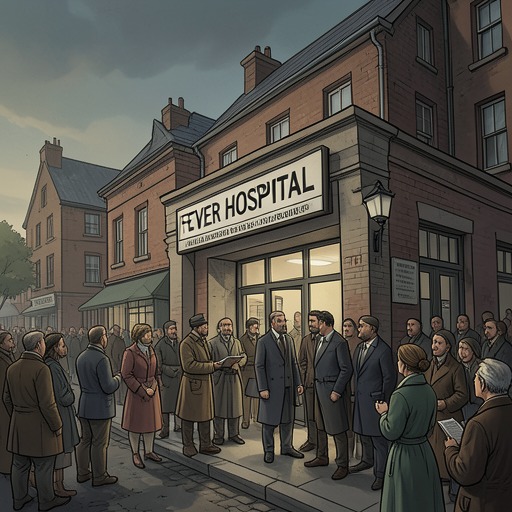
When Nicholas Bulstrode first invites Lydgate to discuss the management of the nearly finished hospital, he presents it as a substantial public undertaking. Lord Medlicote has supplied land and timber, but Bulstrode says that responsibility for the decision rests with him. Lydgate sees a special fever hospital not as a building alone, but as a possible foundation for a provincial medical school and for medical reform beyond London. His early professional ambitions therefore join scientific inquiry to a local institution: the hospital could make knowledge useful where patients lived, rather than drawing every opportunity toward the capital.
That hope is part of a larger conviction about medical practice. Lydgate intends to prescribe without dispensing medicines or taking a percentage from druggists, despite knowing that the reform will offend colleagues accustomed to the country-town system. He regards removing this financial temptation as a practical safeguard for acting according to his beliefs. His research ambition is similarly reformist: around 1829, he imagines pathology as a territory still open to discovery, and the study of bodily tissues as a means of clarifying disease and treatment. The hospital plan belongs to this same effort to unite better knowledge, ethical practice, and public usefulness.
A doctor tested by uncertain knowledge
Lydgate’s early work in Middlemarch shows both his willingness to act on clinical judgment and the social cost of doing so. When called to see Fred Vincy, he identifies the illness as typhoid fever, judges that the medicines already given are wrong, and orders immediate bed rest, a regular nurse, and other precautions. He acknowledges the awkwardness of intervening in Mr. Wrench’s established practice, but Fred’s condition makes delay more serious than professional etiquette.
Nancy Nash’s case brings a different kind of conflict between diagnosis and reputation. Dr. Minchin has described her condition as a tumor and recommended her as an Infirmary outpatient. Lydgate examines her and tells the house-surgeon that it is cramp, then prescribes a blister and steel mixture and sends a note to her employer asking that she receive good food. When Nancy becomes much worse, he attends her at home for a fortnight, until she recovers and returns to work. Yet local report continues to frame the case as a tumor dramatically cured. Minchin avoids acknowledging his mistaken diagnosis, while Mr. Wrench joins him in criticizing Lydgate’s breach of professional etiquette. Lydgate does not turn the episode into an occasion for self-congratulation or contempt for Minchin; nevertheless, the inaccurate story brings him public prestige of precisely the sort he mistrusts, and helps overcome prejudice against his methods without making those methods understood.
His treatment of Borthrop Trumbull makes the uncertainty of reform especially visible. Lydgate uses an expectant approach, watching pneumonia develop rather than intervening heavily with drugs, and invites Trumbull to regard his illness as a contribution to medical science. The patient consents, taking encouragement from the thermometer, the possibility of observation under the microscope, and Lydgate’s technical explanations. Such episodes show the promise of Lydgate’s practice, but also its dependence on trust, interpretation, and a community willing to distinguish deliberate observation from neglect or impropriety.
Refusing Dorothea’s proposal
In the later crisis, Dorothea tries to keep Lydgate’s professional future from being decided by Middlemarch’s suspicion. She suggests that, if his wife knew that friends believed in and supported him, she might be glad for him to remain at his post and recover his hopes. Dorothea links that personal reassurance to the hospital: if Lydgate still believes it can make his knowledge useful, she hopes he will agree to continue there. She allows him several days before she sends her answer to Bulstrode, leaving room for him to reconsider.
Lydgate will not accept the interval. He says that he is no longer sure what he can do under the altered circumstances of his life, and that it would be dishonorable to let others make a serious commitment depending on him. He asks that the new hospital be joined with the old Infirmary and that the undertaking go forward as though he had never come to Middlemarch. His kept register, a record of work already done, will be sent to someone who can use it. The practical decision thus separates the institution’s future from his own: he relinquishes the post rather than allow the hospital to depend on a promise he may be unable to fulfill.
The refusal also exposes how he understands the proposed aid. Dorothea says that sharing some of her money until he can escape his need for income would relieve her, not burden her. Lydgate rejects the offer because he believes he has not given sufficient guarantees and must not become a pensioner for work he has not achieved. His concern is not merely whether assistance is generous; it is whether accepting it would make his livelihood rest on an accomplishment he does not believe he has secured. He sees departure as the necessary way to make changes and earn money, however compromised he expects that course to be.
Leaving, and asking to be believed
Lydgate describes the alternatives he expects outside Middlemarch in deliberately unflattering terms: he may seek an opening in London, establish himself in a fashionable watering-place, or go to a southern town with many idle English visitors and get himself advertised. He calls this a shell in which he must try to keep his soul alive. The image contrasts the outward tactics required for an income with the inward purpose that originally drew him to scientific medicine. Dorothea calls the decision to give up the fight unbrave. Lydgate does not deny her judgment, but compares his fear to creeping paralysis: he is afraid that the defeat will spread until no initiative remains.
Her belief nevertheless changes the immediate weight of that prospect. Lydgate tells Dorothea that speaking with her has made everything more bearable and asks her to clear him in other minds, especially Farebrother’s. He does not ask her to explain away the fact that he disobeyed his orders; he fears that detail would quickly be distorted. In his view, there is no evidence available to him except other people’s prior opinion, and Dorothea can only repeat his account of himself. Her offer is therefore moral and social rather than institutional: she can testify that it would be absurd to suppose he had accepted a bribe in order to do wrong.
Lydgate remains uneasy even about that defense. He says that he has not taken a bribe, but warns of what he calls a pale shade of bribery sometimes named prosperity. The remark connects his fear of financial compromise to his earlier refusal to profit from dispensing medicines: in both cases, money can quietly alter the terms on which professional conduct is judged. He leaves the conversation resolved to seek income elsewhere, but not wholly cut off from the work or people he values. Before parting, he asks Dorothea to visit his wife. His hospital service and provincial ambition have been abandoned, yet the appeal to Dorothea preserves a narrower hope—that trust may survive even when public reputation and professional plans do not.