Ahab–Fedallah alliance
Moby-DickThe Ahab–Fedallah alliance is the Pequod’s hidden center of power: a partnership between Captain Ahab, whose obsession commands the ship, and Fedallah, the mysterious Parsee whose presence seems to bind prophecy, secrecy, and violence to that obsession. Fedallah does not merely serve as another harpooneer. He arrives as the leader of a concealed group, rows Captain Ahab’s private boat, appears to possess influence over Ahab’s fortunes, and offers predictions that Ahab treats as pledges of victory and survival. The alliance therefore joins practical command to supernatural interpretation, turning the pursuit of Moby Dick into a fate-laden enterprise whose final fulfillment destroys both men and the ship’s remaining hope of withdrawal.
Formation and Hidden Authority
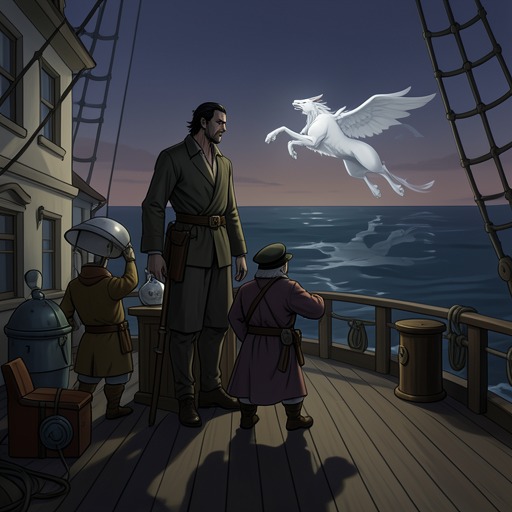
Fedallah enters the narrative at the moment when the Pequod is preparing its first lowering. While the ordinary boats wait to attack the whales, Captain Ahab is suddenly seen surrounded by five dark figures who appear to have formed out of the air. The strangers silently release the tackles and bands of the boat hanging from the starboard quarter, a craft technically called the captain’s boat because of its position. Their leader is a tall, dark man in a black Chinese jacket and trousers, crowned by a white turban and marked by a single protruding white tooth. Captain Ahab addresses him by name and asks whether everything is ready; Fedallah replies that it is, and Ahab immediately orders the boats lowered.
The command reveals the alliance’s practical structure. The ordinary crew launches three boats, but Fedallah and his companions take a fourth keel from the windward side and row Captain Ahab himself. Standing upright in the stern, Ahab orders Starbuck, Stubb, and Flask to spread their boats across the water, yet the other crews hesitate because their attention remains fixed on the unexpected strangers. Fedallah’s group therefore operates beside, but not fully within, the Pequod’s established chain of command. It is an unofficial command unit created by Ahab and kept concealed from the ship’s company until the decisive moment.
Fedallah’s authority remains deliberately unexplained. The subordinate members of his group eventually find places among the crew, but Fedallah remains a muffled mystery to the last. No one knows where he came from, by what tie he is connected to Captain Ahab’s peculiar fortunes, or whether he exercises some influence, perhaps even authority, over Ahab. His inscrutable appearance and unfamiliar customs make him seem less like a conventional sailor than a figure from a half-seen world beyond ordinary maritime society. The narrative never converts this mystery into a simple, verifiable origin story; instead, it makes uncertainty itself part of his power.
Alliance Within the Pequod’s Command Structure
The alliance gains force because Captain Ahab already governs the Pequod through an unusually concentrated authority. He demands implicit and instantaneous obedience and observes the formal usages of the sea even while using those forms for private ends. The quarter-deck’s ceremonies and command protocols become external defenses for what the narrative calls the sultanism of his mind: private will made practically supreme through institutional authority. Fedallah’s special position extends this arrangement beyond ordinary hierarchy. Ahab’s public command remains naval and procedural, while his partnership with Fedallah creates a covert channel of influence operating behind that command.
The contrast between open and hidden authority is also visible in the ship’s daily rituals. Officers may carry themselves boldly on the deck, yet become deferential and almost humble when they enter Ahab’s cabin and sit at his table. The dinner scene shows the crew receiving even a slice of meat from Ahab’s knife as though receiving alms. This cultivated obedience explains how Fedallah can remain distinct from the crew without immediately provoking revolt: Ahab’s authority has already trained the men to accept an exceptional power at the center of the ship, even when its basis is obscure.
When Captain Ahab summons the entire company aft, the gathering appears at first to be another exercise of command. He asks what the men do when they see a whale, receives their collective answer that they sing out for it, and then assembles the harpooneers with their weapons while the mates stand beside him with lances. The crew forms a circle around the group, and Ahab turns the ordinary instruments of whaling into the equipment of a collective oath. Fedallah’s presence within this wider machinery is significant even when he is not explicitly speaking: Ahab’s private alliance is being translated into a public mission, and the ship’s institutional power is recruited for a pursuit that originates in one man’s obsession.
Prophecy, Suspicion, and Mutual Dependence
The crew interprets Fedallah through suspicion and folklore. Stubb says that Fedallah claims a ship carrying both a Sperm whale’s head on one side and a Right whale’s head on the other can never capsize, but Stubb fears that Fedallah may charm the ship to no good end. He notices the snake-like carving on Fedallah’s tusk and imagines him as the devil in disguise. Stubb also rejects the story that Fedallah was secretly stowed aboard, and jokes that his hidden tail explains why he sleeps in his boots and lies in a coil of rigging rather than a hammock.
This comic speculation nonetheless identifies the alliance’s central danger. Stubb imagines Captain Ahab as being tempted to exchange his silver watch, his soul, or something comparable for the surrender of Moby Dick. The joke gives supernatural form to a plainly visible exchange: Captain Ahab has placed the ship, its crew, and his own body at the service of the White Whale, while Fedallah appears to confirm and intensify that bargain. The crew cannot determine whether Fedallah is a devil, a charlatan, or merely an inscrutable sailor, but they recognize that his closeness to Ahab is connected to the captain’s dangerous purpose.
The alliance becomes most explicit in the nocturnal conversation beside a dead whale. Captain Ahab wakes and finds Fedallah watching the sharks in the darkness. Ahab says that he has dreamed the vision again, and Fedallah responds by recalling his prophecy about hearses. He has told Ahab that neither a hearse nor a coffin will be Ahab’s own death, that two hearses must be seen by Ahab at sea before Ahab can die, and that the visible wood of the second must have grown in America. Fedallah further declares that he will go before Ahab as his pilot and, finally, that only hemp can kill him.
Captain Ahab does not dismiss these statements. He treats them as two pledges that he will kill Moby Dick and survive the encounter, while Fedallah’s phrase about hemp allows him to claim that he is immortal on land and sea. Their exchange shows mutual dependence rather than simple domination. Fedallah supplies a prophetic framework through which Ahab can interpret danger as confirmation; Ahab supplies the will and command necessary to make the prophecy operative. The prediction does not restrain Ahab’s pursuit. It gives that pursuit a structure in which apparent warnings become promises of victory.
Fulfillment and the Alliance’s Fatal End
The alliance ends in the third-day chase when Fedallah’s prophecy begins to come true. After the whale has been struck and the pursuit has already cost the crew boats, weapons, and physical strength, Fedallah is discovered lashed around and around to Moby Dick’s back. His body has been caught in the turns of the lines that the whale reeled around itself during the night. His black clothing is torn to shreds, and his distended eyes are turned directly toward Captain Ahab. The prophetic pilot is now literally carried ahead of Ahab by the whale he helped Ahab pursue.
Captain Ahab drops his harpoon when he sees the corpse. He recognizes Fedallah again and understands that the body on the whale is the hearse Fedallah promised. Yet recognition does not produce surrender. Ahab insists on holding Fedallah to the exact wording of the prophecy and asks where the second hearse is. He orders the damaged boats repaired and commands the men to return to him if possible, declaring that Ahab is enough to die even without them. Fedallah’s death thus fulfills the prophecy while making the alliance’s purpose more destructive: instead of treating the first hearse as a limit, Ahab treats it as proof that the final pursuit must continue.
Fedallah’s absence is noticed before his body is seen. When the crew is mustered, the Parsee is missing, and Captain Ahab orders the men to search the ship. Once Ahab realizes that his line and harpoon are entangled with Moby Dick, his reaction joins personal loss, prophetic confirmation, and renewed violence. He cries that he will girdle the unmeasured globe and dive through it if necessary to kill the whale. The missing ally has become part of the whale’s body and the chase’s material machinery, so that Fedallah’s death does not separate Ahab from the pursuit; it fuses the dead man more tightly to the object of Ahab’s desire.
Starbuck sees the moral reality that Ahab refuses to accept: Moby Dick does not seek Ahab, but Ahab madly seeks Moby Dick. Ahab answers that he is the lieutenant of the Fates and that the entire act was decreed long before the present voyage. He presents himself as a man whose body has been reduced to a stump yet whose purpose still moves on many legs. In this final assertion, Fedallah’s role is transformed from hidden associate into confirmation of Ahab’s fatalism. The prophecy has not made Ahab passive; it has allowed him to interpret his own choices as commands imposed by destiny.
Narrative Significance
The Ahab–Fedallah alliance concentrates the novel’s conflict between institutional command and private obsession. Captain Ahab uses the Pequod’s formal hierarchy, rituals, weapons, and collective labor to pursue a personal enemy, while Fedallah represents the secret, unofficial power that gives this pursuit an aura of destiny. The alliance also exposes the instability of knowledge at sea. Fedallah’s origin, authority, and predictions remain uncertain, yet they exert concrete effects on decisions, morale, and action. What the crew cannot verify nevertheless becomes operationally real.
The relationship further complicates the boundary between human agency and fate. Captain Ahab repeatedly chooses to pursue Moby Dick, but Fedallah’s prophecies provide a language in which each consequence can be read as a foretold sign. The first hearse is both an actual death and a symbolic confirmation; it should warn Ahab to stop, but instead it persuades him that the last stage of his design has arrived. The alliance therefore does not merely accompany the tragedy. It supplies the interpretive mechanism by which Captain Ahab converts danger into necessity and prophecy into permission.
Fedallah’s death also reveals the alliance’s ultimate inequality. Captain Ahab depends on Fedallah’s knowledge and presence, yet when the prophecy is fulfilled he does not mourn by abandoning the chase. He absorbs the death into his monomania and demands the second promised hearse. Fedallah has served as pilot, prophet, conspirator, and sign; once dead, he remains useful to Ahab as evidence that the appointed sequence is proceeding. The alliance’s final meaning is therefore both intimate and terrifying: it joins two wills, but the shared pursuit finally subordinates the human bond itself to Ahab’s desire to destroy Moby Dick.