Ahab–Moby Dick feud
Moby-DickThe Ahab–Moby Dick feud is the governing conflict of the voyage of the Pequod. Moby Dick has taken Captain Ahab's leg, but Ahab's response exceeds injury, prudence, and ordinary hunting: he turns the whale into the object of an absolute revenge that absorbs his body, command, crew, and understanding of fate. The feud therefore joins a concrete maritime pursuit to a metaphysical struggle against an inscrutable power, while the whale remains an animal whose behavior repeatedly resists the human meanings imposed upon it.
Origin in Injury and Obsession
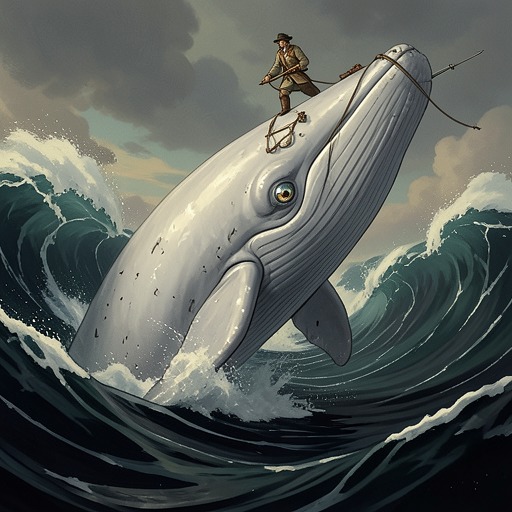
The feud begins with a violent encounter in which three of Captain Ahab's boats are stove around him, with oars and men whirling in the eddies. Ahab, armed with a line-knife, attacks Moby Dick from the broken prow, and the whale's sickle-shaped lower jaw sweeps beneath him and removes his leg. The wound is not presented as a simple accident in the emotional history that follows. Moby Dick's physical force appears to Ahab as deliberate malice, and the mutilation becomes the fixed point around which his later identity turns.
The decisive transformation occurs after the encounter, during the long homeward passage around the stormy Cape. Ahab's torn body and wounded mind lie together for months, and their pain is said to bleed into one another. His later monomania thus does not arise as a fully formed doctrine at the instant of mutilation; it develops through prolonged suffering, delirium, and inward fusion of bodily anguish with spiritual rage. By the time he returns ashore, he can conceal the secret of his hatred well enough that Nantucket regards him as naturally grieving rather than possessed by an inextinguishable purpose.
Captain Ahab nevertheless sails on the Pequod with one engrossing object: hunting the White Whale. The ship's expected aim is a profitable whaling cruise, but Ahab secretly substitutes an audacious and supernatural revenge for commercial purpose. His means remain outwardly those of a whaling captain—ships, weapons, lookouts, boats, and trained harpooneers—while his motive and object have become radically disproportionate to them. The resulting relation is already unequal: Moby Dick is the hunted animal, but Ahab's entire command has been reorganized around the whale's power to occupy his mind.
Public Declaration and Recruitment
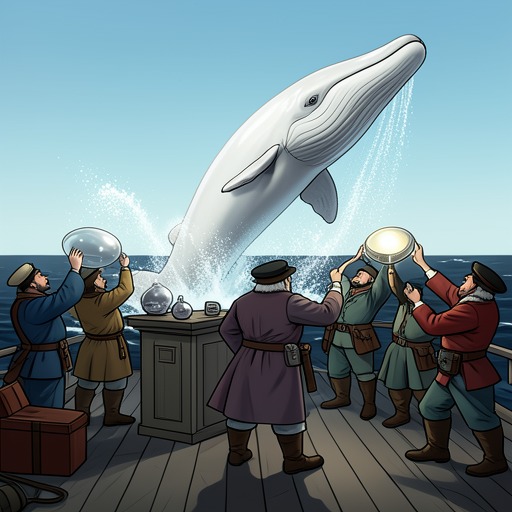
Ahab makes the private feud public when he summons the crew and displays a Spanish ounce of gold, a sixteen-dollar coin. He offers it to whichever sailor raises a white-headed whale with a wrinkled brow, a crooked jaw, and three holes punctured in the starboard fluke. He then has the coin nailed to the mainmast, converting the whale into a marked target and the pursuit into a collective wager. The reward gives the crew a visible object, while Ahab's exact physical description reveals that his revenge is directed toward one identifiable individual rather than toward whales in general.
The crew's recognition confirms the target. Tashtego identifies the whale as the one some call Moby Dick; Daggoo recalls its unusually bushy spout; Queequeg remembers that numerous harpoons lie twisted in its body; and Captain Ahab confirms the whale's corkscrew-wrenched irons, great spout, and fan-tail. The details establish Moby Dick as an experienced survivor of human attacks as well as the particular animal that wounded Ahab. The crew's excited response—pledging a sharp eye and a sharp lance—allows Ahab to turn personal vengeance into a shared undertaking.
Starbuck immediately exposes the moral and practical difference between the captain's purpose and the ship's legitimate business. He is willing to face Moby Dick if the confrontation fairly comes within whale-hunting, but he insists that he came to hunt whales, not his commander's vengeance. His objection treats the whale as an economic object and the voyage as work; Ahab treats the whale as the bearer of a cosmic insult. When Starbuck calls vengeance against a dumb brute madness and blasphemy, the feud is shown to violate both rational judgment and religious proportion.
Ahab overcomes this resistance not by proving that Moby Dick possesses conscious malice, but by redefining the whale as a mask. He argues that visible objects conceal an unknown reasoning power behind them, and that the White Whale is the wall nearest to him through which he can strike at that hidden force. Whether Moby Dick is the agent or merely the principal's visible instrument does not matter to Ahab: the whale is accessible, embodied, and therefore attackable. This logic makes the feud impossible to resolve through evidence, because any uncertainty about the whale's intention becomes further evidence of the inscrutable power Ahab hates.
The Whale as Totalized Adversary
In Ahab's imagination, Moby Dick becomes the incarnation of every malicious agency that torments human beings. The White Whale carries not only the memory of Ahab's lost leg but also his intellectual and spiritual exasperations, all the evil and frustration that he feels working beneath ordinary life. Ahab piles the general rage of humanity onto the whale's white hump and directs against one animal a hatred too large for any single injury to contain. The feud consequently changes scale: its apparent subject is Moby Dick, but its emotional content includes suffering, mortality, injustice, and the desire to strike back at what cannot be fully known.
This enlargement also explains why Ahab can recognize the madness of his purpose without abandoning it. He has some awareness that his methods are sane while his motive and object are mad, and he knows that he has disguised this condition from other people. His secrecy protects the voyage from immediate opposition, but it also makes the crew participants in a project they did not knowingly choose. The ship's many backgrounds and temperaments do not dissolve the danger; they become, in Ishmael's account, an instrument through which Ahab's hatred is amplified.
The relation between captain and whale is therefore both intimate and asymmetrical. Ahab knows Moby Dick through the marks of survival—the damaged body, the recognizable spout, the distinctive jaw and tail, the harpoons embedded and wrenched away. Moby Dick, by contrast, is not given a comparable interior declaration of enmity. The whale acts with immense force, but Ahab supplies the interpretive structure that turns force into malice, accident into affront, and animal resistance into a personal metaphysical war. The feud's intensity comes from this collision between the whale's material agency and Ahab's human projection of total meaning upon it.
Global Pursuit and Final Escalation
Ahab's pursuit extends across the world's whaling grounds. As the Pequod approaches the Sunda Strait, he plans to pass into the Javan sea, cruise northward through waters frequented by the Sperm Whale, sweep by the Philippine Islands, reach the far coast of Japan for the major whaling season, and then descend to the Line in the Pacific, where he most confidently expects to meet Moby Dick. The route is not a normal commercial itinerary but a vast net cast over the whale's known range. Ahab intends to search almost every principal cruising ground before concentrating on the place and season in which Moby Dick is most likely to appear.
The global scale of the chase reflects the feud's transformation of geography into purpose. The Pequod carries its crew, weapons, water, and necessities rather than an ordinary cargo, allowing it to remain at sea while pursuing the whale across enormous distances. Ports and landfall recede; the ship becomes an instrument directed by a single target. The ocean's size appears to promise endless room for pursuit, yet that apparent freedom intensifies the captivity of the crew, since every region is made subordinate to Ahab's chosen line of revenge.
When Moby Dick is finally sighted, the recognition is immediate and charged with the history of the entire voyage. From aloft comes the cry of a hump like a snow-hill, followed by the identification of Moby Dick. The crew rushes into the rigging, and Ahab takes a perch above the other lookouts while the whale shows its high, glittering hump and regular spout ahead. The famous animal is at once physically present and symbolically overburdened: the sight confirms the crew's expectation, but it also brings Ahab's concealed purpose to its decisive trial.
Fate, Resistance, and Destruction
After two days of pursuit, the chase has already produced unmistakable warnings. Boats have been smashed, Ahab's leg has again nearly been taken from beneath him, and the pursuit has cost the expedition lives and instruments. Starbuck argues that these reversals should end the hunt before the whale swamps the last man or drags the crew to the bottom. His appeal restores the ordinary values of command—preservation, responsibility, and the limits of a profitable hunt—against Ahab's single imperative.
Ahab refuses. He tells Starbuck that the whole act has been immutably decreed and casts himself as the lieutenant of the Fates, acting under orders that reach back before the ocean itself. His damaged body becomes part of the argument: though he stands cut down to a stump and leans upon a shattered lance, he insists that his soul still moves on many legs and that his purpose remains capable of towing the ship. Fate, in this speech, does not restrain Ahab's will; it authorizes it, allowing him to interpret his own determination as obedience to a cosmic command.
When his line disappears and the harpoon is lost, Ahab does not accept defeat. He treats the disappearance as a temporary interruption and vows to circle the globe again and even pass through it if necessary to kill Moby Dick. His language turns pursuit into an attempt to overcome the world's measure itself. Starbuck sees the accumulated evidence of ruin; Ahab sees only a delayed fulfillment. He predicts that Moby Dick, having risen twice, will rise on the third day for the final spout, converting the chase's temporal pattern into an omen and the expected ending into a prophecy.
The Ahab–Moby Dick feud thus ends not as a balanced contest between two equivalent wills, but as the destruction produced by Ahab's refusal to distinguish animal force from moral intention, injury from universal evil, or fate from self-imposed command. Moby Dick remains the material adversary whose body can break boats, tear lines, and kill men; Captain Ahab makes that adversary bear the weight of every grievance he cannot otherwise master. The relation's tragic power lies in the fact that the whale is real, the wound is real, and the danger is real, while the total explanation Ahab builds from them is both psychologically compelling and catastrophically unbounded.