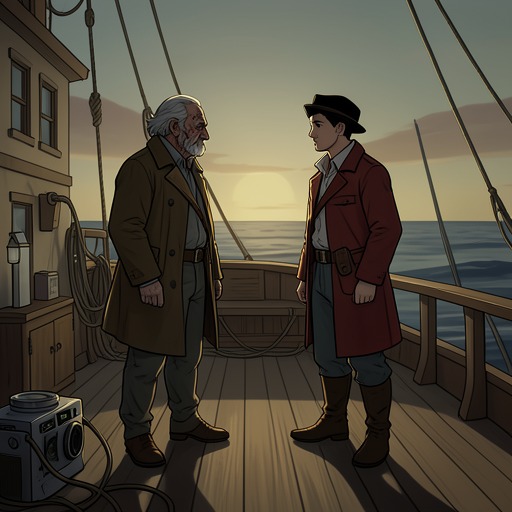
Ahab–Pip bond
Moby-DickAhab–Pip bond is one of the Pequod’s most revealing relationships: the ship’s maimed and monomaniacal captain discovers a profound affinity with the ship’s smallest and most vulnerable crewman. Pip’s abandonment at sea leaves him outwardly treated as an idiot but inwardly opened to visions and forms of wisdom beyond ordinary reason; Captain Ahab responds not with dismissal but with recognition, claiming Pip as someone bound to him by shared suffering. Their bond briefly creates a shelter of tenderness within a voyage governed by violence, profit, and pursuit, yet its very intensity exposes the limits of Ahab’s compassion when his hunt for Moby Dick reaches its final crisis.
Pip’s Abandonment and Transformation
Pip enters the relationship through catastrophe. As one of the Pequod’s ship-keepers, he is kept from the whale boats because he is considered physically slight, clumsy, or timid, although the narrative distinguishes his bright, genial intelligence from Dough-Boy’s dull torpor. Pip loves life and its peaceful securities, making the dangerous work of whaling especially discordant with his nature. When he jumps from Stubb’s boat during a whale chase, Stubb warns him in explicitly economic terms that a whale is worth thirty times what Pip is worth, then refuses to risk losing the catch by recovering him when Pip jumps again. The other boats turn toward whales rather than toward the abandoned crewman, and the Pequod rescues Pip only by chance after three minutes and roughly a mile of ocean have separated him from Stubb’s boat.
The rescue does not restore Pip to his former condition. From that hour, his shipmates call him an idiot, while the narration presents his altered consciousness as something more complex than simple mental loss. The sea has kept his finite body afloat while carrying what the narrative calls the infinite part of his soul into depths where strange forms of the primal world pass before him and hidden wisdom is disclosed. Pip’s speech therefore occupies an unstable border between nonsense, revelation, and poetic insight. His experience makes him socially vulnerable, but it also makes him a figure through whom the Pequod’s ordinary distinctions between sanity and madness are unsettled.
Ahab’s Recognition of Pip
Captain Ahab’s attachment begins when he sees Pip not merely as a damaged subordinate but as a fellow being marked by suffering. In a moment of direct recognition, he declares that Ahab’s cabin shall henceforth be Pip’s home and says that the boy touches his inmost centre, tied to him by cords woven from his heart-strings. Ahab’s language makes the relationship intimate and bodily: Pip is not simply under his command but drawn into the captain’s emotional interior. The captain even says that he feels prouder leading Pip by his black hand than he would feel grasping an emperor’s.
This response contrasts sharply with the treatment Pip receives from the whale fishery and from Stubb. Stubb’s abandonment reduces Pip to an obstacle against profitable labor; Ahab instead treats his vulnerability as a source of human value. Yet Ahab does not present Pip as untouched by madness. He calls himself both black and crazy in the same breath in which he praises human fidelity, while the Manxman sees two daft men together, one daft with strength and the other with weakness. The bond thus joins complementary extremes: Ahab’s force and Pip’s frailty, his fixed purpose and Pip’s wandering consciousness, his bodily wound and Pip’s psychological dislocation.
Mutual Consolation and Substitution
The bond is reciprocal rather than purely paternal. When Queequeg lies in the coffin he has prepared as his possible final bed, Pip approaches him sobbing, holding his tambourine, and speaks of a missing Pip who might be somewhere in the Antilles. The scene suggests that Pip experiences his own lost identity as a person who must be sought and comforted. His concern for Queequeg’s impending death is therefore inseparable from his own sense of being abandoned and spiritually displaced. The tambourine, previously associated with his lively presence aboard ship, becomes an emblem of the self he believes has gone missing.
Ahab later becomes the person toward whom Pip directs a more explicit loyalty. When Captain Ahab moves toward the deck, Pip catches him by the hand and insists on following. Ahab tries to keep him below, promising that he may sit in the captain’s own screwed chair and be served as though he were captain. The offer is protective, but it also reveals Ahab’s anxiety: Pip’s presence is comforting enough to cure or soften his malady, and therefore dangerous to the monomania that Ahab has made his chosen health. Ahab says that like cures like, because Pip’s suffering resembles his own and offers the possibility of relief from it.
Pip rejects separation. He tells Ahab that the captain does not possess a whole body and asks to be used as the lost leg, even offering himself as something on which Ahab might tread if that would allow him to remain part of the captain. The image converts Ahab’s ivory leg into a metaphor of attachment and substitution: Pip wants to become the missing portion of Ahab’s body, while Ahab recognizes in Pip a tenderness capable of interrupting his pursuit. Pip’s offer is not presented as a practical solution but as an extravagant expression of dependence, fidelity, and the desire to repair another person by joining himself to that person’s wound.
Protection Against the Final Hunt
Ahab’s effort to protect Pip is sincere but divided. He tells Pip that the boy contains something curative to his malady, yet he also knows that his hunt transforms that malady into his most desired health. He therefore orders Pip to remain below, where the crew will serve him as captain, rather than accompany the boats and the captain’s dangerous purpose. The command separates physical care from emotional closeness: Ahab can provide a place of safety, but he cannot allow Pip to remain beside him at the decisive moment.
Pip answers that he will never desert Ahab as Stubb deserted him. The comparison gives the relationship its ethical centre. Pip’s attachment is shaped by the memory of abandonment, and his pledge defines loyalty negatively, as the refusal to repeat the injury done to him. Ahab is moved by this declaration, admitting that it makes him a bigot in the faithfulness of man and that Pip seems to be growing sane again. The supposed madman becomes the bearer of moral clarity, while Ahab, who commands the ship through strength and authority, recognizes that his own purpose may be undone by the boy’s devotion.
Ahab finally warns Pip that if Pip continues to weep, he may murder him, because Ahab himself is mad. The threat is a desperate attempt to force separation before affection can weaken the hunt. Even so, Ahab promises that Pip will hear his ivory foot on the deck and know that he is there. Their parting is sealed by a clasped hand and by Ahab’s blessing, with Ahab acknowledging Pip as true as a circumference is true to its centre. The language offers emotional certainty at the very moment when physical companionship must end.
Absence, Madness, and Significance
Once Ahab leaves, Pip immediately experiences the cabin as a space of absence. He stands where Ahab had stood, says that he is alone, and calls for Pip as though the missing self were another person who might return. Sitting in the captain’s chair, he imagines himself hosting white men in gold lace and presiding over them, transforming the cabin into a theatre of inverted hierarchy. His vision places the Black boy at the centre of authority, but it also shows how completely his consciousness has become entangled with the symbolic world of the ship and its captain.
The Ahab–Pip bond therefore joins personal compassion to the Pequod’s larger structure of violence and hierarchy. Captain Ahab can recognize suffering with startling tenderness, take Pip’s hand, give him shelter, and value his fidelity above imperial grandeur. Yet he remains unable to abandon the purpose that has organized his life, even when Pip’s presence offers a possible cure. Pip, meanwhile, finds in Ahab a protector who acknowledges him but also another figure whose departure reopens abandonment. Their relationship briefly imagines repair through mutual recognition, while its failure shows that affection on the Pequod cannot fully escape the captain’s destructive pursuit.