Ahab–Starbuck conflict and loyalty
Moby-DickAhab–Starbuck conflict and loyalty is the Pequod’s most sustained internal contest: Captain Ahab’s private vengeance against Moby Dick is repeatedly opposed by Starbuck’s practical conscience, religious unease, and responsibility toward the ship’s company. Their relationship never settles into simple friendship or simple rebellion. Starbuck sees the moral and physical danger of Ahab’s purpose, but the authority of the commander, the habits of maritime obedience, and his own loyalty keep converting resistance into compliance.
Identity and Opposing Principles
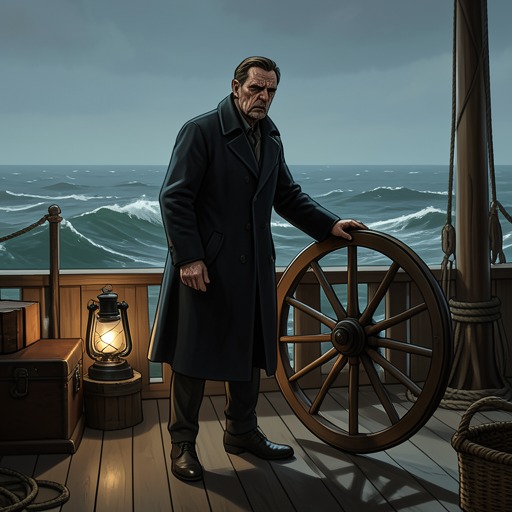
Starbuck, the Pequod’s chief mate, is a Nantucket Quaker by descent and a man marked by disciplined endurance. He is described as lean, hardened, and condensed rather than weakened, with the eyes of someone who has calmly confronted many dangers. His courage is practical rather than theatrical. He does not seek peril for its own sake, avoids lowering for whales after sundown, and sees the purpose of whaling as killing whales for a living rather than being killed by them. His memories of a young Cape wife and child, together with the deaths of his father and brother in the fishery, make danger more than an abstraction.
Starbuck’s most revealing principle is that no man should enter his boat without fearing a whale. Fear, in his understanding, is not cowardice but an accurate estimate of danger, and therefore a condition of useful courage. His conscience and superstition arise together from intelligence, experience, and reverence. The narrative presents him as brave enough to face seas, winds, and whales, yet vulnerable to a more spiritual terror: the enraged will of a powerful man. Captain Ahab’s authority therefore threatens Starbuck in a different register from the ordinary hazards of the fishery.
Ahab, by contrast, turns the ship’s ordinary purpose into the instrument of an absolute personal design. The Pequod’s formal hierarchy gives him the means to transform revenge into policy. Although the only homage he openly requires is immediate obedience, he uses the forms and usages of the sea as external supports for a private dictatorship. His command does not merely occupy a legitimate office; it makes the office serve his monomania, until obedience to the captain becomes participation in Ahab’s metaphysical war.
The White Whale and the First Open Conflict
When Ahab summons the entire ship’s company to the deck, he begins with the familiar practical question of what sailors do when they see a whale. The crew answers that they call out, but Ahab turns this routine response into a revelation: the whale they have seen is Moby Dick. He then discloses that Moby Dick took his leg, leaving him a stump, and announces that he will pursue the white whale around Good Hope, around the Horn, around the Norway Maelstrom, and through perdition before abandoning the chase.
The men respond enthusiastically, joining the cry for a sharp eye and a sharp lance against Moby Dick. Starbuck does not deny the danger or claim that he lacks courage. Instead, he draws the decisive distinction between legitimate whaling and personal vengeance. He says that he is ready to face the whale and Death if that fairly belongs to the business they follow, but he came to hunt whales, not his commander’s revenge. His question about how many barrels Ahab’s vengeance will yield exposes the conflict between the voyage’s economic purpose and Ahab’s private obsession.
Ahab rejects the language of the Nantucket market and argues that vengeance possesses a value greater than money. He then explains that visible objects are merely masks and that an unknown reasoning force may act behind them. To Ahab, the white whale is the wall nearest him, the concrete surface through which he may strike at an inscrutable power. Whether Moby Dick is agent or principal matters less to him than the hatred he projects through the whale. This explanation makes Starbuck’s objection more urgent: Ahab is not pursuing an animal merely because it injured him, but using the whale as the material target of a rage directed toward the unknown structure of existence.
Ahab then turns the crew’s collective excitement against Starbuck. He insists that Starbuck cannot hang back when every foremast-hand has taken up a whetstone, and he treats the mate’s silence as tacit consent. Starbuck murmurs a prayer that God keep him and the others, but Ahab interprets the situation as victory: the chief mate, he believes, has been absorbed into the common purpose and can no longer oppose him without appearing rebellious. The scene establishes the recurring pattern of their relationship. Starbuck recognizes the danger, voices a measured objection, and then finds that command, group pressure, and the crew’s enthusiasm have made refusal nearly impossible.
Authority, Ritual, and Compelled Obedience
The conflict is intensified by the Pequod’s institutional structure. Whaling ships depend on shared labor and shared profit, yet they preserve the quarter-deck’s formal distinctions and rituals. The officers may behave boldly on deck, but when they enter the captain’s cabin for dinner, they often become humble and deferential. Ahab presides over the ivory-inlaid table with a power that is at once official and social; the officers wait to be served, and Starbuck receives a slice of beef as though receiving alms. The ordinary ceremony of dining therefore reinforces the command that Starbuck contests intellectually.
This hierarchy does not mean that Ahab constantly displays shallow arrogance. He often demands only obedience, and he sometimes addresses the crew with unusual condescension or urgency. Yet the forms of maritime authority allow his private will to become an irresistible practical power. The ship’s customs are the institutional armor of his personal rule. Starbuck is not confronting one man in an open field; he is confronting a command system in which refusal can be recoded as insubordination, disloyalty, or dereliction of duty.
The same contradiction appears when Ahab calls the ship’s company together and arranges the harpoons, lances, and crew around the capstan. The gathering resembles a political or military ceremony, but its purpose is to bind the men emotionally to the white-whale hunt. The grog circulates, the weapons are displayed, and the crew forms a ring around Ahab. Ritual transforms a captain’s grievance into a collective oath. Starbuck’s warning is not defeated by argument; it is surrounded by ceremony, comradeship, intoxication, and the visible pressure of the crew’s unanimous response.
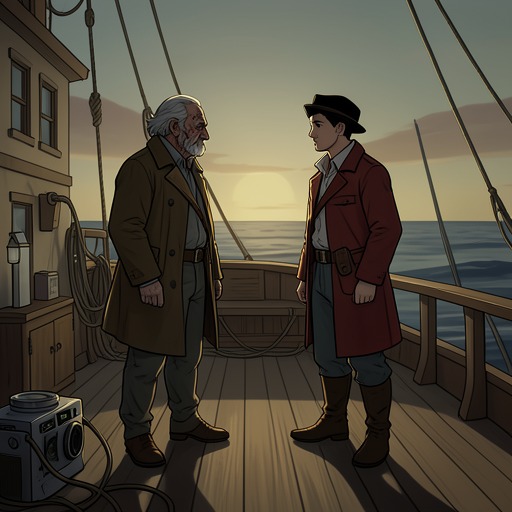
Ahab’s relationship with Starbuck is consequently built from both domination and recognition. He understands that the chief mate’s importance makes open disaffection dangerous. When Starbuck later challenges him, Ahab points a loaded musket at him and declares that one God is lord over the earth and one captain lord over the Pequod. Starbuck answers that Ahab has outraged rather than merely insulted him and warns Ahab to beware himself. Ahab’s weapon makes the power relation unmistakable, but Starbuck’s reply preserves a moral independence that physical obedience cannot erase.
The Cabin Confrontation and Its Aftermath
In the cabin, Starbuck confronts Ahab over the danger to the ship and the owners’ interests. His manner is daring but carefully respectful, as though he distrusts not only Ahab’s anger but also his own ability to challenge it without provoking catastrophe. He asks whether they cannot understand each other better. The appeal is not simply procedural. Starbuck seeks to recover a relation in which command can still be addressed by reason and in which the captain can recognize obligations beyond his own will.
Ahab refuses that opening. He seizes a loaded musket and points it at Starbuck, making the authority of the captain literal and lethal. Starbuck masters his emotion and leaves, obeying without surrendering his judgment. His warning that Ahab should beware himself is the clearest formulation of the danger he has been trying to name: the threat is not only Moby Dick, the storm, or the sea, but the captain’s own determination.
Once Starbuck has withdrawn, Ahab acknowledges that the mate is a good fellow. He then orders the sails furled, the topsails reefed, the main-yard backed, and the cargo broken out. The practical orders restore the ship’s routine, but they do not resolve the confrontation. Ahab may have experienced a flash of honesty, or he may simply have understood that the ship could not risk open disaffection from its chief officer. In either case, Starbuck’s resistance produces a temporary adjustment rather than a change of course. He remains loyal enough to carry out commands and opposed enough to expose their moral cost.
Recognition, Pity, and the Failure of Escape
Their relationship reaches its most intimate point when Ahab briefly abandons the posture of the invulnerable commander. After forty years of whaling, he speaks to Starbuck of privation, danger, and the solitude of command. He recalls having spent almost all of those years at sea, leaving his young wife immediately after marriage and effectively turning her into a widow while he remained alive. He imagines the son who wakes during his noon sleep and is told that his father is abroad upon the deep.
Ahab asks Starbuck to stand close and says that the mate’s eye becomes a magic glass in which he sees his wife and child. The image reverses the usual structure of their conflict. Starbuck is no longer merely the subordinate who questions a dangerous order; he becomes the human presence through whom Ahab momentarily sees the domestic life he abandoned. Ahab even tells him not to lower a boat during the chase, because the hazard should not belong to a man whose wife and child await him.
Starbuck responds with open compassion. He recognizes Ahab as a noble soul and urges him to abandon the hated fish, alter the course, and return to Nantucket. For a moment, the two men imagine a shared homeward voyage and the mild blue days of land. Starbuck’s loyalty here is not submission to Ahab’s obsession but attachment to the person beneath it. He tries to save the captain by appealing to the family life that both men have sacrificed to the sea.
Ahab appears to consent: he says that they will head for Nantucket. Yet the decision collapses almost immediately. His glance turns away, and he asks what hidden master compels him to continue against his own natural loves and longings. He wonders whether his actions belong to himself, to God, or to Fate. The exchange exposes the deepest limit of Starbuck’s influence. Starbuck can awaken Ahab’s memory and pity, but he cannot break the force by which Ahab interprets his own will as an instrument of destiny.
Final Loyalty and Tragic Significance
After the chase has already lasted two days and the boats have been stove to splinters, Starbuck again protests. He points to the repeated warnings: Ahab’s leg has once more nearly been taken, the evil shadow has disappeared, and the danger threatens to swamp the last man. His questions are a final ethical indictment of the pursuit. He asks whether the crew must be dragged to the bottom of the sea or to the infernal world for the sake of a murderous fish.
Ahab answers that he and Starbuck have been bound to this act from before the ocean existed. He calls himself the Fates’ lieutenant and orders Starbuck to obey. The language converts personal responsibility into fatalistic service. Ahab remains physically damaged, leaning on a shattered lance and supported by a single foot, but he imagines his soul as possessing innumerable legs and his purpose as a hawser that will continue to tow him. His body has been broken; his command has not.
Starbuck’s final position is therefore paradoxical. He is Ahab’s most perceptive critic, his moral counterweight, and the officer most capable of recognizing that the captain is endangering the whole ship. He is also the subordinate who continues to report changes in the deck, execute orders, and remain with the Pequod. Even when he is alone before the cabin door and sees the loaded muskets, he feels the temptation to remove Ahab and thereby save the crew, but fear, duty, and the impossibility of overcoming Ahab’s command hold him back.
Their conflict gives the Pequod’s disaster its internal shape. Ahab’s revenge becomes collective because Starbuck’s objections never become successful mutiny; Starbuck’s loyalty protects the ship’s discipline while also helping the captain retain the authority that drives it toward destruction. The relationship thus embodies the struggle between conscience and command, prudence and vengeance, human attachment and fatalistic compulsion. Starbuck can see the abyss clearly, and Ahab can briefly see the home he has lost, but neither recognition is strong enough to redirect the voyage.