Koui Geku shō byō to iku to jin no kanzō o tsukuru
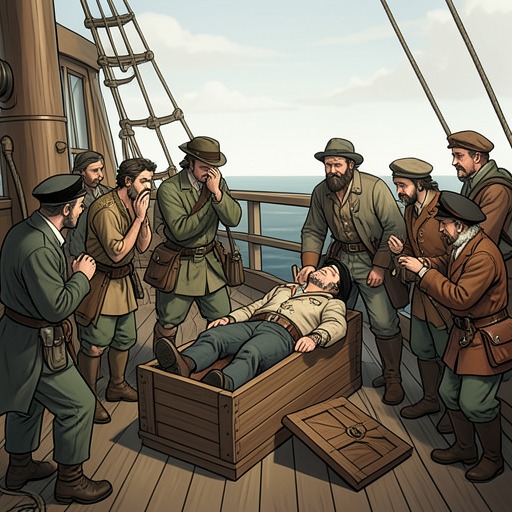
Moby-DickQueequeg's illness and coffin episode is a decisive reversal in the voyage of the Pequod. After a fever brought on by exhausting labor in the ship's hold, Queequeg was believed to be dying. He requested a coffin modeled on the canoe burials of his native island, entered it with his own chosen objects, and calmly tested it as his final bed. Yet the completed coffin did not become his grave. Once he decided that an unfinished duty ashore prevented him from dying, he recovered, and the object prepared for his death became his sea-chest. The episode therefore makes mortality tangible without allowing it to remain final: Queequeg confronts death through ritual, craftsmanship, and personal will, then returns to the work and fellowship of the ship.
Illness and the Approach of Death
Queequeg's crisis develops amid the practical hazards of whaling rather than in isolation from them. A leak forced the crew to break deeper into the hold, removing casks, water, bread, beef, staves, and iron bundles until the decks were crowded and the ship became dangerously top-heavy. As a harpooneer, Queequeg belonged to the working class of whalemen whose rank carried relentless labor: he faced living whales, mounted dead ones in rough seas, and handled heavy casks in the damp confinement below deck. While crawling through the hold in heat, slime, and sweat, he caught a severe chill that became a fever.
His decline is described as a physical wasting that nevertheless preserves an inward radiance. Queequeg grew thinner until little seemed left but his frame and tattooing, while his eyes appeared increasingly full, soft, and luminous. The narrator presents his sick body not merely as evidence of medical deterioration but as a site of mystery and spiritual intensity. The rolling sea seems to rock him toward a destined heaven, and the approaching death that levels everyone supplies a final revelation beyond ordinary language. The entire crew gave him up, making the coffin request both a practical response to imminent death and a public acknowledgment that the ship might soon lose one of its central companions.
A Coffin Shaped by Cultural Memory
Queequeg's request is governed by a specific funerary imagination. In Nantucket he had seen dark wooden canoes used as coffins for dead whalemen, and he found the form congenial because it resembled the canoe burial custom of his own race. His people embalmed a dead warrior, laid him in a canoe, and sent him toward starry archipelagoes; their cosmology imagined the stars as islands and the seas beyond visible horizons as flowing into the heavens. He rejected the ordinary sea burial in a hammock, which would leave the dead exposed to sharks, and preferred a vessel without a keel, accepting its uncertain steering and drift through the ages.
The Pequod's Carpenter was ordered to honor the request immediately. He used dark, coffin-colored lumber cut from the aboriginal groves of the Lackaday islands, measured Queequeg's body with exactness, marked the dimensions on his vice-bench, and built the box with the indifferent promptitude characteristic of his workmanship. The crew's discomfort briefly turns the coffin into a social disturbance: some attempted to drive it away, but Queequeg demanded that it be brought to him. His approaching death gives him an unusual authority, and the living are compelled to accommodate the dying man's chosen form of burial.
Entering the Final Bed
Queequeg personally furnished the coffin with the objects that defined his identity and practice. He had the iron of his harpoon placed inside, together with one of his boat's paddles. Biscuits lined the sides, a flask of fresh water stood at the head, and a small bag of earth scraped from the hold was put at the foot. A rolled piece of sail-cloth served as a pillow. He then asked to be lifted into the coffin so that he could test its comfort, called for his little god Yojo, crossed his arms over his breast with Yojo between them, and requested that the lid be lowered like a hatch. After lying there for several minutes, he pronounced the arrangement satisfactory and easy before returning to his hammock.
This scene is simultaneously funeral preparation, cultural self-definition, and an act of practical testing. The coffin is not an anonymous container: its contents connect Queequeg to weapon, boat, food, water, earth, clothing, and deity. His body enters a space assembled from the material and spiritual elements of his life aboard the Pequod. By treating the lid as a hatch and the coffin as a canoe-like vessel, he makes death legible through the working vocabulary of a sailor and harpooneer.
Pip's response adds a contrasting emotional register. Hovering near the sick man, Pip approached with soft sobbing, holding Queequeg's hand while carrying his tambourine. His grief is followed by a grotesque mock ceremony in which he imagines making Queequeg a general and praises him as dying game, while condemning Pip himself as a coward for having jumped from a whale-boat. The episode thus places tenderness beside delirious performance and exposes how the ship's language of courage can turn suffering and death into spectacle.
Recovery and the Refunctioning of the Coffin
The coffin proves a fit, but Queequeg's preparation for death produces an unexpected change in value. He suddenly rallied and explained that he had remembered a small duty ashore he was leaving unfinished. For that reason, he said, he had changed his mind about dying and could not die yet. He maintained that living or dying was a matter of sovereign will and pleasure: if a man resolved to live, sickness alone could not kill him, though a whale, a gale, or another violent and unintelligent force might do so.
His recovery is presented through abrupt physical action. After sitting on the windlass for several idle days while eating vigorously, Queequeg leaped up, stretched his arms and legs, yawned, sprang into the head of his hoisted boat, balanced a harpoon, and declared himself ready for a fight. The sudden return of appetite, mobility, and combat-readiness reverses the earlier image of a body wasting toward death. It also restores him to the laboring world from which the illness had temporarily separated him.
The coffin consequently changes from a prospective grave into a practical storage chest. Queequeg emptied his canvas clothing bag into it and arranged his garments there. During spare hours he carved its lid with grotesque figures and drawings that seemed to imitate the twisted tattooing on his body. Those tattoos had been made by a departed prophet and seer of his island, who had inscribed upon Queequeg a complete theory of heaven and earth and a mystical treatise on attaining truth. The living body and the coffin lid therefore become parallel surfaces of inscription: both carry a knowledge that Queequeg embodies but cannot fully decipher. The coffin preserves not only goods but an unresolved intellectual and spiritual mystery.
Narrative and Thematic Significance
The episode links Queequeg's personal survival to the wider material culture of the Pequod. Throughout the voyage, bodies are sustained, repaired, measured, armed, and endangered through objects: the Carpenter makes a new leg for Captain Ahab from sperm-whale ivory, harpooneers depend on their weapons, and the ship's work is organized through lines, vessels, tools, and fittings. Queequeg's coffin belongs to this world of craftsmanship, but its use shifts repeatedly—from burial canoe, to final bed, to sea-chest, and eventually to an object capable of serving the ship's future needs.
The event also complicates the opposition between civilized and savage. Queequeg's funerary custom is treated as unfamiliar, yet it is coherent, practical, and deeply connected to his sense of whaling identity. His coffin protects him from the sharks associated with ordinary sea burial, carries food and water, contains his weapon and paddle, and gives material form to his island cosmology. Meanwhile, the supposedly civilized crew cannot explain or control the boundary between illness and recovery any more securely than Queequeg can read the hieroglyphics written across his skin.
Most importantly, the episode transforms death from an endpoint into a threshold. Queequeg passes through the gestures of separation—fever, isolation, measurement, construction, and entry into the coffin—then returns to communal life without erasing what the passage revealed. The coffin remains as a durable reminder that survival does not cancel mortality; it converts the signs of death into tools for continuing the voyage. In that reversal, Queequeg's episode gives material shape to the book's recurring uncertainty about whether human beings command their fate or merely negotiate with forces greater than themselves.