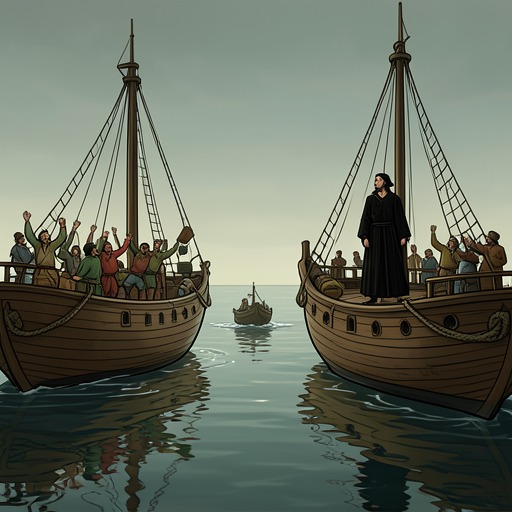
Pequod refuses to help the Rachel
Moby-DickPequod refuses to help the Rachel is one of the clearest revelations of Captain Ahab’s moral isolation. When the Rachel encounters the Pequod, Captain Gardiner asks for help searching for a missing boat whose occupants include his twelve-year-old son. Ahab has the means to assist but refuses because the search would delay his pursuit of Moby Dick. The encounter turns a customary appeal between whaling ships into a stark conflict between human obligation and monomaniacal purpose, and its aftermath gives the Rachel the image of a ship still searching for the children it has lost.
Encounter and Immediate Crisis
The Rachel approaches the Pequod with all her spars crowded with men, but her sails collapse as she comes near, making the vessel appear suddenly stricken. Ahab’s first concern is not the condition of the approaching ship but the White Whale: he asks whether Gardiner has seen Moby Dick. Gardiner answers that he saw the whale the previous day and then asks whether the Pequod has seen a drifting whale-boat. The exchange immediately establishes the unequal priorities of the two captains. Gardiner is searching for human beings; Ahab is measuring every encounter by its relevance to the whale.
The missing boat had separated from the Rachel while three boats pursued a shoal of whales several miles from the ship. Moby Dick then appeared to leeward, and the Rachel lowered a fourth, reserved boat to pursue him. From the mast-head, the crew saw the boat apparently fast to the whale, followed by a flash of bubbling white water; after that, both boat and pursuers disappeared. The Rachel first feared that the boat had been carried away by the whale, then spent the night trying to locate it. After recalling the three distant boats, the ship crowded all sail, lit a fire in the try-pots as a beacon, kept men aloft, lowered spare boats repeatedly, and searched through darkness until daylight without finding the missing keel.
Gardiner’s Appeal and Ahab’s Refusal
Gardiner boards the Pequod to request a coordinated search. He proposes that the two ships sail four or five miles apart on parallel lines, thereby sweeping a double horizon. His appeal is practical as well as humane: the Rachel can search more effectively with another ship, and the missing people may still be alive. The request becomes personal when Gardiner explains that his own son is among the missing men. He asks Ahab to charter the Pequod for forty-eight hours and offers to pay generously if that is necessary.
Gardiner then invokes Ahab’s own family. He reminds him that Captain Ahab also has a boy, a child of his old age who is safely at home. The appeal asks Ahab to imagine the same loss turned upon himself and to act as he would wish another captain to act in that circumstance. For a moment Gardiner believes Ahab has relented and orders men to prepare the yards, but Ahab interrupts him. He commands the crew not to touch a rope-yarn and tells Gardiner that he will not go. Ahab orders Starbuck to consult the binnacle watch and warn off all strangers after three minutes, declaring that the Pequod must resume its course.
Ahab’s refusal is not presented as uncertainty or inability. He does not argue that the missing men are certainly dead, nor does he deny that the search might succeed. He acknowledges that he is losing time and chooses that loss rather than interrupting his pursuit. His withdrawal into the cabin after delivering the decision intensifies the cruelty of the scene: Gardiner is left transfixed, while Ahab retreats from the consequences of the appeal he has rejected.
The Rachel’s Search and the Pequod’s Departure
The two ships soon separate. The Rachel continues to turn toward every dark spot on the sea, altering her yards from starboard to larboard, tacking, beating against the head sea, and then being pushed before it. Her men remain clustered in the rigging as they search the water. The repeated changes of direction show a vessel governed by hope, uncertainty, and parental desperation rather than by a single predetermined route.
The Pequod, by contrast, returns to Ahab’s planned circuit of the Sperm Whale grounds. He intends to pass through the Javan Sea, cruise northward toward the Philippine Islands and the coast of Japan, and then descend upon the Line in the Pacific, where he expects to confront Moby Dick. This larger itinerary explains the pressure behind his refusal: Ahab has organized the voyage around reaching the whale at a favorable time and place, and every interruption appears to him as an intolerable diversion. Yet the contrast also exposes the moral cost of that organization. The Pequod possesses a ship, boats, crew, provisions, and navigational capacity that could contribute to the search, but Ahab treats those resources as instruments of his private objective.
Moral and Narrative Consequences
The episode converts the ordinary solidarity of seafaring into a test that the Pequod fails. Captain Gardiner’s request assumes that one vessel should aid another in an emergency, especially when a child may be among the endangered. Ahab’s rejection places his own command outside that reciprocal maritime ethic. His authority remains operationally effective—he can order Starbuck to clear the Rachel and make the Pequod sail on—but it has become detached from communal responsibility.
The Rachel’s fate is captured in the image of a ship that continues to weep for its children because they are absent. The wording gives the vessel a parental identity and makes its movement itself a form of mourning. Gardiner’s search does not end with a confirmed recovery or a witnessed death in this encounter; its significance lies in the unresolved absence and in the visible persistence of the search. The Rachel becomes the living counterimage to Ahab: where Ahab narrows the world to Moby Dick, Gardiner’s ship turns repeatedly toward every possible sign of human life.
The refusal also foreshadows the larger disaster of the Pequod. By rejecting a forty-eight-hour delay to assist a fellow captain, Ahab demonstrates how completely his pursuit has displaced judgment, kinship, and the value of other lives. The encounter therefore deepens the meaning of his later chase: the catastrophe is not only a struggle between a man and a whale, but the consequence of a command structure in which every human claim is subordinated to one obsession.