Town-Ho mutiny
Moby-DickThe Town-Ho mutiny is a story of labor, authority, and revenge in which a dispute over shipboard discipline becomes an insurrection and then a fatal encounter with Moby Dick. The Town-Ho is already endangered by an undiscovered leak, while its crew works the pumps; Radney’s needless provocation of the exhausted Steelkilt converts ordinary nautical hierarchy into personal persecution. The revolt is suppressed only temporarily, and Radney’s later death during the pursuit of the White Whale gives the episode its grim symmetry: the officer who abuses his power is destroyed in the very labor and danger that bind him to his subordinate.
Narrative Setting and Immediate Danger
The episode is not presented as an impersonal report. Ishmael recounts it in Lima to a circle of Spanish friends, including Pedro and Sebastian, preserving the conversational form of an orally transmitted sea tale. He explains that he had learned the events about two years before telling them, and places the Town-Ho somewhere north of the Line in the Pacific. The ship is making more water than usual, perhaps because a sword-fish has stabbed it, but the captain refuses to leave the cruising ground because he expects good luck. The leak grows, and the vessel finally turns toward the nearest island harbor for repairs.
The danger is serious but not initially fatal. The Town-Ho carries thirty-six men, and its pumps are considered strong enough to keep the ship afloat during the passage, especially because favorable winds assist the voyage. The entire crew must therefore perform exhausting, repetitive work while the captain delays departure. The leak creates the material pressure behind the quarrel: the sailors are not merely idle men resisting discipline, but workers whose bodies are already being spent to preserve a damaged vessel.
Radney and Steelkilt’s Quarrel
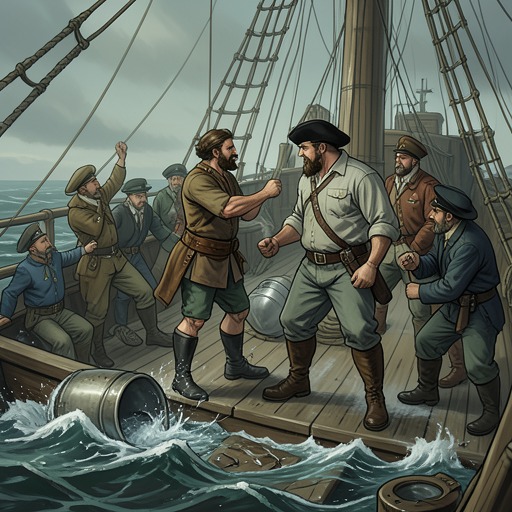
Steelkilt, a Lakeman from Buffalo and one of the ship’s strongest sailors, has been assigned as captain of a pump gang. After prolonged exertion, he leaves the pumps panting, red-faced, bloodshot, and drenched in sweat, then sits on the windlass to recover. At that moment Radney orders him to fetch a broom and sweep the deck, together with a shovel to remove refuse left after a pig has been allowed to run loose. Deck-cleaning is an established evening duty, but it normally belongs to the boys aboard ship; Steelkilt’s special responsibility at the pumps also makes the order an inappropriate humiliation rather than a necessary nautical command.
Steelkilt initially suppresses his anger and remains seated without answering. Radney intensifies the confrontation by approaching with a hammer, shaking it within inches of Steelkilt’s face, and repeating abusive curses. Steelkilt warns him to remove the hammer and look to himself, then declares that he will kill Radney if the weapon touches his cheek. Radney persists. When the hammer finally grazes Steelkilt’s face, Steelkilt strikes him with such force that Radney’s lower jaw is broken and his head is stove in; he falls onto the hatch spouting blood.
The blow transforms a private quarrel into a crisis of command. Steelkilt immediately reaches for a backstay leading aloft to two fellow sailors, the Canallers. The three junior mates and four harpooneers surround him, but the Canallers slide down the ropes and join the struggle, while other sailors attempt to pull Steelkilt toward the forecastle. The captain, armed with a whale-pike, circles the confusion and orders his officers to seize the assailant. Steelkilt and his supporters nevertheless force their way forward and establish a barricade from several large casks behind the windlass.
Confinement, Betrayal, and Suppression
The captain threatens the barricaded men with a pistol in each hand and orders them to surrender. When Steelkilt refuses, the captain commands the rebels into the forecastle. Most resist, but they eventually descend into the dark compartment. As Steelkilt’s head reaches the level of the deck, the captain and his men leap the barricade, slide the scuttle shut, and lock ten insurgents below. More than twenty sailors remain neutral, while officers keep an alert night watch around the scuttle and fore hatchway. Throughout the night, the pumps continue their clinking, so the ship’s physical emergency never disappears beneath the mutiny.
At sunrise the captain summons the prisoners to work. They refuse, and he lowers water and throws down a few handfuls of biscuit before locking them in again. This routine is repeated twice daily for three days. On the fourth morning, four men emerge from the forecastle and announce that they are ready to work. The fetid air, inadequate food, and fear of eventual punishment have forced them to surrender. Steelkilt, however, remains defiant. Enraged by the defection of seven associates and driven nearly mad by prolonged confinement, he proposes that he and the two Canallers break out at the next summons, seize their knives, run from bowsprit to taffrail, and attempt to take the ship.
The planned escape reveals the instability beneath the rebels’ solidarity. Each Canaller wants to be first up the ladder, believing that the first man on deck might be the first to surrender and thereby gain a chance of pardon. When Steelkilt insists on leading, the two secretly turn against him. While he sleeps, they bind and gag him, then call for the captain. Expecting violence, the captain and his armed officers rush to the forecastle. Steelkilt is pushed up into the open air bound hand and foot, while his treacherous allies claim credit for securing a man who, they say, was ready for murder. All three are dragged across the deck and hoisted into the mizzen rigging until morning.
At daybreak the captain separates the mutineers from the neutral sailors. He considers flogging the rebels, and presents punishment as what justice requires, but finally gives them a reprimand in recognition of their surrender. When the rope is prepared for Steelkilt, he hisses a secret message to the captain. The captain reacts with astonishment, paces rapidly, throws down the rope, and orders his men to cut Steelkilt free. The contents of the message are withheld from the listeners, but its effect is decisive: the captain abandons the punishment he had publicly justified.
Moby Dick and Radney’s Death
Radney, pale and bandaged after the injury, has been confined to his berth but emerges upon hearing the disturbance. His mouth is so damaged that he can scarcely speak. He declares that he is willing and able to do what the captain has refused to attempt, takes the rope, and approaches the bound Steelkilt. Steelkilt calls him a coward. The confrontation therefore survives the mutiny’s formal suppression; Radney’s physical injury and wounded authority keep the original antagonism alive.
The conflict is interrupted and transformed when the Town-Ho suddenly sights a snowy whale within fifty yards. The crew had apparently agreed not to announce the sighting, but a sailor involuntarily cries out. Captain, mates, and harpooneers immediately shout for the White Whale, eager to capture a famous and valuable prize, while the mutinous crew regards the vast pale body with curses and apprehension. The episode’s fatal logic gathers around the fact that Steelkilt is Radney’s bowsman. In the chase, he must sit beside the mate, obey his commands, and handle the line while Radney stands in the boat’s bow with his lance.
The mate’s violence continues in the boat. Radney orders Steelkilt to beach him on the whale’s back. Steelkilt hauls him upward through blinding foam, where the boat’s whiteness and the whale’s whiteness merge. The boat strikes as though against a submerged ledge and overturns Radney into the sea on the whale’s opposite side. For an instant he is visible through the spray, trying to escape Moby Dick’s sight. The whale turns in a sudden whirlpool, seizes him between its jaws, rises with him, and plunges down again.
Steelkilt, meanwhile, has slackened the line so that the boat falls astern from the whirlpool. When the boat is jerked downward, he cuts the line with his knife, freeing the whale. Moby Dick later surfaces carrying fragments of Radney’s red woolen shirt in its teeth. The four boats resume the pursuit, but the whale eludes them and disappears. Radney’s death is thus caused directly by the whale, yet the surrounding circumstances make it inseparable from the earlier quarrel: Steelkilt’s assigned position places him beside the mate, his skill saves the boat from the whirlpool, and his act of cutting the line allows Moby Dick to escape after killing Radney.
Aftermath and Significance
The Town-Ho eventually reaches a savage, isolated port. Led by Steelkilt, all but five or six of the foremastmen desert among the palms. The deserters ultimately seize a large double war-canoe and sail toward another harbor. The captain is left with too few sailors to handle the damaged ship, so he recruits Islanders to help heave it down and repair the leak. The remaining crew must keep constant watch over their dangerous new allies while enduring exhausting labor. When the Town-Ho is ready for sea, the captain judges the weakened company unable to sail such a heavy vessel safely; he anchors offshore, runs out two cannon, stacks muskets on the poop, warns the Islanders away, and sails with one man in his best whale-boat toward Tahiti, five hundred miles distant, to obtain reinforcements.
The episode’s violence exposes the labor system on which whaling depends. Pumping, cleaning, steering, rowing, hauling, and lancing are governed by custom and rank, but the same customs can become instruments of arbitrary degradation. Radney invokes discipline at the moment when Steelkilt’s body has been consumed by essential work. Steelkilt’s resistance then becomes both a personal act of self-defense and a collective challenge to command. The mutiny does not produce liberation: it produces confinement, hunger, betrayal, desertion, and a ship left dangerously short-handed.
Its narrative design also links human conflict with the larger violence of the sea. Ishmael tells the story as a delayed account embedded within his own voyage, and the withholding of the captain’s secret gives the tale an element of withheld knowledge. The White Whale appears not simply as background prey but as the force that reopens the suppressed antagonism and turns the mate’s punitive authority into vulnerability. The event therefore joins the book’s recurring concerns with fate, free will, and chance: a leak, a captain’s delay, an insult, a hammer’s touch, a secret whisper, an involuntary cry, a boat’s collision, and a knife at the line converge in Radney’s death. The mutiny is at once a workplace revolt, a revenge plot, and a miniature image of the larger world in which human designs remain exposed to the inscrutable movements of Moby Dick.