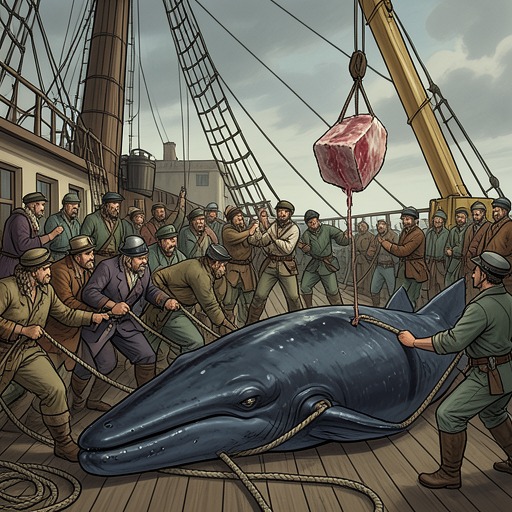
Stabu kills sperm whale
Moby-DickStubb’s killing of a Sperm whale is one of the Pequod’s most fully realized hunting scenes: a sleeping vessel is abruptly awakened, a boat is launched into pursuit, and coordinated labor drives a harpoon and lance into the whale until its heart bursts. The event produces both a practical victory and an uneasy image of mastery, because the same whale-line that joins the hunters to their quarry also exposes every human body to sudden death.
Discovery and Sudden Awakening
The attack begins after an interval of deceptive stillness. Ishmael, standing at the foremast-head, drifts into a dreamlike loss of consciousness while the other lookouts and the helmsman grow drowsy. The calm is broken when he returns to life and sees, less than forty fathoms to leeward, a gigantic Sperm whale rolling in the water. Its broad dark back glistens like a frigate’s overturned hull, while its tranquil spout makes it resemble a comfortable smoker. The resemblance is sharply ironic: the whale appears harmless and at ease, yet the narration immediately marks its pipe as its last.
The sight transforms the entire ship. Sleepers throughout the Pequod spring awake, voices answer the lookout’s cry, and the customary whale sighting becomes an instantaneous mobilization. Captain Ahab orders the boats cleared and takes control of the helm himself, driving the vessel into the attack before the helmsman can manage the spokes. The scene therefore moves from suspension to collective action in a single shock, converting a quiet ocean into an organized hunting operation.
The Boat Chase and the Whale-Line
Stubb’s boat advances through a mixture of command, exertion, and ritualized excitement. Daggoo strains at his oar like a pacing tiger, while Queequeg shouts a warlike cry and the oarsmen pull together under the force of the leading stroke. Tashtego rises to throw the harpoon. Once it strikes, the whale-line becomes the scene’s central mechanism: the boat is not merely following the whale but is physically connected to its flight.
The line races around the loggerhead, smoking from friction, and cuts through Stubb’s unprotected hands after his hand-cloths have fallen away. He compares the sensation to gripping an enemy’s double-edged sword by its blade while the enemy tries to wrench it free. The boat’s survival depends on controlling this dangerous connection, so the tub oarsman wets the line with seawater. As it tightens like a harp string, it seems to give the boat a second keel, one cutting through the air while the other cleaves the sea. The craft pitches and cants at every movement, and Tashtego crouches low at the steering oar to keep his balance while the whale tows the boat through boiling water.
The pursuit is therefore not a simple expression of human command. Stubb’s crew must exploit the whale’s strength while remaining exposed to it. Their progress depends on the very force that threatens to overturn them, and the line makes their relation one of mutual entanglement rather than detached observation. The episode’s larger whaling logic appears here in concentrated form: human skill converts animal power into motion, but the conversion remains perilous at every instant.
Harpooning and the Whale’s Death
When the whale slackens its flight, Stubb orders the crew to haul in. The men pull the boat toward the animal even as the line continues towing them. Ranging alongside the whale’s flank, Stubb throws dart after dart, repeatedly bringing the boat out of the way of its wallow and then back into position for another strike. The hunt becomes a sequence of advances and withdrawals, governed by the whale’s movement and the boat’s narrow margin of safety.
Blood begins to pour from the whale on every side, streaming behind it like brooks down a hill. The sea becomes a red wake, and the sunlight reflects the color into the faces of the hunters. White vapor shoots agonizingly from the whale’s spiracle while Stubb, breathing smoke from his pipe, hauls on each crooked lance and straightens it against the gunwale before driving it in again. The visual contrast between the whale’s white spout, the red water, and Stubb’s tobacco smoke gives the killing a ceremonial intensity, but it remains a materially precise act of repeated penetration and exhaustion.
As the whale’s resistance wanes, Stubb calls the boat close. He slowly churns his lance into the animal, as though searching for a swallowed gold watch that must not be broken before it can be recovered. The image makes the whale’s life into a hidden treasure and the lance into an instrument of extraction: what Stubb seeks is the innermost life of the fish. The whale then enters its flurry, rolling in blood and boiling spray. The boat drops astern and struggles blindly out of the violent turbulence before the hunters can see clearly again.
The final death is marked by the whale’s broken breathing. Its spout-hole dilates and contracts with sharp, cracking respirations; clotted gore rises into the air and runs down its motionless flanks. At last its heart bursts. Daggoo states that the whale is dead, and Stubb answers by identifying both pipes as smoked out, withdrawing his own pipe and scattering its dead ashes over the water. The gesture closes the contest through a grim parallel: the whale’s respiratory pipes and Stubb’s smoking pipes have both been exhausted, but only the whale has been killed.
Consequences and Whaling Context
Within the Pequod’s voyage, the event confirms the practical competence of Stubb, Tashtego, Daggoo, Queequeg, and the other boatmen. Their success depends on a chain of specialized actions: sighting, launching, rowing, harpooning, wetting the line, steering, hauling, darting, lancing, and escaping the flurry. The kill is collective even though Stubb directs its decisive stages. It displays the vessel’s ability to turn an encounter with a massive marine animal into coordinated labor and a valuable catch.
The scene also gives concrete force to the novel’s defense of whaling as a powerful global enterprise. Whaling is presented elsewhere as an industry whose lamps and candles burn around the world, whose fleets number hundreds of vessels and thousands of men, and whose ships carry oil and other products into international commerce. Stubb’s hunt is the violent local act beneath that worldwide system: a single whale’s body is transformed into a harvest, just as ambergris found in the whale’s bodily depths is treated as a valuable commercial substance. The killing’s immediate triumph thus belongs not only to the boat crew but to the larger economic and maritime network represented by the Pequod.
At the same time, the event prevents that industrial achievement from appearing clean or abstract. The water is filled with blood, Stubb’s hands are blistered by the line, and the boat nearly vanishes in the whale’s final turbulence. The whale is both quarry and active force, capable of dictating the boat’s speed, direction, and danger even while the hunters work toward its destruction. The episode’s value shift is consequently severe: a serene, living creature becomes a corpse, while the hunters move from drowsy vulnerability to exhilarated mastery, carrying away a victory that has required them to approach the limits of death.
Narrative Significance
The killing functions as a miniature of the Pequod’s broader relationship with the sea. It begins in a calm that conceals danger, passes through a violent entanglement of bodies and lines, and ends with a dead whale floating where a living presence had seemed almost domestically peaceful. The scene’s language repeatedly brings incompatible categories together: the whale resembles a frigate, a burgher, and a treasure-bearing body, while the boat becomes an unstable second-keel craft dragged through opposed elements. Such comparisons do not reduce the animal to a single meaning; they register the difficulty of seeing it as both creature and resource, both autonomous power and object of human extraction.
The whale-line extends this tension beyond the scene. Its apparent calm before the chase becomes an emblem of latent peril, and the danger experienced by Stubb’s crew anticipates the broader condition of all human life at sea. The hunt demonstrates that whaling depends on connection, but connection is never innocent: the line binds hunter and whale together while also threatening the hunter with mutilation or death. Stubb’s successful kill therefore stands as a triumph of courage and technique, but also as an image of the mortal cost hidden inside the commerce, glory, and worldwide reach of whaling.