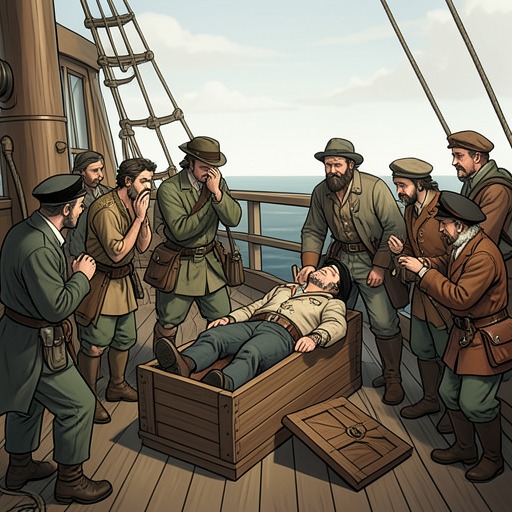
Pequod sailor lost at sea and Queequeg's coffin life-buoy
Moby-DickThe event titled Pequod sailor lost at sea and Queequeg's coffin life-buoy marks a decisive reversal in the Pequod's material and symbolic order. A sailor falls from the foremast while the ship is approaching the Equatorial fishing-ground, and the vessel's existing life-buoy fails to save him. When the crew cannot find a suitable replacement, Queequeg's coffin—made during his illness and intended as his final resting place—is sealed, rigged, and hung at the stern as a life-saving device. The episode binds death, failed technology, superstition, and survival into one of the voyage's most consequential preparations.
Disaster and Foreboding
The incident begins in an atmosphere already charged with apprehension. The Pequod has been steering south-eastward toward the Equator under Ahab's direction, crossing unusually empty waters in monotonous trade winds and calm seas. That unnatural quiet is presented as a prelude to violence rather than as safety. Near a cluster of rocky islets, the watch hears cries that sound like the wailings of drowned men. The Christian or civilized members of the crew interpret them as mermaids, while the pagan harpooneers remain unafraid; the old Manxman identifies them as the voices of newly drowned sailors.
Ahab later gives the sounds a natural explanation: the islands are inhabited by seals, and separated young seals or mothers seeking their cubs have produced the human-like cries. Yet the rational explanation does not dispel the omen. The crew's superstition is reinforced when, at sunrise, a sailor climbs to the foremast-head and soon falls into the sea. The narration leaves the precise cause unresolved, allowing sleepiness, inattention, or the hazardous transition from hammock to mast-head to remain possible explanations. What is certain is the suddenness of the fall: the crew sees a falling figure and then only a small heap of white bubbles in the blue water.
The Failed Life-Buoy
The Pequod's ordinary life-buoy is dropped from the stern immediately. It is a long, slender cask suspended by a spring and intended to be released in an emergency, but the device has deteriorated under prolonged exposure. The sun has shrunken the cask; the parched wood absorbs water through its pores; instead of remaining afloat, the iron-bound buoy follows the sailor to the bottom. No hand rises to seize it, and the supposed instrument of rescue becomes a second weight in the drowning.
The failure is both mechanical and interpretive. The sailor is the first man from the Pequod to climb a mast specifically to look out for the White Whale on the White Whale's own ground, so his death is treated by the crew as the fulfillment of an evil already announced by the nocturnal cries. The crew does not primarily read the event as a warning of future disaster; they regard it as the completion of a portent. The old Manxman resists that consoling interpretation, keeping the episode open between accident, supernatural sign, and the larger violence toward which the voyage is moving.
The Coffin Becomes a Rescue Device
With the original life-buoy lost, Starbuck is ordered to replace it. No cask light enough can be found, and the crew, consumed by the feverish expectation of the voyage's approaching crisis, has little patience for work not directly related to its final purpose. At that point Queequeg communicates that his coffin may serve. Starbuck reacts with startled reluctance, Stubb calls the proposal queer, and Flask observes that the Carpenter can adapt it. After a melancholy pause, Starbuck orders the coffin brought up and instructs the Carpenter to rig it.
The transformation reverses the coffin's original function. Queequeg had prepared it as a carefully furnished final bed: his harpoon iron and a boat paddle were placed inside, biscuits lined the sides, fresh water stood at the head, woody earth was set at the foot, sail-cloth served as a pillow, and Yojo rested between his crossed arms. He had tested its comfort, pronounced it easy, and returned to his hammock. The object therefore carries the marks of personal identity, ritual preparation, and anticipated death before it is converted into communal maritime equipment.
The Carpenter's work makes the conversion literal and technically exact. He nails down the lid, caulks the seams, pays them with pitch, battens the coffin tight, and hangs it from the ship's stern by a snap-spring. He plans thirty separate Turk's-headed life-lines, each three feet long, to hang around it so that, if the hull goes down, the ship's company will have multiple handholds. His unease about the improvised construction reveals the tension between professional standards and emergency necessity: a coffin is being forced into the role of a life-saving apparatus, and a grave-yard object is made to serve the living.
Consequences and Survival
The episode changes the relationship between death and rescue aboard the Pequod. The sailor is not saved because the ship's designed safety device has failed, while Queequeg's intimate possession becomes the replacement that remains available when ordinary equipment does not. The contrast exposes the fragility of the ship's technological order: survival depends not on a reliable system but on the repurposing of an object shaped by illness, ritual, and mortality.
The coffin's final significance is revealed only after the Pequod sinks. When the ship is destroyed, the sea closes over the vessel, the crew, and the objects of its doomed pursuit. Yet Ishmael survives by clinging to Queequeg's coffin life-buoy and is eventually rescued by the Rachel. The object prepared for Queequeg becomes the means by which the narrator escapes the catastrophe that kills the rest of the Pequod's company. Its meaning thus shifts again—from private coffin, to public life-buoy, to the material basis of the sole survivor's testimony.
Symbolic and Narrative Significance
The event is structured as a movement through separation, threshold, and reconstitution. The sailor's fall separates a human body from the ship's ordered community; the failed cask demonstrates that the established apparatus cannot bridge that separation; the coffin then supplies a new, improvised threshold between sinking and survival. The crew's ritual language and reactions make the transformation socially legible, while the Carpenter's labor gives it physical form.
The coffin also joins the Pequod's recurring pattern in which instruments of death become instruments of pursuit or survival. The ship's whaling technology is repeatedly exposed to failure, while objects associated with bodies and burial acquire unexpected practical power. In this episode, material culture carries memory: the coffin retains Queequeg's illness, his harpoon, Yojo, food, water, and earth even after its function changes. Its later role as Ishmael's buoy does not erase its funerary identity; it makes survival depend upon an object already marked by the expectation of death.
The event consequently anticipates the voyage's ending without simply predicting it. The sailor's disappearance and the sinking of the first life-buoy foreshadow the Pequod's destruction, while the replacement buoy quietly preserves a possibility the crew cannot yet recognize. The ship's collective pursuit leads toward annihilation, but the rejected or improvised remnant of Queequeg's personal world provides the means for a surviving voice. Death is therefore not overcome by command, prophecy, or perfected equipment; survival emerges from an unstable conversion of what the voyage had prepared for burial.