Pequod's compass reversal
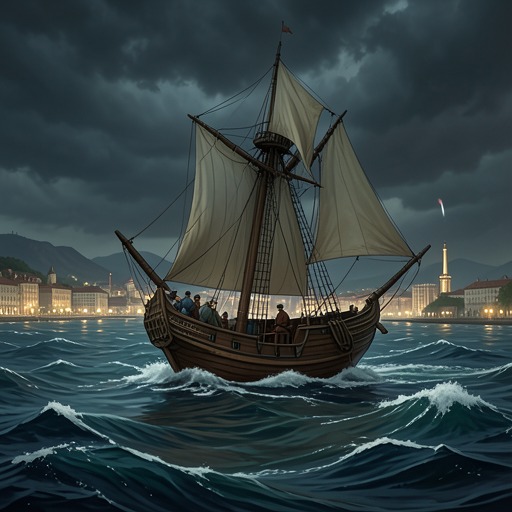
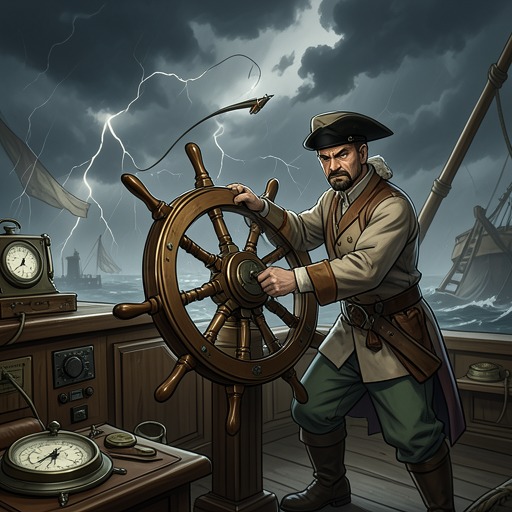
Moby-DickThe Pequod's compass reversal is a nautical accident that turns a storm's electrical force into a crisis of direction and authority. After the thunderstorm, the ship's two compasses point East even though the Pequod is unmistakably sailing West. Captain Ahab explains the reversal as a known effect of lightning, but he immediately transforms the damaged instruments into a test of command: he makes a new needle from a lance and a sail-maker's needle, magnetizes it before the watching crew, and triumphantly presents himself as master of the ship's altered magnetic world.
Circumstances and Discovery
The event follows a period in which Captain Ahab's navigation has already become increasingly independent of ordinary instruments. The Pequod has relied on assumed courses and other means of fixing its position, while its log and line have been used only rarely. Ahab has also rejected or damaged equipment that might limit his confidence in his own judgment, including the quadrant whose sight-tubes he had smashed. Against this background, the compass reversal is not merely a mechanical inconvenience. It strikes at the remaining material system by which the ship can determine where it is and where it is going.
The discovery comes in the morning after the storm, when the ship is moving under a strong wind. Ahab notices that the sunlight appears in the wrong relation to the ship's course. He first challenges the apparent heading, then thrusts his head into the binnacle and sees that both compasses point East while the Pequod is actually going West. The simultaneous reversal of both instruments makes the error collective rather than local: the entire ship's navigational reference has been displaced.
Technical Cause and Material Failure
Ahab identifies the thunder of the previous night as the cause, and the narrator supplies a practical account of the phenomenon. The magnetic energy of a mariner's needle is connected with the electricity displayed in the heavens; violent storms can therefore alter a compass, destroy its magnetic virtue, or leave its needle permanently useless. If the binnacle compasses are affected, the damage can extend to every other compass aboard, even one placed deep in the vessel. The event thus joins celestial violence to a precise failure in maritime technology.
The reversal is especially consequential because the compasses do not simply cease to function. They continue to give a definite direction, but that direction is wrong. Ahab can still steer by the inverted needles if he correctly understands their error, and he orders the yards hard up so that the Pequod changes course accordingly. Yet the apparent reliability of the instruments has become dangerous: their orderly motion conceals a fundamental inversion. The compass remains an object of use only after human interpretation has recognized that its authority has been corrupted.
Ahab's Countermeasure
Ahab refuses to let the damaged compasses define the meaning of the crisis. He orders Starbuck to bring him a lance without its pole, a top-maul, and a sail-maker's needle. With the maul, he knocks the steel head from the lance and has Starbuck hold the remaining iron rod upright without allowing it to touch the deck. He repeatedly strikes the rod, places the blunted needle upon it, and then suspends the needle horizontally by linen thread over one of the compass cards.
The procedure combines practical manipulation with theatrical uncertainty. The narrator leaves open whether Ahab's strange motions are necessary to magnetize the steel or are intended to increase the crew's awe. The new needle initially spins and vibrates, but eventually settles. Ahab then declares that the sun is East and that the compass confirms it. The improvised instrument does not restore the original equipment; it gives Ahab a substitute through which he can claim that his own intervention has overcome the storm's assault.
Authority, Fear, and Reversal
The technical accident becomes a scene of political theater aboard the Pequod. The crew watches with servile wonder, while Starbuck looks away. Ahab's success, or apparent success, reassures the men that their commander can master even a force capable of reversing the ship's instruments. The narrator explicitly locates Ahab's power in such displays: elsewhere, Ahab requires implicit and instantaneous obedience and uses the formal customs of the quarter-deck as external supports for an otherwise private dictatorship. Here, the compass provides another such support, allowing scientific uncertainty to be absorbed into personal authority.
The reversal also reveals the divided loyalty of the officers. Starbuck understands the danger more clearly than the others and has already considered whether Ahab should be prevented from dragging the whole crew toward destruction. He remembers that Ahab once pointed a loaded musket at him, and he recognizes the ship's favorable wind as favorable only to the pursuit of Moby Dick. Nevertheless, when the compasses turn, Starbuck issues the necessary orders and does not openly oppose Ahab. The sailors' fear of Ahab becomes greater than their fear of fate, while the harpooneers remain comparatively unmoved, responding instead to the magnetic force of Ahab's inflexibility.
Consequences and Significance
The compass reversal is both an external accident and a symbolic confirmation of Ahab's inward course. A navigation device that should establish orientation now points in the opposite direction, mirroring the way Ahab has made the Pequod's entire voyage serve his private feud with Moby Dick. When he sees the broken sight-tubes of the quadrant, he treats the damaged instrument and the altered compasses as successive challenges, asking whether the compass would have wrecked him as he had wrecked the quadrant. His answer is an assertion that he remains master of the magnetic level.
That assertion is unstable. Ahab's improvised needle may restore a usable bearing, but it cannot restore the moral or strategic direction of the voyage. The episode strengthens the crew's fascination with him while deepening the danger of their obedience. It also belongs to the chain of omens and material failures surrounding the Pequod: a storm, altered instruments, Ahab's damaged quadrant, and the crew's growing sense that ordinary safeguards no longer protect them. The event therefore functions as a practical correction in navigation and as a tragic reversal in which every instrument of guidance becomes another stage for Ahab's fatal pride.