Beppo’s failed search for Momo and ransom bargain
MomoBeppo Roadsweeper’s failed search for Momo becomes a coerced bargain with the Men in Gray: they promise that she can be returned if he keeps silent and saves one hundred thousand hours for them. To meet the demand, he abandons the patient rhythm and pride of his street-sweeping, turning his labor into a desperate attempt to buy Momo’s freedom. The episode shows how the Men in Gray extend their control not only by taking time, but by making a friend’s devotion serve their system of time-saving.
The search for Momo
Since the night Momo disappeared, Beppo had returned to the Amphitheater whenever his work allowed and waited there. As concern mounted, he decided to override Guido Guide’s objections and seek help from the police. He feared Momo might be shut away in a children’s home, but reasoned that even this would be preferable to captivity by the Men in Gray if she was still alive. He also believed that finding her was the first step toward helping her.
Beppo went to a police station on the city’s outskirts. He lingered outside, twisting his hat in his hands, before gathering the courage to enter and tell the desk sergeant that something dreadful must have happened. His effort was not treated as a credible report about Momo. After similar visits to other stations, where he was dismissed, sent home, or humoured, one inspector decided that Beppo might be a threat to society and ordered him taken to the cells. He spent half a day there before police drove him across the city to a white building with barred windows: a hospital for nervous disorders, not a prison as he had initially thought.
Confinement and the revelation
The hospital staff treated Beppo kindly and repeatedly asked him to tell his story. They did not openly challenge it, but he sensed that they did not believe him; despite his questions about when he could leave, they said their investigations were incomplete and kept him there. Beppo understood those investigations as a search for Momo’s whereabouts. The uncertainty of his confinement thus prolonged his hope that official help might still be under way, even as it left him unable to search freely.
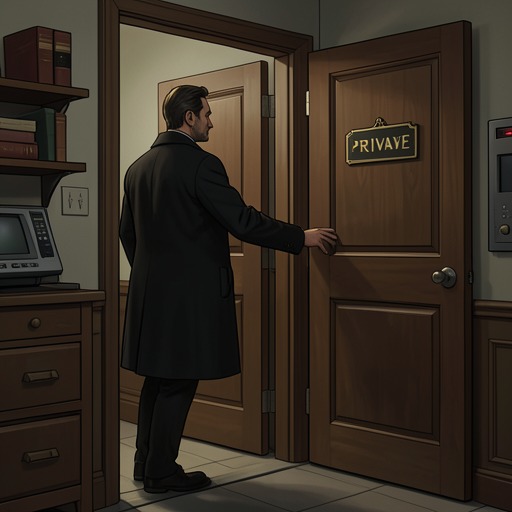
One night, in a large ward, Beppo noticed a figure beside his bed and recognized the visitor by his bowler and briefcase. The visitor was one of the Men in Gray. Beppo began to call for help, but the agent silenced him and asserted that the Men in Gray already had power over him. He also confirmed the fact Beppo most needed to know: Momo was their prisoner. The agent warned that Beppo’s attempts to find her were making her position harder, and claimed that further efforts would cause her to suffer. The threat turned Beppo’s hope of rescuing Momo into a means of frightening him into compliance.
The ransom bargain
The agent offered to have Momo returned only if Beppo never spoke again about the Men in Gray or their activities. The condition of silence came with a second demand: Beppo must deposit one hundred thousand hours of his time with them. The agent said the Men in Gray would handle the banking and that Beppo’s task was simply to save the hours. If he agreed, the agent promised that Beppo would be released within a few days; if he refused, he would remain confined for as long as Momo remained in their hands.
Beppo agreed. His decision came under the pressure of his confinement and the agent’s claim that Momo’s safety depended on what he did. The bargain joined two forms of leverage: the Men in Gray made Beppo’s freedom conditional on his obedience, and made Momo’s return conditional on his silence and labor. He stopped telling his story from that night onward. When people asked why he had told it before, he only looked sad and shrugged. The hospital authorities discharged him a few days later, but his release was not the end of his captivity to the bargain.
Labor turned into payment
Instead of going home, Beppo went straight to the depot where he and his workmates collected their brooms and handcarts. He began sweeping the city, but no longer worked in the way that had once given his labor its distinctive rhythm: a breath before each step and each stroke of the broom. He hurried, without pride, intent only on saving time. The change sickened and tormented him because he understood it as a betrayal of beliefs he had held throughout his life. He would have endured poverty rather than give those principles up for himself; with Momo’s ransom at stake, he believed that saving time was the only means available to him.
Beppo swept day and night, never returning to his shack near the Amphitheater. When exhaustion overcame him, he slept for a few minutes on a park bench or even a kerb, then woke with a guilty start and resumed work. He reduced meals to hurried snacks eaten while moving. Weeks and months passed, autumn gave way to winter, and he continued. His old, measured approach to work had made each step and stroke part of a patient progression; now the same task was driven by the demand to accumulate hours as fast as possible.
The wider logic of time-saving
Beppo’s bargain belongs to a system the Men in Gray have already been establishing across the city. They know that time is bound to human life, and plan secretly to take control of people’s time before their victims understand what is happening. Their recruitment of Mr Figaro shows how that system enters ordinary work: the gray agent urges him to shorten customer visits, cut conversations, and measure an apprentice’s work by the minute. Mr Figaro then subjects customers and employees to a timetable and displays a notice declaring that saved time is doubled.
The promise of efficiency conceals its cost. People do not notice that saving time means losing something else, and life becomes poorer, bleaker, and more monotonous; children feel the deprivation especially because adults no longer have time for them. Beppo’s response makes that cost intimate and visible. He does not embrace time-saving as a personal improvement: he adopts it under threat, in the hope of recovering Momo. Yet the hours demanded from him are extracted through the very habits the Men in Gray promote, while his patience, pride in his work, rest, and ordinary life are all sacrificed to the demand. The episode therefore makes the ransom both a plot mechanism and a concentrated example of the book’s central reversal: the more people save, the less they have.