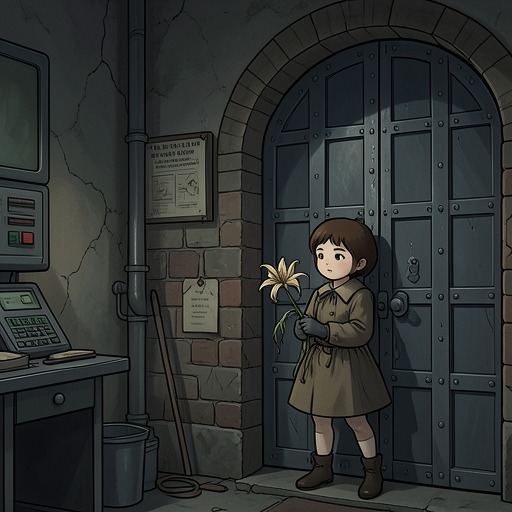
Momo closes the time-store door and defeats the Gray Men
MomoMomo closes the Time Warehouse’s cold-storage door and defeats the Gray Men by turning an Hour-Lily into the means of shutting off their supply. The episode reverses the balance of power: the Gray Men, who have made other people’s time an instrument of control, become dependent on a single dwindling flower, while Momo and Cassiopeia use patience, foreknowledge, and movement to outlast them. The door’s closing converts a desperate attempt to escape into the decisive act that ends the Gray Men’s pursuit.
The stakes of the door
The action draws force from the book’s account of time as more than a measurable resource. Clocks and calendars can count it, but an hour may feel long or pass quickly according to how it is lived; time is life itself, residing in the human heart. The Gray Men understand that principle as a means of exploitation. Their knowledge of time resembles a predator’s knowledge of what it consumes, and their concealed plan is to enter people’s lives gradually, take over their choices, and keep their activity unnoticed.
The earlier story of Mr Figaro shows what that theft looks like in ordinary life. The Gray Men’s agent urges him to cut each customer’s visit from half an hour to fifteen minutes, shorten time with his mother, send her to a cheap old folks’ home, sell his budgerigar, see Miss Daria less often, and give up singing, reading, and conversation. Mr Figaro adopts the measures as though they were his own resolutions. He becomes curt with customers, hires two assistants, and monitors their every movement according to a timetable beneath a notice declaring that saved time will double. He also sends Miss Daria a brief note ending their meetings, sells the bird, and reduces visits to his mother to once a month. Though he saves minutes, his work loses its pleasure and his life narrows. The warning that people save time yet have less of it gives the later struggle at the cold-storage door its larger meaning: the Gray Men’s power is built on converting life into something they can store and consume.
Momo closes the cold-storage door
With the door open, the Gray Men can obtain fresh cigars, and Momo sees no way to move the heavy door herself. Cassiopeia nudges her and communicates the necessary instruction: shut it. When Momo doubts her ability, Cassiopeia insists that she will manage and directs her to use the flower. Trusting the tortoise’s advance knowledge, Momo sets her down and hides the Hour-Lily inside her jacket. The flower is already wilting and has lost most of its petals, so the opportunity is limited.
Momo goes down on all fours and crawls beneath the conference table, moving unseen toward the door. Her route takes her close to the Gray Men’s six pairs of legs, and her heart pounds as she reaches the far end. She carefully removes the flower, grips its stem between her teeth, and crawls the remaining distance without being noticed. At the door she touches it with the Hour-Lily and pushes at the same time. The well-oiled hinges make no sound as the door swings shut; only when it closes does a mighty clang ring through the chamber and the underground passages. The silent movement has concealed her action until the barrier is already in place.
The Gray Men are left rooted in their chairs, shocked to discover that Momo can move during the universal standstill. Momo immediately runs for the exit. They recover and pursue her, but the consequences of the closed door are already clear to them: they cry out that they need to seize her flower, because without access to it they are finished. The resource they treated as secure has become a dwindling object in Momo’s hands.
The pursuit turns against the pursuers
Momo disappears into the tunnels. The Gray Men know the maze better, but she manages to evade them by zigzagging. Cassiopeia, though able only to crawl, contributes a different advantage: she knows in advance where the pursuers will go and positions herself in their path. The Gray Men trip over her, and those following stumble over the fallen men. Cassiopeia’s intervention repeatedly saves Momo from capture, even as the rushing feet send the tortoise hurtling against walls. She continues despite being knocked aside, acting on what she already knows she will do.
The pursuit also exposes how completely the Gray Men depend on their cigars. Several, driven by their craving for the Hour-Lily, drop their cigars and vanish one after another. Only two remain. Momo doubles back to the conference chamber, where they chase her around the table and fail to catch her. When they split up and run in opposite directions, one approaches the flower while the other pulls him away, each claiming it for himself. Their contest makes the danger they face visible: the need that once bound them to their enterprise now turns them against one another.
In the struggle, one knocks the other’s cigar from his mouth. The cigar-less man groans, turns transparent, and vanishes. The last Gray Man advances on Momo with only a tiny smouldering cigar butt. He demands the flower, but the butt falls and rolls beneath the table. He throws himself down and reaches for it without success; then, facing Momo, he struggles upright and raises a trembling hand. He acknowledges that he is glad it is over, and disappears too. The sequence leaves Momo staring at the place where he stood. Cassiopeia then appears and indicates that Momo will open the door, shifting the scene from the Gray Men’s defeat toward the next necessary action.
Consequences and significance
The episode resolves the immediate confrontation through a chain of material limits rather than a contest of strength. The Hour-Lily is fading; Momo cannot move the door unaided; Cassiopeia supplies the plan and uses her foreknowledge to obstruct the chase; and the Gray Men’s cigars prove essential to their continued presence. Once the door shuts, their access to fresh supplies is cut off, and their pursuit accelerates their own collapse. Momo does not overpower them so much as recognize the dependence that makes their apparent control fragile.
That reversal completes the scene’s moral contrast with the Gray Men’s earlier campaign of efficiency. Their method reduces human relationships and pleasures to time that can be saved, scheduled, and appropriated. Here, however, time cannot be secured by calculation alone: the rescue depends on Momo’s care in carrying the nearly spent flower, Cassiopeia’s loyal assistance, and the persistence required to cross the chamber unseen. The closed door is therefore both a practical barrier and a break in the Gray Men’s system of supply. Their disappearance ends their immediate threat; Cassiopeia’s final message makes clear that Momo’s work is not yet complete.