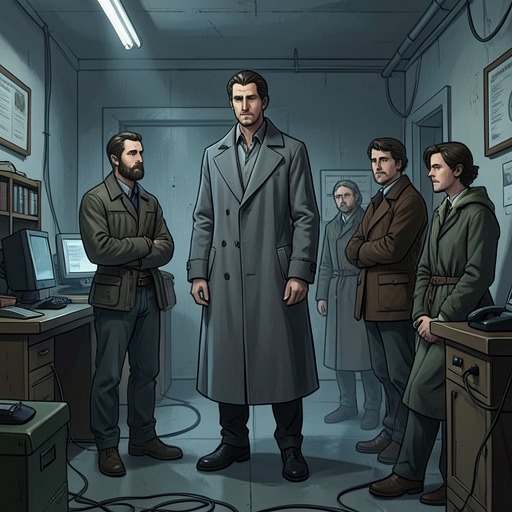
Momo refuses the Gray Men’s bargain at the square
MomoMomo’s refusal of the Men in Gray’s bargain turns a promise to reunite her with her friends into a direct test of whether that promise can outweigh the danger posed to Professor Hora and to everyone whose time the Men seek to take. Cornered in a deserted square, she hears their real purpose and declines to guide them, even though she is so cold and exhausted that speaking is difficult.
The square and the trap
Momo reaches a huge, empty square whose dark, featureless buildings stand against the night sky. It is not a welcoming public place with trees or a fountain, but an expanse with no recognizable landmark to direct her. A clock begins chiming as she crosses it, perhaps signaling midnight. She fears that if the gray man she was meant to meet is waiting at the Amphitheater, she will arrive too late and lose the chance to save her friends. Lost and uncertain what to do, she chews her knuckles.
The scene’s isolation changes abruptly when cars, advancing slowly with their engines purring, stop bumper to bumper in a ring centered on Momo. The Men in Gray get out but stay beyond the headlights, so she cannot count them; she can only sense their many unfriendly eyes in the darkness. Their arrangement makes the square feel less like a place to cross than a space they have closed around her. Momo is physically surrounded, while the offer that follows tries to make her choose between her friends and the person the Men want to reach.
The offer and its confession
The Men begin by agreeing to tell the truth, though the effort visibly strains them: Momo hears what sounds like a gasp from a thousand throats. The unusual pause gives the disclosure weight. The truth is not merely a more persuasive version of their bargain; it reveals the scale of their ambition and the danger hidden inside their request.
They say they want Momo to show them where Professor Hora lives. In return, they promise to give her friends back and let them resume their former carefree life. Their appeal is carefully framed as a fair exchange: a guide to Hora in return for the friends whose safety Momo has reason to fear for. When Momo asks what they want with him, they first try to turn her concern aside, insisting that he can look after himself and suggesting they will not harm him if he cooperates. The reassurance immediately reveals its limit: if he does not cooperate, they have ways of making him.
The Men then disclose that they no longer want to collect people’s time hour by hour, minute by minute, and second by second. They want all of it at once, and they expect Hora to hand it over. Their demand makes clear that the proposed meeting is not an ordinary visit or negotiation. Hora is the person they believe can give them access to the totality of time they covet, and Momo’s role would be to lead them to him.
When Momo asks what will happen to the people to whom that time belongs, the answer is more revealing still. The speaker dismisses people as obsolete and declares that the Men will rule the world. They then soften their tone and offer an exception: if Momo and her friends stop interfering, they may remain the last and only people allowed to play games and tell stories. The promise of safety and play is therefore conditional on silence and submission; it does not undo the Men’s stated plan for everyone else.
Momo’s refusal
Momo asks what the Men mean to make Hora do, and what will happen to the people whose time they intend to take. Her questions keep the threatened people in view even as the Men try to reduce the matter to her personal concern for her friends. This contrast sharpens the choice: the bargain offers a private rescue in exchange for helping the Men pursue a much larger seizure.
Almost fainting with cold, Momo struggles through several attempts before answering that even if she could help, she would not. The Men challenge the premise of her refusal because she has visited Hora and must know the way. Momo replies that she would never find it again: she has tried, and only Cassiopeia knows the route. Her response is both a moral refusal and a statement of the practical limit the Men’s demand ignores. She will not guide them, and she cannot supply the path they want.
Stakes and significance
The encounter exposes the Men in Gray’s ambition in their own account: they want to stop gathering time in small increments, compel Hora to give it all up, and rule a world in which they regard people as obsolete. Their promised return of Momo’s friends cannot be separated from that ambition, because it is offered specifically to secure her cooperation. The scene thus turns a desperate hope of saving her friends into leverage against her, while revealing that the Men’s apparent bargain depends on her helping endanger others.
Momo’s answer does not resolve the friends’ situation or bring her to Hora. It does establish the boundary the Men cannot purchase with a promise of reunion: she will not show them the way. The episode’s tension rests on the distance between their confident assertion that she must know the route and her actual inability to find it again. Faced with a ring of cars, an unseen crowd, and a conditional offer made in the cold, Momo refuses both the role they assign her and the bargain’s moral terms.