Children's Depot Policy
MomoThe Children's Depot Policy is the citywide system that takes children out of streets, parks, and freely chosen play and places them in supervised institutions. Presented as a response to neglect and disorder, it turns children’s time into something adults and authorities claim the right to manage—and helps leave the Amphitheater, once alive with games, silent and deserted.
Origins and Rationale
The Men in Gray cannot detach the children from Momo by bringing them directly under their control, so they enlist adults to achieve the same end indirectly. Parents and other grown-ups supply arguments that make coercion sound like care: busy parents cannot look after their children; unsupervised youngsters might run wild, become delinquent, or obstruct traffic; and the authorities should protect them from danger and neglect. One strand of the case is explicitly economic, treating road accidents as costs that could be put to better use.
The policy’s broader justification casts children as material to be prepared for a future dependent on computers and nuclear energy. In this account, self-directed play wastes years that should be spent becoming useful experts and technicians. The Men in Gray favor the proposal, and their influence helps convince the authorities to act. The shift is consequential: children’s own activities are redescribed as a social problem, while adult supervision and preparation for work are presented as solutions.
Rules and Enforcement
Large buildings called child depots appear in every neighborhood. Children whose parents are too busy to care for them must be deposited there and can be collected when convenient. The rules also ban children from playing in streets, parks, or anywhere else outside the depots. A child caught playing is taken immediately to the nearest one, while the parents face a heavy fine. The system thus combines centralized supervision with punishment for both children and families who do not comply.
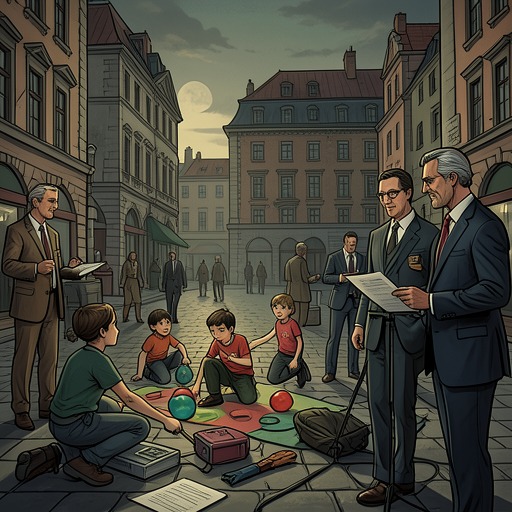
The policy reaches Momo’s entire circle of young friends. They are sorted according to the districts they come from and sent to different depots, breaking up the group that had gathered in the Amphitheater. Inside, supervisors choose the games, which must serve a useful educational purpose. Children can still be told to play, but they no longer decide what play will be or make its rules together.
Effects on Play and the Children
The contrast with the children’s earlier games is stark. Before the depots, Momo’s presence helped children invent new games day after day, though she did not need to supply ingenious suggestions herself. A boy could propose turning the Amphitheater into the research ship Argo, bound for perilous seas and the Travelling Tornado; when Momo arrived, the imagined voyage could become vivid and shared. Such play depended on the children’s capacity to supply what the scene did not literally contain.
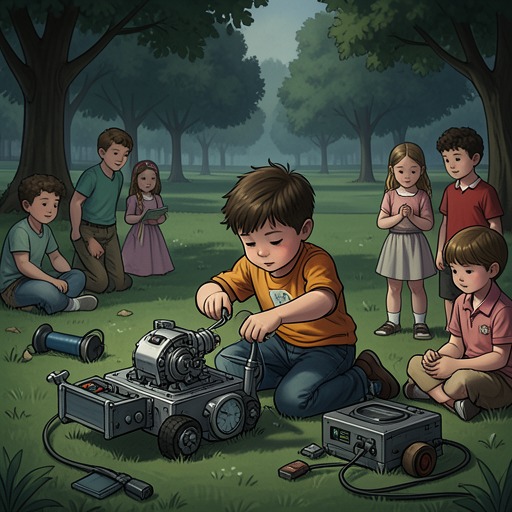
The city’s earlier drift toward ready-made diversions already showed what was at stake: elaborate remote-controlled tanks, rockets, and robots left little to the imagination, and their owners watched them, mesmerized but bored. The depots extend that narrowing from toys to institutions. There, prescribed educational games displace games of the children’s own devising. They learn the assigned activities but, in the process, lose the ability to find happiness, take pleasure in small things, and dream.
After weeks in the system, the children resemble miniature time-savers: sullen, bored, and resentful, they obey instructions but no longer know what to do when left to themselves. Their noise has changed from the joyful clamor of shared play to an angry, ill-tempered sound. The Men in Gray need not approach them directly; the close-knit controls across the city leave even resourceful children unable to escape the system, and the Amphitheater stands empty.
Later Signs of Its Reach
When Momo later encounters Paolo, Franco, and Maria in the city, she can hardly recognize them. They wear gray uniforms and have stiff, lifeless expressions; they barely smile at her invitation to return to the Amphitheater and play. Franco explains that they are going to a play class, where they are taught how to play. That day’s activity is data retrieval, a useful exercise in which the children pretend to be punch cards and must concentrate intensely.
The scene makes the policy’s transformation visible in the children themselves: play has not disappeared as a word, but has been reorganized as an assigned lesson. Against the spontaneous games that once made the Amphitheater a place of invention and companionship, the depots impose separation, supervision, and utility. Their effects show how a system justified in the language of protection and preparation can diminish the very capacities—imagination, shared initiative, and enjoyment—that children’s play had nurtured.