The Gray Men's Unnoticed Presence
MomoThe Gray Men's Unnoticed Presence is not literal invisibility but a persistent failure of attention and memory, a condition that lets the Gray Men move through the city in plain sight without attracting sustained notice. Their secrecy depends less on hiding their bodies than on preventing people from recognizing their presence as significant. The contrast between Momo’s brief, physical encounter with them and their later explanation of their work reveals how this unnoticedness protects the Timesaving Bank’s theft of human time.
How Their Presence Goes Unnoticed
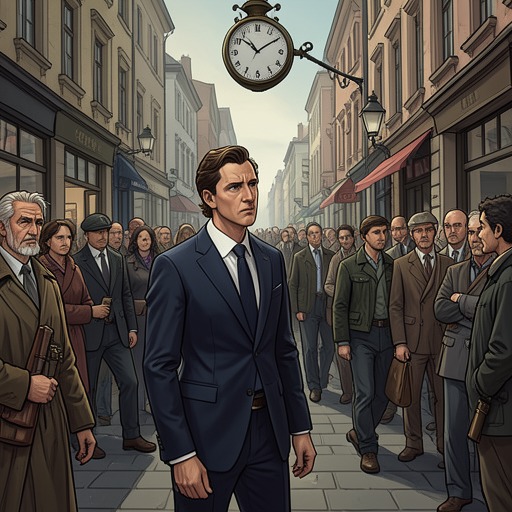
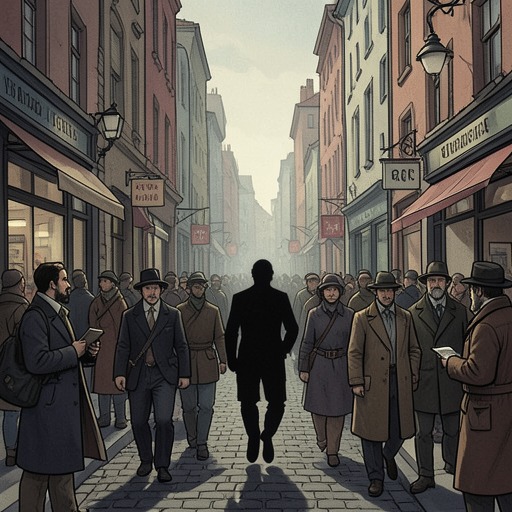
The Gray Men are not invisible. People see them, but do not properly notice them; even when someone catches sight of one, the encounter may soon disappear from memory. Their inconspicuousness is therefore more than a matter of appearance: it disables the ordinary sequence by which seeing becomes recognition, and recognition becomes a question about who the strangers are and what they are doing. The Gray Men can be present without becoming a subject of thought.
Their numbers grow day by day, yet that increase prompts no inquiry into where they came from or where they continue to come from. The absence of questions is part of the condition’s effect. It does not merely protect individual encounters from scrutiny; it prevents the city from assembling those encounters into evidence of a growing collective presence. The Gray Men’s expansion thus proceeds alongside public unawareness, each reinforcing the other.
Their movements make the contrast especially stark. They drive smart gray limousines through the streets, haunt buildings and frequent restaurants, and sometimes write in little gray notebooks. Their clothes, faces, bowler hats, cigars, and steel-gray briefcases make them visually distinctive, not concealed. Yet the repeated grayness seems to turn conspicuous detail into a kind of camouflage: they are everywhere and visibly marked, but those marks do not prompt people to attend to them as a group with a purpose.
Momo’s Brief Recognition
The Gray Men’s reconnaissance of the ruined amphitheater shows that their unnoticedness also creates a danger that can approach its targets without warning. While Guido Guide remains unaware that several of them have inspected the place and recorded notes, Momo sees shadowy figures peering over the building’s edge. They signal to each other and confer, but she cannot hear what they say. She has perceived them, yet their activity remains unreadable to her.
Her first response is bodily rather than explanatory: she shivers as she has never shivered before and pulls her baggy jacket tightly around herself, without relief. The chill is not ordinary cold. This moment briefly interrupts the Gray Men’s usual invisibility to attention, but Momo does not yet understand who they are or what their presence means. That night she hears none of the soft but majestic music she often hears; the following day, life seems to proceed as usual, and she soon forgets the strange visitors too. Even her exceptional glimpse does not immediately free her from the same lapse that protects them from everyone else.
Secrecy and the Theft of Time
When a Gray Man is confronted by Momo, his account makes explicit what the earlier scenes had shown through action. He says, “We have to remain unrecognized,” and insists that no one must know of the Gray Men’s existence or activities. They deliberately ensure that people do not remember them because their business can continue only if they pass unnoticed. The secrecy is thus not incidental to their work; it is a necessary operating condition.
The same confession identifies what that secrecy conceals. The Gray Men bleed people of time by the hour, minute, and second, draining and hoarding what people save. They claim to understand time’s value while human beings do not, and their need grows as their own numbers grow. Their expanding ranks and their systematic theft are linked: more Gray Men require more time, while unnoticedness allows the extraction to continue without effective resistance. The ordinary movement through streets, buildings, and restaurants is the public face of a hidden economy.
Exposure and Narrative Significance
Momo’s question about whether anyone loves the Gray Man unsettles him. He admits that someone like her threatens the Timesaving Bank’s survival: if many people were like Momo, it would have to close and the Gray Men would dissolve into thin air. His response suggests that her capacity to attend to another person, rather than accept the encounter as ordinary, challenges the condition on which their existence depends.
Under that pressure, the Gray Man’s explanation pours out against his will; his face convulses with horror before he clamps his hands over his mouth and seems to emerge from a trance. He then stammers that he is ill and accuses Momo of spying on him. His abrupt retreat into denial does not undo the disclosure. Instead, it dramatizes the strain between the Gray Men’s need to remain unrecognized and the moment when one of them is forced to describe that need aloud.
The state also shapes how the threat is introduced to the reader. The Gray Men first appear as an invading presence that is already spreading, but whose progress goes unnoticed; Momo’s glimpse supplies a bodily warning before the plot supplies an explanation. Her later forgetting shows that recognition is fragile, while the Gray Man’s confession names the system behind that fragility. Unnoticedness is therefore both a tactic of concealment and a narrative mechanism: the danger can be visible from the beginning and still remain, for a time, unseen.