Dissolution After Losing Time
MomoDissolution After Losing Time is the consequence the novel gives to the complete deprivation of time: a person dependent on it gradually disappears. The sentence imposed on Agent No. BLW/553/c turns the story’s idea that time is life into an immediate, visible outcome, while contrasting that total loss with the smaller losses hidden inside ordinary efforts to save time.
The Meaning of Time
The episode rests on the distinction between clock time and lived time. Calendars and clocks measure hours, but the same hour may seem to pass quickly or stretch out depending on how it is spent. The novel presents time not merely as a quantity a person possesses, but as life itself, residing in the human heart. On that account, losing time is not simply losing a resource: it is losing the condition that sustains a human life.
The Men in Gray understand this relationship and treat time as something to take and control. Their expertise is compared to that of leeches on blood, and their plans depend on entering people’s lives unnoticed. The agent’s fate later reveals the peril beneath their scheme: time is not only something they steal from others but also what they themselves need in order to exist.
The Sentence and Its Consequence
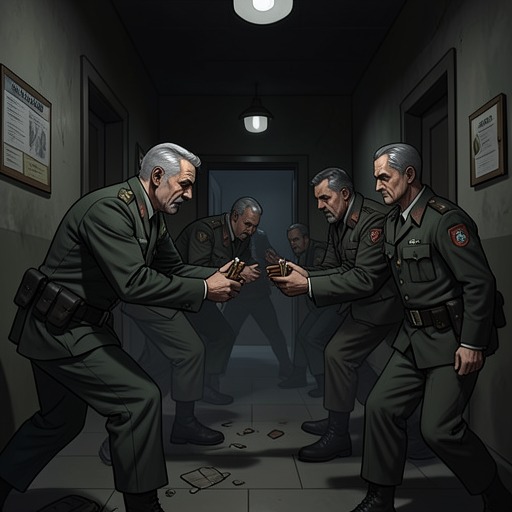
At the trial, Agent No. BLW/553/c pleads guilty to high treason. The judges sentence him to be deprived of all time immediately. Two Men in Gray take away his steel-gray briefcase and small cigar; once he has lost the cigar, he begins to grow transparent. His cries fade as he gradually disappears, leaving only a brief trace of ash before that, too, is gone. The sequence links the sentence directly to the vanishing, without offering a separate explanation of its mechanics.
The other Men in Gray then disperse, including the judges and spectators. Their swift departure leaves the deserted Municipal Garbage Dump as the scene’s remaining setting, while the condemned agent’s disappearance supplies the sentence’s final proof. The episode makes the punishment more than a legal declaration: the loss of time removes the agent from the world.
Saving Time and Losing Life
The agent’s dissolution is the stark counterpart to the gradual impoverishment of life elsewhere in the novel. Following the gray visitor’s advice, Mr Figaro cuts the time he spends with customers, reduces his visits to his mother, and organizes his barbershop around a precise timetable. He watches his assistants to ensure that no moment is wasted. These measures do not make time-saving an equivalent of the agent’s sentence, but they show how the same logic enters ordinary routines by treating human attention and companionship as waste.
The wider consequence is a life that becomes poorer, bleaker, and more monotonous, with children especially affected because adults no longer have time for them. The novel’s paradox is that the more people save, the less they have. Against this slow erosion, Agent No. BLW/553/c’s abrupt disappearance is an extreme and concentrated image of the same underlying principle: when time is severed from life, what remains cannot endure.