Time at a Standstill
MomoTime at a Standstill is the condition in which the world’s clocks stop and the city becomes motionless, while Momo remains able to move. The pause makes the novel’s central contrast tangible: time cannot be secured by treating life as a resource to be saved, but its return can restore what the Men in Gray have taken from people.
The Meaning of Time
The stillness reverses the logic that has governed the city since the Men in Gray began their quiet campaign. The story establishes time as more than what calendars and clocks measure: an hour may seem long or brief depending on how it is lived, and time is identified with life itself, which resides in the human heart. The Men in Gray understand time’s value as exploiters understand the resource they consume. They secretly enter people’s lives, identify those they can manipulate, and wait for the moment when each can be drawn into their plan.
Their influence spreads through an ideal of efficiency. The agent who recruits Mr Figaro recommends reducing customers’ visits, cutting time spent with his mother, dismissing his bird, and abandoning music, reading, and conversation. Mr Figaro follows these instructions, shortens each customer’s appointment, hires assistants, and watches their use of time. A notice in his barbershop declares that saved time will double, but his days instead seem to grow shorter. As the campaign spreads, advertising promises that time-saving will make a better life possible, while people become tired, irritable, and unable to enjoy their work or tolerate silence. Old buildings give way to standardized housing and straight streets; people’s lives, like the new streets, seem planned to run in a single direction. The stillness later exposes the failure beneath that promise: saving time has not made it more available.
The Onset of Stillness
At Nowhere House, Momo opens the small door bearing Professor Hora’s name, then forces open the heavy bronze front door and returns to the great hall with Cassiopeia. A sudden jolt follows. It is described as a timequake rather than an earthquake, accompanied by a sound likened to a sigh from the depths of the ages. The interruption is brief, but it changes the conditions of the world around her.
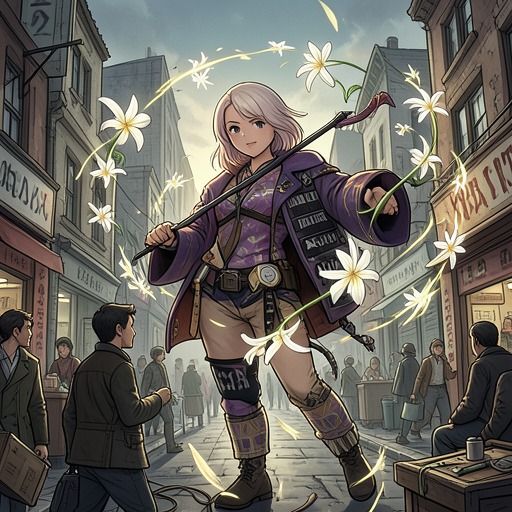
Clocks stop ticking, whirring, and chiming; pendulums halt at unexpected angles. A large hour-lily appears in Momo’s hand without her feeling it being placed there. She can walk and sit, but the rest of the room cannot respond to her: the chair is hard and unyielding, and the breakfast remains fixed in place. Chocolate in a cup, honey, and crumbs are as immovable as the furniture. The change is therefore not merely a silence among clocks. Time’s stoppage arrests ordinary material life as well, while leaving Momo able to act within it.
The Frozen City and the Men in Gray
The Men in Gray soon realize that the stoppage reaches beyond Nowhere House. One reports that their agents’ cars have stopped and that everything in the world is at a standstill; their supply of time has been cut off. They interpret the event as Professor Hora having switched time off. Their alarm makes plain how completely their existence depends on the time they have been stealing: without any more to obtain, even their remaining supply is in question.
When Momo emerges, the city presents familiar activity arrested mid-gesture. Cars choke the streets, their drivers frozen at the wheel; cyclists remain poised at junctions, and pedestrians stand like wax figures. Traffic policemen are caught waving vehicles on, whistles in their mouths. Pigeons hang motionless above a square, an aeroplane is fixed overhead, and water, falling leaves, and a small dog are all held in place. The city resembles a photograph of life rather than life continuing.
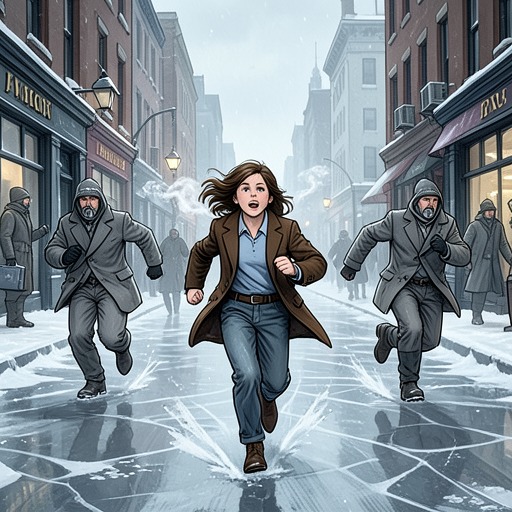
The Men in Gray, by contrast, can still run. They flee from Nowhere House toward the city, and Momo follows them at a cautious distance, carrying a flower and holding Cassiopeia. The pursuit reverses the usual relation between pursuer and pursued: a girl and a tortoise trail a column of fleeing gray figures through an otherwise frozen world. The Men in Gray are exhausted by the effort and, absorbed in their flight, stop noticing their surroundings. Some lose their Gray cigars while running and vanish before they can recover them. Their movement is not freedom; it is a desperate attempt to escape the consequences of having lost access to the time on which they depend.
Restoration and Consequence
The suspension ends when the stolen hour-lilies return to people’s hearts. A cloud of flowers descends over the frozen earth and disappears as the flowers reach their true home. At the same moment, time begins again: traffic moves, whistles sound, pigeons resume circling, and the dog continues its interrupted action. The pause has lasted an hour, but nobody notices it, because nothing moved during the interval. From the city’s perspective, the return happens in an instant.
People suddenly find that they have time to spare, though they do not understand that their own time has been restored to them. The stillness thus resolves the story’s contrast between apparent economy and actual loss. The city had become faster, more standardized, and less hospitable to work, relationships, leisure, and silence; none of that efficiency had given its inhabitants more life to use. Once time resumes, the people regain what the Men in Gray had taken, without recognizing the cause. Momo returns to the side street where she last saw Beppo Roadsweeper, who is again leaning on his broom without hurrying and seems brighter and more hopeful. The renewed ease in his posture offers a small, personal counterpart to the city’s return to motion: restored time can be felt not only in resumed activity but in the possibility of no longer being driven by haste.