Time-saving society
MomoThe time-saving society is the city’s gradual conversion to an order in which efficiency governs work, relationships, leisure, public space, and childhood. Fostered by the Men in Gray, it promises people more time for a better future but instead leaves them with days that seem to race away and lives made poorer, more monotonous, and less connected. Its most consequential reach is not simply that people work faster: it reshapes what they consider worthwhile and eventually turns the city’s children into targets of administrative control.
Origins and governing promise
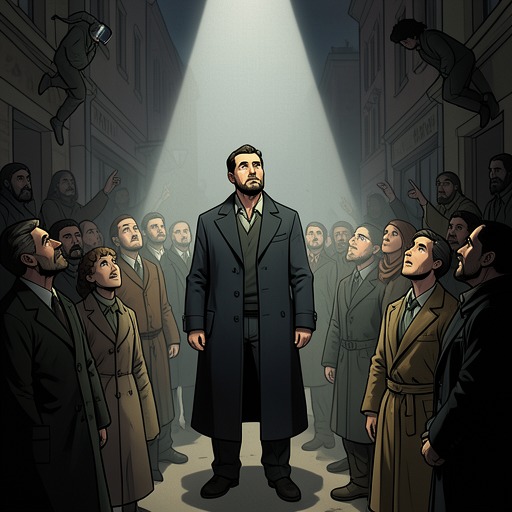
The society takes hold against the story’s distinction between clock time and lived time. Calendars and clocks can measure an hour, but the same hour may feel long or fleeting depending on how it is spent. The underlying principle is that time is life, and life resides in the human heart. The Men in Gray understand the value people attach to every minute and second, and quietly install themselves in the city to take control of inhabitants’ time. They identify potential targets in advance and wait for circumstances that will make their intervention persuasive.
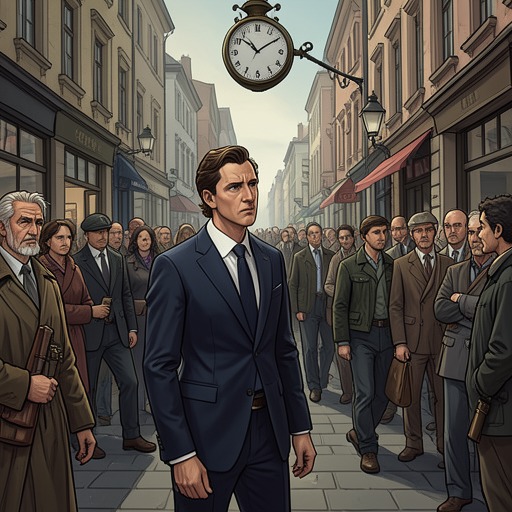
Their method is to present the surrender of ordinary pleasures as an individual’s own practical decision. When Mr Figaro asks how to save time, the gray agent advises him to shorten customer appointments, reduce visits to his mother, put her in an inexpensive old folks’ home, sell his budgerigar, see Miss Daria less often, and give up singing, reading, and conversations with friends. The recommendations make efficiency seem measurable and manageable, but together they strip time from work, family ties, affection, and enjoyment. Mr Figaro accepts the program without learning where the saved time goes; after the visitor disappears from his memory, he believes the resolution is his own.
Work discipline and everyday life
Mr Figaro’s barbershop becomes a small-scale model of the new order. He first handles a customer in twenty minutes rather than the usual thirty, then applies the same shortened routine to everyone. He hires two assistants in addition to his apprentice and watches them closely so that no moment is wasted. A timetable and a notice declaring that saved time is doubled make the new discipline visible in the shop. His work no longer gives him pleasure, but he treats that loss as less important than saving time.
The policy also reorganizes the relationships around him. Mr Figaro sends Miss Daria a brief note ending their meetings, sells his budgerigar, and reduces his visits to his mother to once a month. He follows the gray agent’s proposals as if each were his own choice. Yet the promised surplus never becomes available to him: he grows restless and irritable, and the time he saves seems to vanish. His days grow shorter; weeks, months, and then years pass with increasing speed. Even when he occasionally notices the acceleration, alarm strengthens his determination to save still more time. The society’s central contradiction thus enters private life as a compulsion: the less time its adherents feel they have, the more urgently they follow the rules meant to provide it.
A city remade for efficiency
The doctrine spreads beyond individual workplaces. Radio, television, and newspapers promote timesaving devices with the promise that people will eventually be free to live properly. Posters on walls and billboards associate speed with success and prosperity. Notices urging people to treat time as money appear not only in factories and offices but above executives’ desks and in doctors’ rooms, shops, restaurants, department stores, schools, and kindergartens. The presence of such instructions in settings across the city makes efficiency a public norm rather than a private preference.
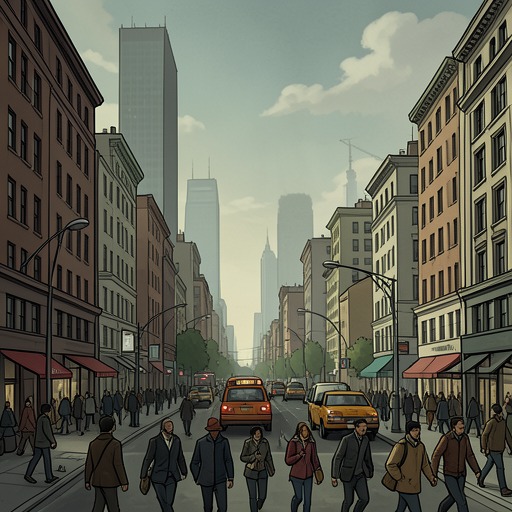
The visible city changes accordingly. Older buildings are demolished and replaced with modern structures stripped of features now considered unnecessary. Rather than designing homes for the different people who will live in them, builders produce identical housing because uniformity is cheaper and saves time. On the northern outskirts, vast developments of multistorey tenements extend in endless rows. Identical buildings produce identical streets, long, straight routes that continue towards the horizon; the surrounding countryside becomes as ordered and uniform as the inhabitants’ planned routines. Architecture and daily life reflect the same assumption: difference and unplanned experience are expendable.
The inhabitants may earn more, spend more, and dress better than people living near the old Amphitheater, but material advantage does not make them content. They look tired, disgruntled, and unfriendly. They lack the kind of listening that might help people become reasonable, conciliatory, or happy, and even leisure is treated as a task to optimize: entertainment and relaxation must be obtained with minimal delay. Daydreaming is regarded as an offence, while silence is so uncomfortable that people answer its approach with an increasingly angry din. Work is valued for quantity completed quickly, not for enjoyment or pride. The outward signs of prosperity therefore stand against the narrowing of ordinary human experience.
Children and the reach of the policy
The children feel the change especially keenly because adults no longer have time for them. Yet Momo’s friends continue to meet at the Amphitheater after her disappearance whenever they can. Crates and boxes become castles, palaces, and ships for imagined voyages; the children also continue to tell one another stories. By behaving as though Momo were still among them, they keep her at the centre of their activities, and their unspoken certainty that she will return helps sustain their community.
The Men in Gray cannot break that attachment by taking direct control of the children, so they enlist adults to accomplish indirectly what they cannot do themselves. Some parents point to children being left alone and call for the authorities to act; others portray unsupervised play as a danger or argue that children should be prepared as efficient future workers. The timesavers support this policy, and their numbers help persuade the authorities to implement it. The appeal to care and preparation thus becomes the justification for separating children from their own games and companions.
Large buildings called child depots appear in every neighbourhood. Children whose parents are too busy to look after them must be deposited there and collected when convenient. Playing in streets, parks, or other places is forbidden; a child caught doing so is taken to a depot, and the parents are fined. Momo’s friends are divided according to their districts and sent to different depots, breaking up the group that had kept meeting at the Amphitheater. Supervisors choose their games and require them to serve an educational purpose. The children learn these prescribed activities but lose the ability to find happiness in small things, to dream, and to entertain themselves. After weeks, they appear like miniature timesavers: sullen, bored, and resentful, making an angry noise rather than the exuberant noise of their former play.
Consequences and significance
The child depots complete a pattern already visible in the adult city. A society that treats attention, conversation, pleasure, and silence as waste also treats children’s independent play as wasted time and recasts control as useful preparation. Its effects accumulate gradually: days contract, relationships are reduced to appointments, streets and homes become uniform, and the children’s imaginative community is scattered. What appears to be a collective effort to gain time produces the reverse. The more people save, the less they have.
The Men in Gray’s strategy also explains why Momo’s friends matter to the society’s development. Their invented games, stories, and confidence in her return preserve forms of life that cannot be scheduled or measured by utility. Unable to absorb that community directly, the Men in Gray use the authorities and the adults’ own anxiety to isolate the children. By the time Momo returns, the Amphitheater is silent and deserted, and the city’s network of control seems almost impossible for even its most resourceful children to escape. The time-saving society is therefore both a social transformation and a means of preparing the city for Momo’s return: it has organized adult life around scarcity and extended that discipline to the young.