Edwina’s grief over Charlie
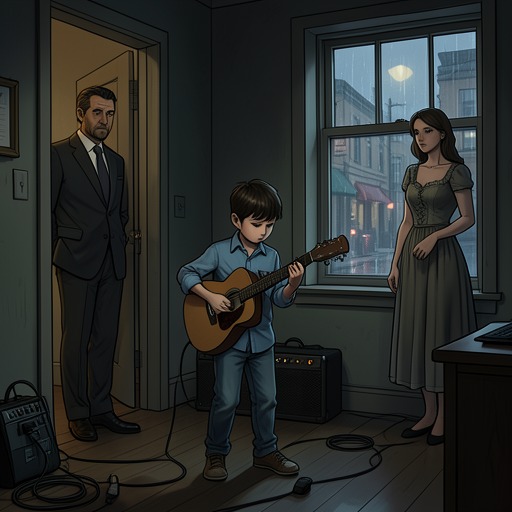
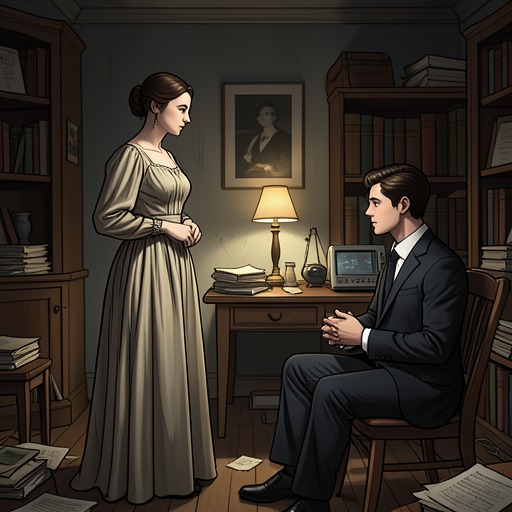
MovingEdwina’s grief over Charlie is shaped by a painful contradiction: she loves him with extraordinary force, yet struggles to accept that his death was his own, irreversible choice. After hoping that Rowena could save him in Thailand, Edwina blames her daughter for years; only later does she begin to recognize the part her own grief played in their estrangement and to understand how loss can make people react badly to one another.
A fear that precedes the loss
A family photograph on the beach gives Edwina’s grief a history that begins before Charlie’s death. In it, Ollie Treadaway holds Rowena on his lap while Edwina clings to Charlie as he reaches toward the sea. She remembers always fearing that he would drown. Looking back, she understands that fear as bound up with a deeper sense that she would lose him one day—not as proof that she could have prevented his death, but as the early shape her apprehension took.
Edwina recalls Charlie’s unexpected arrival in the middle of the night as the moment she understood he was only visiting and could never be hers to keep. The memory makes her love inseparable from anticipated departure: Charlie is her beloved child, but also someone she cannot hold permanently in her life. His later death turns that old recognition into a wound, while the photograph preserves a moment of family closeness that cannot be recovered.
Love, damage, and recognition
After Charlie falls through what Edwina thinks of as the trapdoor into prison, she believes his release may offer them a second chance. Instead, he emerges badly damaged, and even Rowena eventually has to get away from him. For years, Edwina’s refusal to blame Charlie helps sustain her attachment to the son she loves; she indulges him and forgives him, holding open the possibility of repair even as his life has changed.
That pattern breaks when Charlie hurts Alicia. Edwina recognizes then what she had resisted seeing: she considers him weak, and says he always had been. The recognition does not cancel her love. Rather, it exposes the cost of making love depend on excusing him. The son whom she had treated as someone to forgive and protect could also harm another person, and Edwina’s understanding of him must now contain both truths.
Thailand and the search for blame
Edwina’s hope shifts to Thailand, where she believes Rowena might be able to save Charlie. When he dies, that hope gives way to accusation. As Edwina later tells it, she holds Rowena responsible for not recognizing how vulnerable her brother was and imagines that, had Rowena stayed with him, he would still be alive. The accusation turns grief into a claim of preventability: if someone else should have acted differently, then Charlie’s death need not be faced as final and beyond anyone’s control.
Charlie is cremated in Thailand, and Edwina carries his ashes home on the plane as if the urn were a small child. The image reverses the family photograph: once she clung to Charlie while he reached toward the sea; now she carries what remains of him. Her care has become a gesture of mourning that cannot restore the son she tried to keep safe. Meanwhile, her anger toward Rowena gives the loss another consequence. Edwina ignores her daughter’s letters and refuses even to speak to her, punishing the person she had hoped would save Charlie.
Blame, family, and belated understanding
Edwina’s grief also bears on her relationship with Lucas. She says she will never forgive him for what he did in court, yet she can at last see how events led to his actions. In her account, consequences began when she caught Dickie’s eye; she recognizes that people react badly when they lose someone they love. The recognition does not amount to forgiveness, but it complicates her judgment of Lucas by placing his conduct within a wider history of family hurt and loss.
That insight turns back upon Edwina herself. She acknowledges that her own behavior after Charlie died was extreme: she blamed Rowena for her twin’s death and maintained that blame for years through silence and rejection. Seeing this pattern does not make the years of estrangement disappear. It does, however, let Edwina recognize that grief, rather than establishing a clear division between guilty and innocent, can drive those who love one another to inflict further pain.
What grief leaves unresolved
Edwina’s later understanding stops short of undoing the damage. She accepts that Rowena has reason not to forgive her, and the relationship remains marked by the years in which Edwina ignored her daughter’s letters. Her recognition that Charlie put the needle into his arm and that no one else made that decision shifts responsibility back toward him, but it arrives after she has already deprived herself of Rowena’s company while trying to make sense of his death.
The ending holds that regret alongside a tentative turn toward reunion. Edwina has Charlie’s ashes behind her history of loss, while Rowena’s latest letter is among the papers she has tidied and picked up. She is preparing to go to Australia, but the letter alone does not establish that mother and daughter have reconciled. Instead, it leaves Edwina at the edge of renewed contact: able to see her own part in the estrangement and to imagine a future with Rowena, without being able to reclaim the years or the son whose death set the rupture in motion.