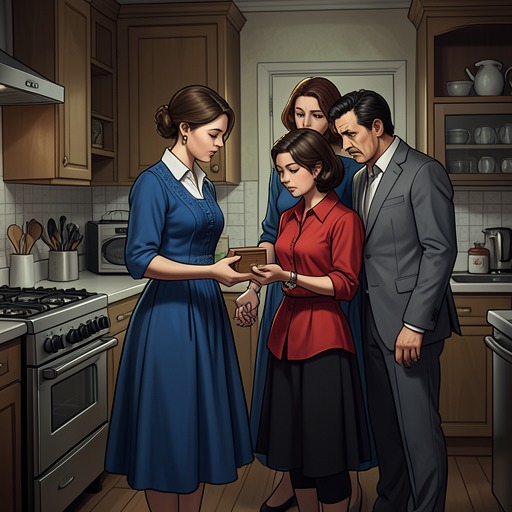
Edwina’s widowhood
MovingEdwina’s widowhood is a period of sudden bereavement, practical isolation, and persistent longing after Ollie Treadaway dies while the family is on holiday. Left with their two small children and a house that needs attention, she must learn a life she had not prepared for; the loss also fixes itself in memory through the colours of the Cornish sky and the funeral flowers. Her later marriages offer a contrast in tone, but do not erase the years shaped by Ollie’s absence.
The Loss and Its Immediate Aftermath
Ollie dies on the beach after a cricket ball flies through the sky and he collapses face down. An ambulance crosses the sand as onlookers watch; the men working on his heart eventually carry him away under a red blanket. The suddenness of the scene is set against ordinary holiday details, including a boy who keeps flying his yellow kite while the ambulance men work.
Edwina cannot recall how she got home. She had not yet passed her driving test, and Ollie’s rusty green Humber Hawk could not simply carry her and the babies back under her own control. His death makes driving one of the responsibilities she has to acquire: as she puts it, “widows must learn to do everything.” The phrase captures the practical force of bereavement as well as its emotional shock.
Isolation and the Work of Continuing
For weeks Edwina is semi-catatonic. When her mother leaves to rejoin her father in Malta, the reality of the loss becomes harder to evade. Edwina is then alone in a large, costly house with two small children and no income. She has days when she imagines taking herself and the babies over Waterloo Bridge, a measure of how extreme her despair becomes.
The support around her is limited and imperfect. Her mother, who barely knew Edwina and had never met Ollie, urges her to be brave by comparing her bereavement with the wartime deaths of other women’s husbands. Edwina’s anguished answer—that Ollie died while playing French cricket—exposes the distance between general consolations and the particular circumstances of her loss. Ollie’s parents come to the funeral, grieving, but the farm needs their attention; later, their birthday cards grow shorter and their invitations gradually cease.
Memory, Loneliness, and Later Change
The loss continues to intrude through colour and place. The Cornish sky and the twins’ yellow-and-blue rubber duck become entangled with the day Ollie died; yellow and blue also recall the irises at his funeral. Years later, Edwina has the bathroom panelled and repapered, replacing the blue with cream woodwork and pale-pink chinoiserie. In time, she can enter without immediately being taken back to the holiday and the funeral. The renovation marks a gradual easing of an association, not the disappearance of the memory.
Edwina recalls both her weddings as registry-office ceremonies without honeymoons: the first, to Ollie, in optimistic knee-length white; the second in cautious grey. The contrast records a change in her expectations after widowhood. In the years after Ollie’s death, she is financially independent and can care for the children and maintain the household, yet practical competence does not resolve her loneliness. Once the children are in bed and Alicia has returned to her own family, Edwina feels the house’s size and her husband’s absence acutely. She thinks of Ollie constantly and sometimes fears she is forgetting his face, even considering waking the children at night so they can remind her. Her widowhood is thus defined not only by the fact of his death, but by the effort to keep his image present while making a life that can continue.