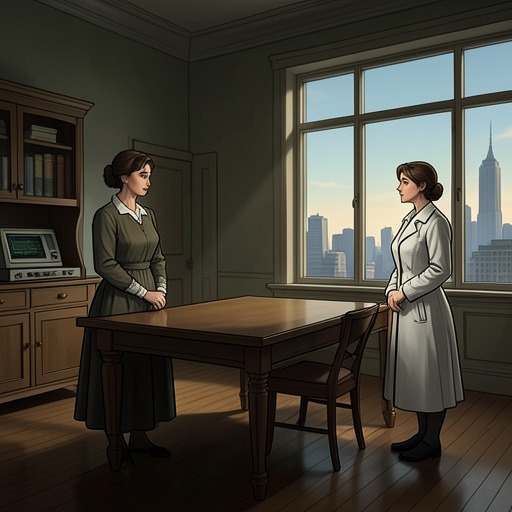
The state of disrepair of house number 137
MovingThe state of disrepair of house number 137 is revealed through Edwina’s changing sight and her dawning recognition that the house and garden have slipped beyond her control. The decay is not one dramatic failure but an accumulation of small, persistent signs: woodworm, cracked skirting boards, mildew, invasive ivy and a garden whose path has disappeared. As the familiar home becomes harder to see past and harder to manage, it seems to tell Edwina that her time there is ending.
Decay Brought into View
Before her cataract operation, Edwina had been blissfully unaware of the house’s deterioration. After returning from Moorfields Eye Hospital with new plastic lenses, she suddenly noticed details that had apparently been accumulating around her: cobwebs hanging from the ceilings, mouse droppings in the kitchen drawers and woodworm spreading through the house. The operation changes what she can see, not the condition of the building itself; the suddenness belongs to her recognition of a decline that had been difficult to perceive before.
That recognition continues in the rooms she inhabits. Hairline cracks run along the skirting boards, musty smells catch in the back of her throat, and the pull cord in the downstairs lavatory has frayed so badly that she has already knotted it twice. None of these defects is presented as a sudden catastrophe. Their force lies in their recurrence and in the sense that each day brings another problem, until the house seems to be acting against its owner rather than sheltering her.
The decay reaches into the bedroom as well. The carpet is freckled with mildew, and Edwina has to use all her strength to open the underwear drawer in her mahogany chest of drawers. The familiar furniture remains part of the room, but age and damage alter the effort required simply to use it. The house’s condition is thus registered not only in what Edwina sees but in the physical work of moving through and managing her home.
The Garden Overruns the House
The garden makes the loss of control visible on a larger scale. The basement windows have become bottle green beneath thick ivy, leaving the kitchen jungle-dark even in June. From inside, the growth presses against the boundary between house and garden; outside, Edwina admits that she rarely goes into the garden because it has become a jungle. When she tries to open the back door, she struggles until Lee steps in front of her and pushes it open with his shoulder.
Once outside, Edwina is shocked by how bad things have become. She has mentioned a lawn mower in the shed, but Lee cannot see the shed: a couple of enormous old fruit trees have completely obscured it. The path has vanished, and only the skeleton of a climbing frame can just be made out above the brambles. The garden’s former arrangement survives only in fragments, with everyday landmarks hidden beneath growth.
The ground itself is difficult to cross. Lee wades through knee-high grass, while Edwina warns him about the nettles; he adds the danger of broken glass and picks his way among smashed panes and splintered wooden frames. The warning and the careful movement through the overgrowth make the garden more than an untidy backdrop: it has become a space with immediate hazards. Edwina’s discovery that matters have worsened beyond what she realized gives this inspection the force of a belated reckoning.
Age, Agency, and the House’s Message
Edwina interprets the house’s condition as an instruction to leave: its allotted time with her is over, and it is someone else’s turn. She thinks that the property needs a firmer hand than her own small, freckled hand on the banister. The image links the building’s demands to the limits she perceives in her ability to meet them. Its cracks, failing fittings and overgrown garden require continuing attention, while the work of maintaining it has become increasingly difficult for her.
Her conclusion that Georgian houses are the enemy of the elderly gives this decline a wider frame. The house is not described as physically hostile in any single spectacular way; rather, its age, accumulated defects and demands make ordinary upkeep a sustained burden. The frayed lavatory cord, the hard-to-open drawer and the obstructed garden each turn routine use into effort. The difficulty emerges from the encounter between a deteriorating home and an older person expected to manage it.
Narrative Significance
The house’s deterioration makes time materially visible. Ivy darkens the kitchen, mildew marks the bedroom carpet, and woodworm moves through the building; the signs appear in different parts of the property, so neglect becomes a condition of the whole home rather than an isolated repair. Edwina’s improved sight sharpens this recognition, while her walk into the garden confirms what the interior had already suggested: the house has changed, and she can no longer assume control over it.
The garden also preserves traces of earlier use without restoring it. The hidden shed, the lost path and the climbing frame’s skeletal outline indicate familiar features now overtaken or reduced to remnants. Alicia’s former apple chutney, made from fruit in the garden with ginger, cardamom and raisins, recalls a use for its old fruit trees; in the present, those same trees conceal the shed. The contrast sets remembered domestic activity against the current overgrowth without implying that the garden can simply be returned to its former state. Together, house and garden give physical form to Edwina’s sense that her tenure at number 137 is drawing to a close.