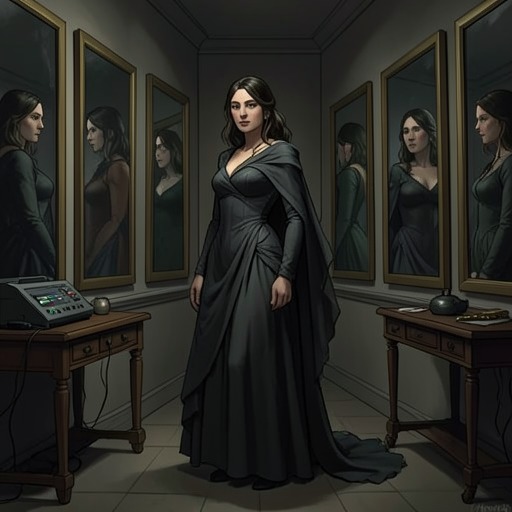
Daji Uses Yellow Peony's Face Against Lu Ting-Pin
MulanDaji Uses Yellow Peony's Face Against Lu Ting-Pin is a confrontation in which Daji’s changed appearance turns Lu Ting-Pin’s armed advance into an encounter with the person he once loved. The face he sees leads into an accusation about his responsibility for Yellow Peony’s exile, heartbreak, and estrangement from her daughter; Lu’s response is to drop his sword and kneel.
The Confrontation
Daji is on the ground among lotus blossoms as Lu Ting-Pin approaches with his sword raised. When she tries to press herself up, she sinks back down. Lu points the weapon toward her, and she lifts her head to look at him. The decisive change is not in Lu’s position or the weapon but in the face before him: it is no longer Daji’s. He freezes.
The scene makes recognition interrupt action. Lu has come forward armed, but the altered face halts him before he can act. Daji’s use of Yellow Peony’s appearance places the past between Lu and the immediate confrontation. What follows is not an account of a physical contest; it is a reckoning in which the identity attached to the face changes what Lu must confront.
Yellow Peony’s Accusation
The woman asks whether Lu would kill the person he once called his delicate peony. She then recalls that he called her his love, but connects that love to consequences that left her disowned by her family and forced from her village. She describes the relationship not as a source of comfort but as the beginning of heartbreak and social separation.
Her account makes Lu’s abandonment the central charge. She says he abandoned her and their child, and that the relationship led her to dishonor her family and ancestors. She also links that shame and resentment to her own treatment of their daughter: the past, in her telling, has shaped a bitterness that turned her against her child. The accusation therefore reaches beyond the two former lovers. It names a family consequence and presents the daughter’s estrangement as part of the damage left by Lu’s choices.
The woman also describes a more profound change in herself. She says that she became someone who did not want her own child, and someone bitter and angry who could no longer see innocence or hope. The scene does not separate that account from her accusation against Lu: she attributes the transformation to what he did, while still speaking as the person who has lived with its consequences. Her speech makes the face before Lu more than a reminder of lost affection; it gives the history of that affection a claim on his present decision.
Lu Ting-Pin’s Response
The woman ends by challenging Lu to decide which of them deserves to be called the demon: the woman he sees, or the man she says destroyed the woman he loved. The challenge turns the confrontation away from a simple opposition between an armed pursuer and a target. It asks Lu to consider his own part in the history that produced the person standing before him, without erasing the harm she now represents.
Lu gives a cry, falls to his knees, and drops Lu Ting-Pin's Peach-Wood Sword beside him. He bows his head and covers his face with his hands. The weapon’s fall marks a concrete reversal: the man who approached with his sword raised no longer acts against Daji. His posture registers the force of the accusation, but the scene does not establish that the conflict between them is resolved or that Daji is forgiven.
Significance of the Scene
The episode binds disguise to recognition. Daji’s use of Yellow Peony’s face does not merely delay Lu; it brings forward a relationship and a family history that his pursuit cannot account for on its own. The frozen pause, the woman’s successive charges, and Lu’s dropped sword form a progression from intended action to personal reckoning.
The exchange also complicates the idea of a demon by making responsibility part of the question. The woman identifies cruelty and bitterness in herself, but argues that Lu’s abandonment and the shame surrounding their relationship helped create that condition. His collapse does not answer her challenge in words. Instead, the scene ends with him kneeling, his sword on the ground and his face covered, leaving the accusation—and its unresolved consequences—at the center of the encounter.