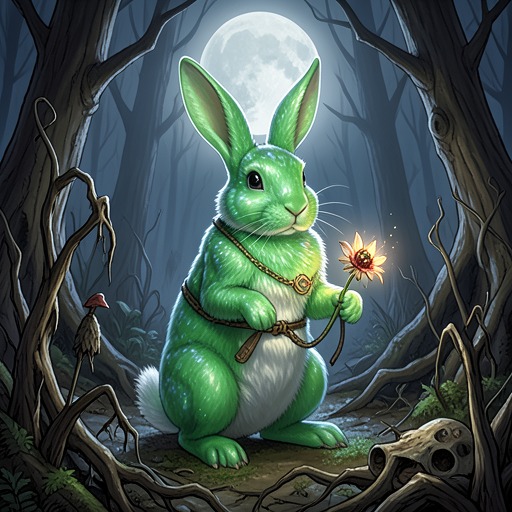
The Jade Rabbit sacrifices himself for the beggar
MulanThe Jade Rabbit’s sacrifice for a beggar turns a feast-day test of generosity into the defining proof of his selflessness: after the White Fox steals the food he gathered, he offers himself as the hungry stranger’s meal. The stranger is the Jade Emperor in disguise. He revives the Jade Rabbit, makes him immortal, and carries him to the moon, where he becomes the Moon Lady’s companion. The Jade Rabbit later recounts this origin to Mulan, explaining how he died and why he is known as the Jade Rabbit.
The sacred feast and its test
When the world was young, the Jade Emperor decreed that the full-moon night of the seventh month would be sacred. On that night, beings from the spirit world and the Heavens could roam the Earth, and mortals were to prepare generous feasts in their honor. The rule extended to every hungry creature: no person or animal, spirit or Immortal, was to go without food if they asked. Refusing someone was not merely shameful; it would dishonor the refuser’s family and ancestors.
The animals prepare according to the decree. The monkey gathers chestnuts, the otter catches fish, and the dog digs up taro roots and radishes. The Jade Rabbit, however, faces a particular difficulty: he eats only grass and recognizes that a grass-only offering would be a poor feast for someone hungry. Rather than accept that limitation, he goes from animal to person, bartering and wheedling until he assembles a varied collection of food, including chestnuts and a pot of milk. His feast is not simply what he can gather for himself; it depends on the contributions and labor he has persuaded others to share.
The White Fox refuses to contribute and mocks the Jade Rabbit for collecting food. She compares his work to a peasant slave’s labor and dismisses the hungry stranger as someone who will only gorge himself. Her scorn sets her against the decree’s demand for hospitality. The Jade Rabbit nevertheless continues preparing to feed the visitor, while the White Fox’s refusal becomes more consequential when the meal is finally served.
The feast is stolen
The visitor behaves like a difficult, ravenous beggar. When the monkey and otter hurry to cook, he complains that the food is raw; the dog’s radishes and the pig’s turnips prompt another demand and an even larger fire. The Jade Rabbit then intervenes with an offer of food he believes the visitor might enjoy. He leads him to the covered feast, expecting to present the assortment he has gathered.
When the covering is removed, the watching animals gasp. The Jade Rabbit finds only bundles of grass scattered across the ground cloth where the rice and fruit should be. The beggar reacts with outrage, insisting that he will not eat grass. The fox interrupts his complaint, coaxes him over to her own covered display, and gives the Jade Rabbit a wink as she lifts its cloth. Beneath it is his missing feast: pink apples, white rice, and the pot of milk among the food he had collected. The White Fox has somehow stolen his offering and presented it as her own.
The beggar falls upon the stolen food, eating ravenously, while the Jade Rabbit can only stare. The White Fox reinforces his humiliation by describing him as having nothing to feed the visitor and claiming that his offer of grass reflects his poor sense of propriety. Her words echo in the Jade Rabbit’s mind as the fire blazes and the scene seems to swim around him. The betrayal has made the feast appear to confirm the fox’s contempt: after all his effort to provide, he stands before the hungry stranger with nothing he can offer.
The Jade Rabbit’s sacrifice
The Jade Rabbit addresses the beggar directly. He apologizes for having nothing to feed him, then offers a startling alternative: the visitor could eat him. Without waiting for another answer, he leaps into the fire. The choice carries the feast-day decree to its most extreme consequence. Having lost the food intended for the hungry, the Jade Rabbit makes his own body the offering, putting the stranger’s need before his life.
For the Jade Rabbit, the fire brings pain, blackness, and death. The other animals see his body charred among the remains of the fire, and the beggar’s apparent hunger has now been answered at a terrible cost. Yet the scene does not end with the death. The beggar’s disguise falls away as his beard smooths and darkens, the blemishes vanish, and his filthy robes reveal sky-colored garments embroidered with dragons. Pearl tassels swing from his hat as he shines with a radiance stronger than the fire. He is the Jade Emperor, the Ruler of the Heavens, who has taken the form of a beggar to test whether the animals would obey his decree and show generosity.
The revelation recasts the feast as a test, but it does not make the Jade Rabbit’s sacrifice merely a performance: the Jade Emperor says he has discovered the most unselfish among them. The animals fall in humble kowtows as the Jade Emperor approaches the fire and extinguishes it with a wave. He then lifts the Jade Rabbit’s blackened remains from the ground. Ash and coals fall from the burned form, which the Jade Emperor regards tenderly before enclosing it in his hands.
Restoration and ascent to the moon
The Jade Emperor restores the Jade Rabbit piece by piece. The scorched, brittle limbs soften and plump; soot gives way to silver fur, fine and lush. Breath returns, the rabbit’s chest rises and falls, and his nose twitches before his eyes open. The return from death happens within the time it takes an incense stick to burn. The Jade Emperor reproaches him for harming himself even as he expresses how deeply the sacrifice has moved him. The story thus distinguishes the Jade Rabbit’s generosity from the need to die for it: the act earns the Jade Emperor’s admiration, but he tells the newly revived animal that he should not have injured himself.
With the full moon high in the sky, the Jade Emperor decides that the moon is an appropriate home for the now-immortal Jade Rabbit. The Moon Lady, he explains, has been lonely and would have a fitting companion in him. Five-colored clouds appear, and the Jade Emperor steps onto them as they rise into the night with the Jade Rabbit. The animals watch in awe as he crosses the sky; the White Fox is the exception. She burns with jealousy and fury and vows to become as powerful as the newly immortal Jade Rabbit.
The story’s significance
The episode joins hospitality, humiliation, and transformation in one continuous reversal. The decree makes feeding a stranger a public measure of honor, but the Jade Rabbit’s preparations are sabotaged and his feast is turned against him. His response is not to retaliate against the White Fox or abandon the visitor: he offers what remains of himself. The Jade Emperor’s revelation then shifts the apparent beggar from a helpless recipient into the authority behind the test, while the restoration shifts the sacrifice from a death without return into the beginning of the Jade Rabbit’s immortal life.
The moon-bound ending also establishes the contrast that carries beyond the feast. The Jade Rabbit’s reward is companionship with the lonely Moon Lady, while the White Fox answers his elevation with jealousy and a vow of her own. When Mulan recognizes the figure from her father’s stories and asks whether he is the Moon Lady’s companion, the Jade Rabbit confirms the identity attached to this remembered event. His story explains not only why he is immortal and lives on the moon, but also why the White Fox regards his power with such hostility.