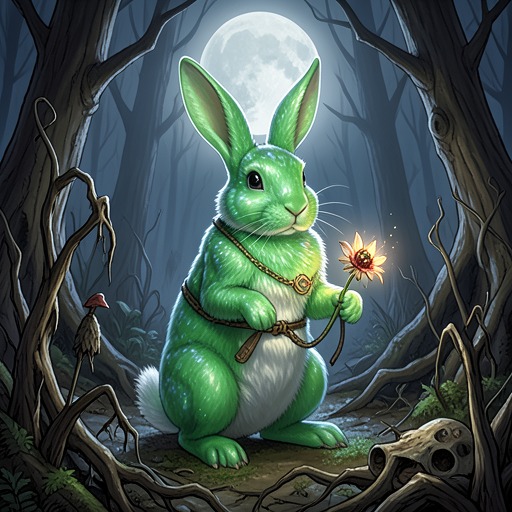
Mulan and Lu Ting-Pin Restore the Jade Rabbit
MulanMulan and Lu Ting-Pin restore the Jade Rabbit with a remedy made from the Flower of Heavenly Majesty's Essence and Dragon Beard Grass, bringing him back from a cold, motionless state that seems indistinguishable from death. The episode turns on a brief but frightening delay: the medicine is prepared and given, yet at first the Rabbit does not stir. His recovery comes only after he asks for more, and the scene closes with him restored and reminding Mulan that Xiu is still waiting.
The Rabbit at the point of collapse
On a stone bench in the Queen Mother's garden, Mulan lifts the Rabbit from his carrier. He is smaller than before, and the bones beneath his thin fur feel brittle. His coat is dull and matted, the color of ash; the heat that had once burned through his body is gone, replaced by cold, clammy stillness. His eyes and mouth have become pale lines. Mulan holds him as if he were stone and looks to Lu Ting-Pin, unable to finish the question of whether the Rabbit is dead.
The stillness carries particular weight because the Rabbit has already told Mulan that he died once before. In his story of the Jade Emperor's decree, a hungry beggar arrives on the sacred full-moon night, when no one is to be refused food. The Rabbit has gathered a feast for others, but when a fox taunts him for having nothing to offer the beggar, he leaps into the fire and gives himself as food. He describes pain, darkness, and death, followed by an outcome that was not the end. The present scene reverses that earlier movement toward death: the Rabbit, who once offered his own body to sustain another, now depends on Mulan and Lu Ting-Pin to bring him back.
Making and administering the remedy
Lu Ting-Pin does not answer Mulan's unfinished question. Instead, he draws his sword and cuts the top from Lu Ting-Pin's Gourd with one sweep, leaving its bowl-shaped bottom in his hand. His next instructions are urgent: the grass, the flower. Mulan searches the bag at her hip and places the needed plants in the bowl. By then, it has filled with hot water, steam rising from it. The plants dissolve, turning the water a shimmering silver-violet, and a crisp scent, likened to a cool spring morning, rises from the mixture.
The medicine is not administered with ceremony or delay. The Rabbit twitches, but his eyes remain closed. Mulan lifts him while Lu Ting-Pin tilts the bowl to his mouth. The liquid runs over the Rabbit's chin and whiskers as he gulps it down. The scene fixes attention on small physical signs—the twitch, the movement of his mouth, the drops against his fur—because they are all the rescuers have by which to judge whether their effort is working.
The pause before recovery
Nothing happens immediately. The Rabbit makes no further movement or sound, and Mulan looks helplessly at Lu Ting-Pin. Twilight is deepening into dusk; the sun has not quite disappeared, but the available light is already fading. Lu Ting-Pin strokes his beard, while Mulan fears they may have arrived too late. The remedy's vivid color and springlike scent have offered hope, but neither has yet altered the Rabbit's stillness.
Then the Rabbit speaks faintly, looking up at them expectantly. He says he would get better faster if they gave him some more. The request breaks the apparent deadlock: the first dose has not produced an immediate visible recovery, but the Rabbit is conscious enough to ask for another. His dry practicality also shifts the scene's tension. Mulan and Lu Ting-Pin have been watching for a sign of life; the Rabbit turns that vigil into a concrete instruction.
Restoration and return to the quest
The recovery proceeds in stages. After another sip, the Rabbit's eyes brighten and he can sit up. After two more, he is able to hold the bowl and drink for himself. By six sips, he is fully restored: standing at his full length, with lustrous fur rippling in a luminous, pearl-like glow. The change is not merely from stillness to movement but from an ash-colored, fragile body to one visibly full of life. The measured progression makes the return legible, sip by sip, rather than instantaneous.
The Rabbit tells Mulan, “Well done,” and hands her the bowl. He says nothing about her search for the flower or the White Fox, but when their eyes meet, Mulan flushes with pride. His brief acknowledgment matters precisely because it is not an explanation or a speech: the restored Rabbit's look and words give her a moment of recognition after the danger of losing him. Lu Ting-Pin has helped prepare and administer the cure, while Mulan has brought the plants and held the Rabbit as he drank; the scene makes their cooperation essential to the outcome.
The recovery does not resolve the journey's larger purpose. As dusk gathers, the Rabbit frowns and urges them to leave because Xiu is waiting. His restored strength enables the group to continue, but the reminder prevents the rescue from becoming a stopping point: Mulan's sister still needs help. The Rabbit's own survival therefore renews the quest rather than replacing it. The scene's movement—from an apparently lifeless body, through a failed first expectation, to a living companion pressing onward—makes recovery both an intimate reprieve and a return to obligation.
The book's afterword connects the Rabbit to Lord Rabbit, a popular Beijing figure represented during the Mid-Autumn Moon Festival by clay statues of a white rabbit dressed as a lord and riding a horse, tiger, or dragon. In that tradition he is the Moon Lady's companion, sent to Earth to save people from a deadly plague, and able to change shape to carry out his task. The restoration scene gives that protective association a personal form: the extraordinary helper who once sacrificed himself for a beggar can himself be saved by the people beside him. His return does not erase the vulnerability shown in his still body; it makes his continued service possible.