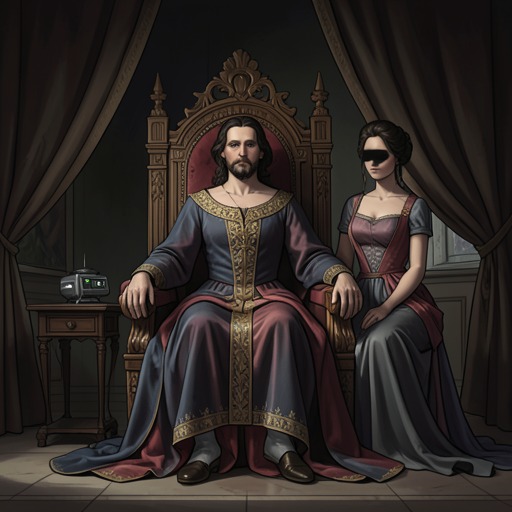
Daji brings down Emperor Zhou’s dynasty
MulanDaji’s influence over Emperor Zhou turns a ruler’s devotion into a national catastrophe: extravagant demands drain the kingdom, cruelty discredits the court, and a war staged for her amusement helps ignite rebellion. Recounted by the Jade Rabbit to Mulan, the episode also exposes Daji as the White Fox and overturns the historical assumption that she died when Emperor Zhou’s reign ended.
Daji at Emperor Zhou’s Court
The account begins with Daji’s ability to assume many names and forms, though she most often appears as a beautiful woman. Across centuries she has refined this transformation until few can resist her charm. Emperor Zhou is among those who cannot. He makes her his royal companion as soon as he sees her, lavishing gifts on her and indulging her whims. The story presents his attachment as the opening through which Daji’s private desires gain public consequence.
The details of court life make that indulgence tangible. Fast horses are exhausted each week carrying fresh fruit from the south. Charcoal for the palace heaters is broken up and mixed with costly honey to sweeten its smell for Daji. She enjoys the sound of silk tearing, so rooms are stocked with finely worked silk for her to rip. These repeated expenditures are not isolated extravagances: the Jade Rabbit describes them as only a small part of her demands.
The scale grows from waste to a burden imposed across the realm. People from four hundred villages are forced to build Daji a vast palace ornamented with jewels and jade, with a garden and a lake of wine. Roasted meat is hung from branches beside the lake for her to take as she passes in a three-story boat made of gold and marble. When a leaf falls from a tree, she demands that it and other fallen leaves be replaced with silk ones. The episode links such caprice to a concrete political consequence: the kingdom is bankrupted.
Cruelty and the War for Spectacle
The Jade Rabbit distinguishes Daji’s cruelty from her appetite for luxury. Her demands do not merely consume the kingdom’s resources; they turn the lives and deaths of others into entertainment. After hearing that a sage should have seven holes in his heart, she orders the kingdom’s wisest men killed so that she can inspect their hearts. When an ant is accidentally cooked in a frying pan, she has Emperor Zhou devise a comparable punishment for his enemies and takes pleasure in their suffering. The account depicts the court’s violence as an extension of Daji’s desire to be entertained and of the emperor’s readiness to please her.
Her demand to see a real war carries that pattern beyond the palace. Daji rejects a staged fight or a small display of soldiers and insists on witnessing a battle involving hundreds of thousands. Emperor Zhou declares war on a neighboring kingdom to satisfy her. Even after the fighting has begun, he makes his troops stop while a road is built to a cliff’s ledge so that Daji can watch comfortably from a rosewood chair, fanned by a handmaid and served fruit.
The battle resumes only once she is settled at the overlook. She watches the fighting with excitement, but eventually grows tired of it and wants to go home. Although his forces are winning, Emperor Zhou halts them midbattle and retreats. The decision makes the war’s human cost purposeless even on the terms of the campaign: the army’s success is abandoned because Daji’s interest has ended. The account presents this spectacle, and the emperor’s compliance, as a decisive provocation rather than a mere private excess.
Revolt and the Fall of the Dynasty
The deaths caused by the abandoned battle leave people aghast. A few days later, Daji asks to see another battle, larger and bloodier, and the kingdom revolts. A new emperor is declared; troops from the regions gather to attack the capital rather than march against an external enemy. Commoners suffering under the regime join the force at the city gates. As the palace is stormed, the Imperial Guard turns to fight alongside the rebels, who encounter no opposition. The people demand an end to a reign defined by bloodshed and extravagance.
Without supporters, Emperor Zhou is easily killed by the new emperor’s son. Daji appears to die by hanging with help from her handmaid, but the apparent ending does not hold. When her body is retrieved for burial the following day, it is a stalk of bamboo. The White Fox has escaped, leaving the destruction behind her. This reversal clarifies that the fall of the dynasty ends Emperor Zhou’s rule, not Daji’s existence or capacity to return in another form.
The Historical Revelation
Mulan recognizes Emperor Zhou as the evil ruler whose reign her father helped end, but she had not known that the White Fox was behind his corruption. The Jade Rabbit complicates the explanation: he describes the emperor as foolish rather than wholly wicked, while acknowledging that he had little goodness. His devotion to Daji was so complete that he worshiped her as a goddess. The account therefore assigns responsibility to Daji without making Emperor Zhou’s choices disappear; his willingness to indulge her turns her desires into state policy.
As a story within the larger conversation, this history changes the meaning of Daji’s identity and survival. The White Fox is not simply a threat in Mulan’s present journey but a figure whose influence has already contributed to a dynasty’s collapse. Her supposed death, like the forms she assumes, proves deceptive. The final substitution of bamboo for a body gives the episode its sharpest reversal: the court believes it has reached an ending, while Daji has once again escaped the consequences of her actions.